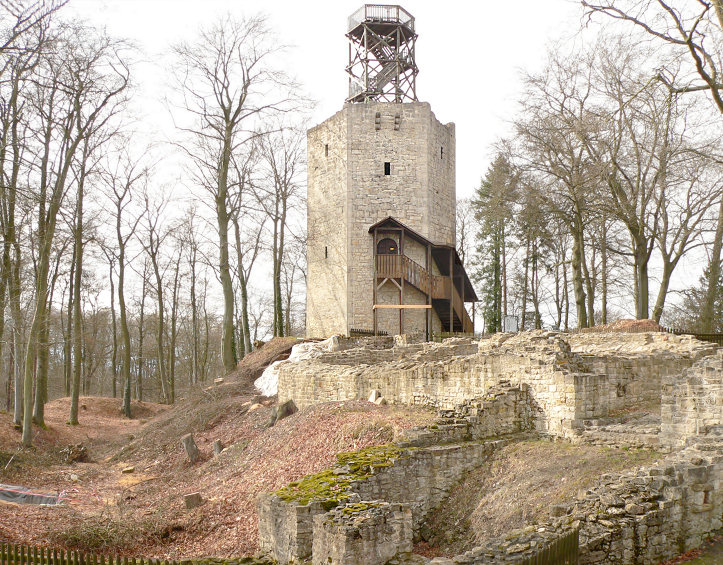
Wohldenberg Castle
Wohldenberg Castle stands as a remarkable example of a medieval hill castle located near the municipality of Wohldenberg in Lower Saxony, Germany. Built in the 12th century, it was originally constructed by the Counts of Wohldenberg, formerly known as the Counts of Wöltingerode, as part of their efforts to consolidate power in the Ambergau region. The castle's strategic hilltop position atop the 218-meter-high Wohldenberg ridge provided commanding views over the Nette valley and controlled key medieval trade routes, including the Frankfurter Straße and the road between Hildesheim and Goslar.
Construction began in 1153, and after 1174, Ludolf I, head of the family, made Wohldenberg his primary residence, converting their former seat at Wöltingerode into a Cistercian monastery. During the conflict between Emperor Frederick I Barbarossa and Henry the Lion, the counts supported the emperor, leading to the castle's destruction by Henry in 1180. It was swiftly rebuilt, allowing the counts to expand their influence, including acquiring the nearby Poppenburg as a fief under Hermann von Wohldenberg.
Administrative and military significance
In 1275, the counts sold Wohldenberg Castle and their county to Bishop Otto I of Hildesheim. Thereafter, the castle served as the administrative center (Amtssitz) of Amt Wohldenberg within the Prince-Bishopric of Hildesheim. Ownership remained with the bishopric, but the castle was frequently pledged or granted as a fief to noble families such as the von Bortfeld, von Oldershausen, von Saldern, von Wallmoden, von Sehlde, von Linde, and von Steinberg. The castle also endured occupation by robber knights during turbulent periods.
The early 16th century saw major upheaval during the Hildesheim Diocesan Feud (1519–1523), after which the castle passed to the Principality of Brunswick-Wolfenbüttel. The then-owner, Aschwin von Bortfeld, was expelled without compensation. Notably, in 1518, he erected a plague column known as the "stony Jacob" near the castle's foot, a significant religious monument.
Destruction and later uses
During the Thirty Years’ War, the castle was destroyed by Imperial forces in 1641, leaving it in ruins. After the Prince-Bishopric of Hildesheim was reinstated in 1643, the site saw new construction in the 18th century, including the erection of Baroque-style buildings and the St. Hubertus church, which replaced the medieval chapel.
In the 19th century, much of the remaining medieval fabric was dismantled for building materials. Restoration efforts began in 1858 under Hanoverian administration, including remodeling the castle’s bergfried (keep) with a crenellated viewing platform, transforming it into an observation tower. The former gatehouse was converted into a vicarage in 1731, and the Amtshaus, built in 1852 below the castle, served as an administrative office and residence, later housing the author Oskar Meding and briefly operating as a hotel.
During World War II, the castle keep was repurposed as an anti-aircraft tower. Since 1946, the Haus Wohldenberg, located below the castle, has functioned as a Catholic youth education center under the Diocese of Hildesheim.
Architectural features and layout
Wohldenberg Castle occupies a naturally defensible kidney-shaped plateau approximately 190 by 110 meters, divided into two main parts: the southern main castle and the northern outer bailey, separated by a defensive wall and moat. The site was originally a pagan sacred place dedicated to Wodan, adding cultural significance to its location.
The main castle contained several key structures, including a large palas (residential hall) and a 32-meter-high bergfried that served defensive and watchtower functions. The 19th-century restoration added a crenellated viewing platform atop the bergfried, adapting it for observation rather than purely military use. A chapel adjacent to the bergfried was replaced in 1731 by the Baroque Catholic Church of St. Hubertus, which still stands next to the castle gatehouse.
Access to the outer bailey was through a fortified gatehouse with a gate tower and a round flank tower, which now forms part of a half-timbered residential building on the southwest side. The surrounding defensive walls vary in thickness, reaching up to two meters, underscoring their protective purpose. Traces of former annexes on both the north and south sides of the bergfried indicate additional buildings once integral to the castle's core.
Below the castle, near the hill’s base, stands a building from 1561 that historically functioned as an inn. About 200 meters downhill lies the Amtshaus built in 1852, designed for administrative and residential use related to the Amt Wohldenberg.
Strategic location and natural defenses
The castle's position atop steep escarpments provided natural defenses, making assaults difficult. Its oversight of major medieval crossroads enhanced its military and administrative importance. The surrounding terrain and the castle's fortifications combined to make Wohldenberg a formidable stronghold in the region.
Cultural and historical legacy
Wohldenberg Castle reflects the complex history of territorial control in Lower Saxony, from its origins with the Counts of Wohldenberg to its role within the Prince-Bishopric of Hildesheim and later the Principality of Brunswick-Wolfenbüttel. The castle's ruins and surviving structures, including the St. Hubertus church and the bergfried, stand as enduring symbols of medieval architecture and regional power dynamics.
Today, the site continues to serve the community through the Haus Wohldenberg Catholic youth education center, linking its historical heritage with contemporary cultural and educational functions.
Frequently asked questions (FAQ)
- How do I get to Wohldenberg Castle?
- Wohldenberg Castle is located near the town of Wohldenberg in Lower Saxony, Germany. It is accessible by car and local roads, with parking available nearby. The castle is situated on a hilltop, so be prepared for a short uphill walk to reach the site.
- What is the historical significance of Wohldenberg Castle?
- Wohldenberg Castle played a key role in the medieval power struggles of the Ambergau region. Built in the 12th century by the Counts of Wohldenberg, it later became the administrative center of Amt Wohldenberg within the Prince-Bishopric of Hildesheim. Its strategic location controlled important trade routes and military access points.
- Is Wohldenberg Castle open to the public?
- Yes, the castle ruins and surrounding grounds are open to visitors during daylight hours. There is no admission fee, making it accessible for tourists interested in medieval history and architecture.
- What remains of the original castle can I see today?
- Visitors can see the ruins of the main castle, including the <strong>bergfried</strong> with its 19th-century viewing platform, defensive walls, gatehouse, and the adjacent Baroque Church of St. Hubertus. The outer bailey and remnants of medieval fortifications are also visible.
- Are there any events or activities held at Wohldenberg Castle?
- The nearby Haus Wohldenberg serves as a Catholic youth education center and occasionally hosts cultural and educational events. While the castle itself is primarily a historic site, the surrounding area offers opportunities for hiking and exploration.
Information
Sources & official resources
Verify the information above using these authoritative references.
Loading map...
Visitor reviews
No reviews yet. Been here? Write the first review and help other travelers!
Write the first reviewVisited this castle? Share your experience
Your review helps other travelers and adds first-hand knowledge to our encyclopedia.