Burg Liebenburg
Burg Liebenburg stands as a remarkable example of a medieval hill castle located in the municipality of Liebenburg, in the region of Lower Saxony, Germany. Constructed initially as a formidable fortress by the bishops of Hildesheim in the late 13th century, the castle was strategically positioned to protect the prince-bishopric's eastern border against the expanding influence of the Dukes of Brunswick. Its location on a prominent hill spur along the eastern slope of a ridge near Salzgitter naturally enhanced its defensive capabilities, making it one of the strongest fortresses in the Harz foreland region.
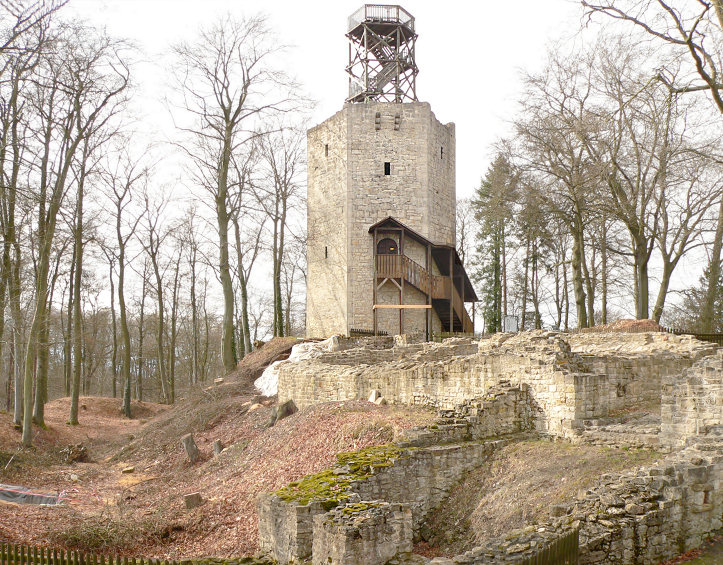
The castle's construction began in 1292 under the direction of Bishop Siegfried II of Hildesheim and was largely completed by around 1302. Designed as a spur castle, it featured a complex defensive system including a ring wall and seven towers. These towers, including the prominent Hausmannsturm built in the late 15th century, served both as strongholds and observation points to monitor and secure the surrounding territory. The Hausmannsturm, a tall bergfried constructed atop an artificial mound, is notable for its thick walls several meters in thickness, pierced by numerous arrow slits set within niches, allowing defenders to use protected archery positions. This tower was designed to operate independently from the main castle, guarding approaches invisible from the rest of the fortress.
The strategic role and historical significance
Throughout its history, Burg Liebenburg played a crucial role in regional defense and political power struggles. Initially built to secure the prince-bishopric's frontier, the castle became a pawn possession of the nearby city of Braunschweig (Brunswick) from 1366 onward. This arrangement allowed the city to control important trade routes leading to the mining town of Goslar, a vital economic center during the medieval period.
Various noble families, including the von Schwicheldt and von Cramm clans, held the castle through pawn agreements during the 14th and 15th centuries. In 1523, control shifted when Duke Heinrich the Younger of Brunswick-Wolfenbüttel took possession. The duke notably used the castle as a place of concealment for his mistress Eva von Trott and their children during the years 1541 and 1542.
Military conflicts and architectural resilience
Burg Liebenburg endured several military pressures during the religious and political conflicts of the 16th and 17th centuries. In 1542, troops from the Schmalkaldic League occupied the castle, but it was recaptured by the duke in 1547. A brief occupation by Count Vollrad von Mansfeld occurred in 1552. During the Thirty Years’ War, the castle served as headquarters for the imperial general Albrecht von Wallenstein in 1625. However, it suffered heavy damage in 1633 when attacked by Swedish forces.
Historical accounts describe how the defending garrison escaped overnight through a secret underground passage, a feature later confirmed in 2005 during archaeological investigations. This tunnel, approximately 2.2 meters high and 0.7 meters wide, extended from the castle to the outside, with a sealed branch believed to have connected directly to the Hausmannsturm. Such concealed passages were vital for discreet movement and resupply during sieges.
Post-war transformations and restoration efforts
Following the Thirty Years' War, Burg Liebenburg returned to the control of the Hildesheim prince-bishopric in 1643 through a formal treaty. In the mid-18th century, Prince-Bishop Clemens August ordered the demolition of the remaining medieval fortress and initiated the construction of a Baroque-style pleasure and hunting lodge on the site. This new complex included a chapel dedicated to the Annunciation. However, the outbreak of the Seven Years’ War in 1756 halted the project, leaving it incomplete.
The west wing of the lodge was completed and later served as the local government office and court until 1959. Since 1974, this building has been privately owned and functions as a residence and studio for the artist Gerd Winner.
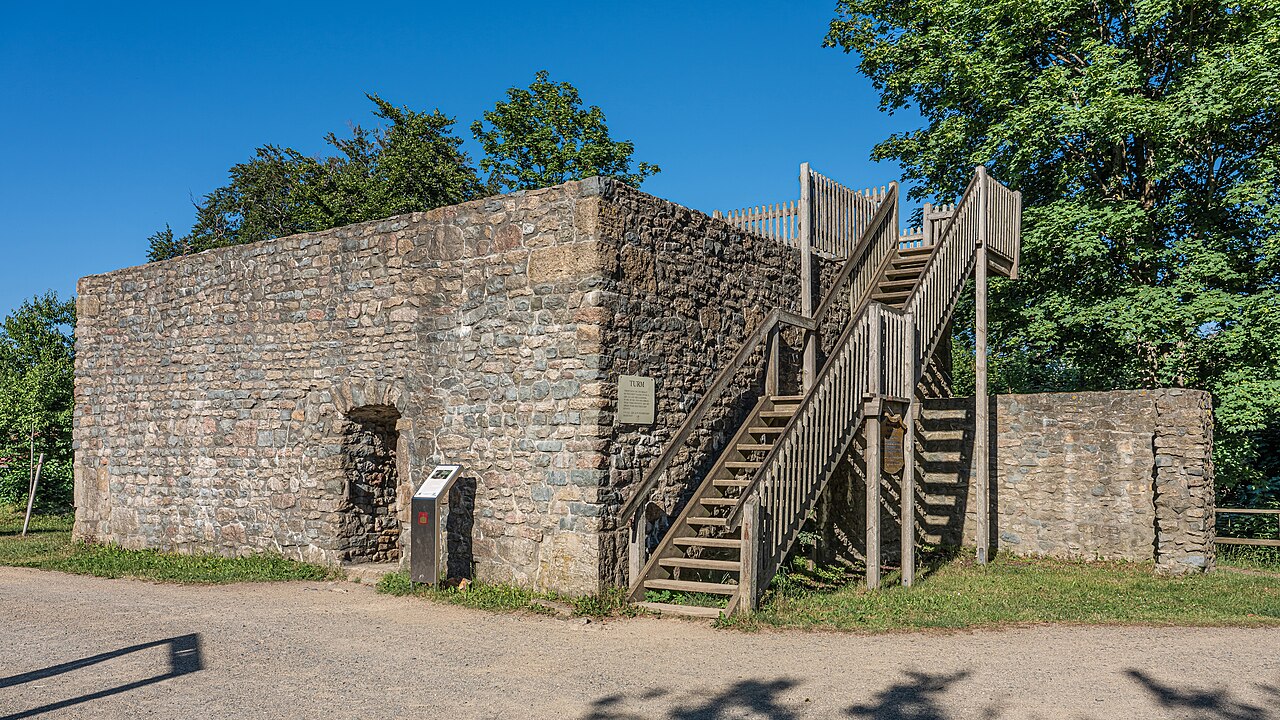
From the 1990s onward, restoration efforts have focused on preserving the surviving elements of the original castle. These efforts included repairing the towers and defensive walls. Notably, the Hausmannsturm was fitted with an internal spiral staircase in 1991 by a local heritage group, making it accessible as a viewing platform. Further masonry restoration was completed in 2005. The flanking tower on the eastern side of the ring wall, dating from around 1290, was fully restored in 2003 and is now used as an event venue. The foundation of the Schulmeisterturm remains, with partial restoration in 2002 adapting it into an observation platform overlooking nearby villages.
Architectural features and castle layout
Originally, Burg Liebenburg featured seven towers integrated into a robust defensive ring wall. The castle's spur castle design took advantage of the natural topography, with steep slopes on multiple sides enhancing its defensibility. The bergfried or keep, known as the Hausmannsturm, was the central stronghold, built for both defense and surveillance.
The castle's walls were constructed with thick masonry, incorporating numerous arrow slits and embrasures for archers and later firearms. The outer bailey, parts of which survive today, would have housed essential support buildings and served as a first line of defense. The discovery of the secret underground passage highlights the castle's sophisticated defensive planning, providing a means for escape or resupply during sieges.
Today, visitors to Burg Liebenburg can explore the remaining towers and sections of the ring wall, gaining insight into medieval military architecture and the castle's historical significance in the region. The castle's combination of medieval fortifications and later Baroque influences reflects the evolving needs and tastes of its occupants over centuries.
Visiting Burg Liebenburg
While the castle is privately owned, the restored towers such as the Hausmannsturm and the flanking tower are occasionally open to the public for tours and events. The viewing platforms offer panoramic views of the surrounding Lower Saxony landscape, including the nearby villages and the ridge on which the castle is situated.
The castle's rich history, architectural features, and scenic location make it a significant cultural heritage site in Germany, attracting visitors interested in medieval fortifications, regional history, and architectural restoration.
Frequently asked questions (FAQ)
- How do I get to Burg Liebenburg?
- Burg Liebenburg is located in Liebenburg, Germany, and is easily accessible by car or public transport. If you are traveling by train, the nearest station is in Goslar, from where you can take a bus or taxi to the castle.
- What is the historical significance of Burg Liebenburg?
- Burg Liebenburg dates back to the 13th century and served as a defensive fortress during various conflicts in medieval times. It played a crucial role in regional power struggles and has been a witness to many historical events over the centuries.
- When was Burg Liebenburg built?
- Construction of Burg Liebenburg began in 1220, making it one of the oldest castles in the region. Over the years, it has undergone several renovations and expansions, which reflect the architectural styles of different eras.
- Can I visit Burg Liebenburg year-round?
- Yes, Burg Liebenburg is open to visitors throughout the year, though hours may vary seasonally. It’s advisable to check the official website for current opening hours and any special events that may affect visiting times.
- Why is the architecture of Burg Liebenburg noteworthy?
- The architecture of Burg Liebenburg is remarkable for its blend of Romanesque and Gothic styles, showcasing the evolution of castle design. The well-preserved structures, including towers and defensive walls, provide insight into medieval fortification techniques.
- Is it possible to take guided tours of the castle?
- Yes, guided tours are available at Burg Liebenburg, offering visitors an in-depth understanding of the castle's history and architecture. These tours are typically conducted by knowledgeable guides who can share fascinating stories and details.
- What are the ticket prices for visiting Burg Liebenburg?
- Ticket prices for Burg Liebenburg are generally reasonable, with discounts available for students and seniors. Children under a certain age may enter for free, so be sure to check the latest pricing details on the official website before your visit.
- What is the best time to visit Burg Liebenburg?
- The best time to visit Burg Liebenburg is during the spring and early autumn when the weather is mild and pleasant for exploring the grounds. Additionally, visiting during these seasons allows you to enjoy the beautiful surrounding landscapes.
- Are there nearby attractions to visit after Burg Liebenburg?
- Yes, there are several nearby attractions, including the historic town of Goslar and the scenic Harz National Park. Both destinations offer a variety of activities and sights, making them perfect for a full day of exploration.
Information
Loading map...
Visitor reviews
No reviews yet. Been here? Write the first review and help other travelers!
Write the first reviewVisited this castle? Share your experience
Your review helps other travelers and adds first-hand knowledge to our encyclopedia.