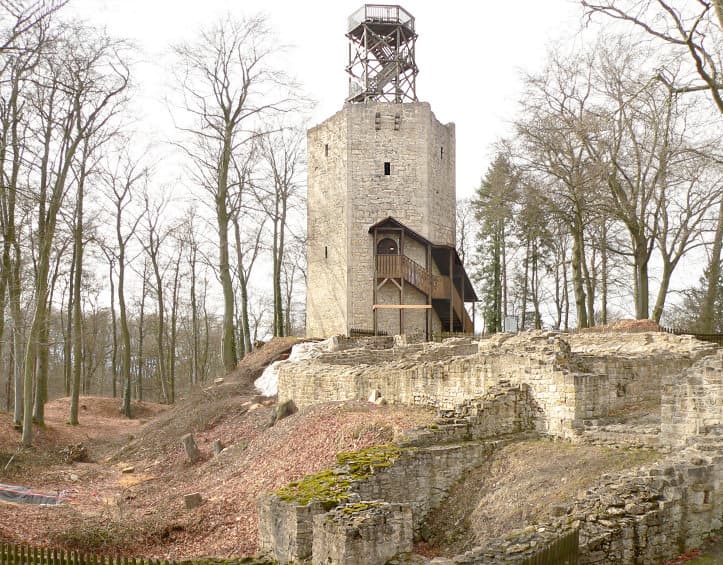
Lichtenberg Castle (Salzgitter)
Lichtenberg Castle (German: Burg Lichtenberg), also known historically as the Heinrichsburg or "Henry Castle," is a significant medieval fortress ruin located near Salzgitter in the German state of Lower Saxony. Perched on the steep summit of the Burgberg hill, which rises to 241 metres within the Lichtenberge hills of the northwestern Salzgitter Hills, the castle commands a strategic vantage point overlooking the surrounding landscape. Its elevated position exemplifies the typical location choice for a hill castle during the High Middle Ages, providing natural defensive advantages and control over key routes.
The castle's origins trace back to the 12th century, a period marked by intense territorial conflicts between powerful dynasties in the region. Duke Henry the Lion, a prominent figure of the Welf dynasty, is credited with the construction of the main fortifications. His intent was to establish a stronghold to counter the influence of the neighboring Bishopric of Hildesheim and the rival Hohenstaufen-controlled Goslar. The castle's design reflects the military architectural principles of the era, featuring a compact and efficient hill castle ground plan optimized for defense and surveillance.
Architectural features and layout
The ruins of Lichtenberg Castle reveal the essential elements of a High Medieval hill castle. The site showcases a carefully planned fortification system adapted to the natural contours of the Burgberg summit. The castle complex included a keep or donjon as the central stronghold, surrounded by defensive walls and battlements. The steep slopes around the castle acted as natural barriers, supplemented by man-made defenses such as moats or ditches and gatehouses controlling access.
The castle's layout exemplifies the strategic use of terrain, with the main buildings positioned to maximize visibility and protection. The surviving ruins indicate the presence of residential quarters, armories, and service buildings within the inner courtyard. The design facilitated both military defense and the administrative functions necessary for controlling the surrounding territory.
Historical context and significance
Lichtenberg Castle played a crucial role in the regional power struggles of the 12th and 13th centuries. Its construction under Duke Henry the Lion was part of a broader strategy by the Welf dynasty to assert dominance in northern Germany. The castle served as a military base and symbol of authority against the Bishopric of Hildesheim and the Hohenstaufen dynasty, who controlled nearby territories.
Throughout its history, the castle witnessed numerous conflicts and sieges, reflecting the turbulent political landscape of the High Medieval period. Despite these challenges, it remained largely intact until the mid-16th century. In 1552, the castle was finally destroyed by the artillery of a mercenary army, marking the end of its military relevance. This destruction was part of the wider conflicts during the Reformation era, which saw many medieval fortresses rendered obsolete by advances in military technology.
Current condition and archaeological importance
Today, Lichtenberg Castle survives as a set of archaeological ruins, offering valuable insights into medieval castle architecture and regional history. The remains include sections of the defensive walls, foundations of key buildings, and traces of the original fortifications. The site is a protected cultural monument and an important destination for historians, archaeologists, and visitors interested in medieval heritage.
The castle's location and preserved ruins provide a clear example of a High Medieval hill castle that was strategically positioned for both defense and control. Its ruins contribute to the understanding of Welf dynasty fortifications and their role in shaping the political geography of northern Germany during the 12th century.
Visiting lichtenberg castle
The castle ruins are accessible to the public and attract visitors who appreciate historical sites set in natural landscapes. The steep climb to the Burgberg summit rewards visitors with panoramic views of the surrounding Salzgitter Hills and the town below. Interpretive signage and guided tours provide context about the castle's history, architecture, and significance.
Visitors should prepare for uneven terrain and limited facilities, as the site remains primarily an archaeological ruin without extensive reconstruction. The castle is an excellent destination for those interested in medieval history, military architecture, and scenic hiking opportunities in Lower Saxony.
Frequently asked questions (FAQ)
- What is the historical significance of Lichtenberg Castle?
- Lichtenberg Castle, located in Salzgitter, Germany, dates back to the 13th century and played a crucial role in the region's medieval history. It served as a fortress and a residence for the noble families, showcasing the power and influence they held during that time.
- When was Lichtenberg Castle built?
- Construction of Lichtenberg Castle began in the early 13th century, with significant expansions and renovations occurring over the years. The castle's architecture reflects the transition from medieval fortress to a more refined noble residence.
- What are the opening hours for Lichtenberg Castle?
- Lichtenberg Castle is typically open to visitors from April to October, with specific hours varying by day of the week. It is advisable to check the official website for the most current information regarding opening hours and any seasonal changes.
- Can I take a guided tour of Lichtenberg Castle?
- Yes, guided tours are available for visitors who want to learn more about the castle's history and architecture. It's recommended to book in advance, especially during peak tourist season, to secure your spot.
- Is Lichtenberg Castle accessible for visitors with disabilities?
- Lichtenberg Castle has made efforts to be accessible, with some areas designed to accommodate visitors with mobility challenges. However, due to the castle's historical structure, certain parts may still pose difficulties, so it’s best to inquire ahead for specific accessibility options.
- What is the best time to visit Lichtenberg Castle?
- The best time to visit Lichtenberg Castle is during the spring and early autumn when the weather is pleasant, and the surrounding landscape is beautiful. Additionally, visiting during this time often means fewer crowds, allowing for a more enjoyable experience.
- Are there any nearby attractions to visit along with Lichtenberg Castle?
- Yes, in addition to Lichtenberg Castle, visitors can explore the picturesque town of Salzgitter and its surrounding parks. Other nearby attractions include the Salzgitter Lake for outdoor activities and various hiking trails in the region.
- What are the ticket prices for Lichtenberg Castle?
- Ticket prices for Lichtenberg Castle vary, with discounts often available for students, seniors, and groups. It is recommended to check the official website for the latest ticket prices and any special offers that may be available during your visit.
Photo gallery

Photo by Axel Hindemith•Public domain
Information
Loading map...
Visitor reviews
No reviews yet. Been here? Write the first review and help other travelers!
Write the first reviewVisited this castle? Share your experience
Your review helps other travelers and adds first-hand knowledge to our encyclopedia.


