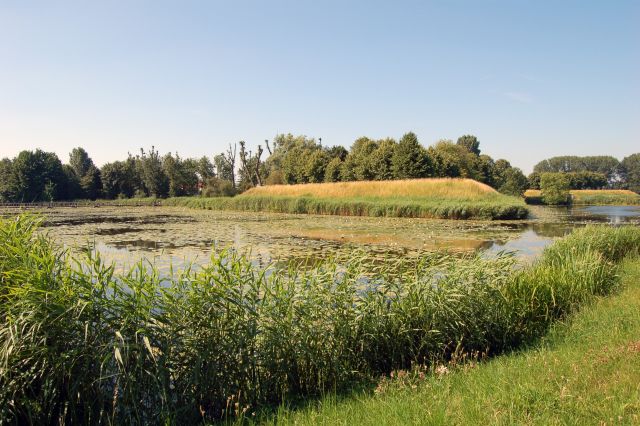
Woerden Castle
Woerden Castle, locally known as Kasteel van Woerden, is a prominent medieval fortress located in the city of Woerden in the province of Utrecht, Netherlands. This castle holds significant historical and architectural value due to its strategic location and its evolution from Roman times through the Middle Ages to the present day.
The site of Woerden Castle has a deep-rooted history dating back to the Roman Empire. Originally, the location was home to a Roman castellum called Castellum Laurum, part of the limes—the fortified northern border of the Roman Empire. This castellum was initially constructed in the 40s AD as a military outpost to defend the empire's frontier. It was destroyed during the Batavian rebellion in 69 AD but was swiftly rebuilt in 70 AD. The Romans maintained control of the site until around 402 AD, with a brief interruption between 275 and 300 AD. Archaeological excavations in the city center of Woerden have uncovered remains of Roman buildings and a Roman cargo ship, underscoring the site's long-standing military and commercial importance.
Medieval origins and strategic importance
The current Woerden Castle was constructed in the High Medieval period, around 1159, by Bishop Godfrey van Rhenen of Utrecht. This construction replaced earlier fortifications and was intended to strengthen the bishopric's defenses against the neighboring County of Holland. The castle's location was of critical strategic importance, situated near the border between the bishopric and the county, making it a focal point in regional conflicts.
The castle was rebuilt and expanded in 1407 under the direction of John III, Bishop of Liège, who was also the Duke of Bavaria-Straubing. This reconstruction emphasized military functionality, as the castle was designed solely for defense rather than as a noble residence. Its walls reach thicknesses of over 3.5 meters in some sections to withstand siege weaponry and artillery fire. A remarkable feature of Woerden Castle is the presence of artillery corridors beneath the structure, unique in the Netherlands, which allowed defenders to move and operate cannons safely during attacks.
Architectural features and military adaptations
Woerden Castle exemplifies the military architecture of the High Medieval and early Late Medieval periods. The thick stone walls and robust defensive structures reflect the castle's primary role as a fortress. Originally, it featured tall towers that provided vantage points for surveillance and defense. However, as military threats diminished over the centuries, these towers were partially dismantled and are now less than half their original height.
The castle's defensive design includes a moat and fortified gatehouses, which controlled access to the interior courtyard. The presence of a pit prison in the northwest tower is notable; it was used to confine unruly prisoners during the castle's later use as a prison until the 19th century.
Historical events and later uses
Throughout its history, Woerden Castle has witnessed numerous military events. In 1672, during the Franco-Dutch War, French forces attempted to destroy the castle as they advanced through the Netherlands. However, the local population prevented this by stealing the fuse intended to ignite the gunpowder, saving the castle from destruction.
Following its military use, the castle served as a prison until the 19th century. The harsh conditions of the pit prison in the northwest tower are a reminder of this period. In the 20th century, the castle was incorporated into military barracks and used primarily for storage. Unfortunately, this period saw poor maintenance, leading to significant decay of the structure.
Restoration and modern function
Recognizing the cultural and historical importance of Woerden Castle, a comprehensive renovation was undertaken in 1989. This restoration aimed to preserve the castle's architectural integrity while adapting it for contemporary use. In the 1990s, the castle was leased to an ICT company that used it as office space, although this tenancy was relatively short-lived.
Subsequent renovations have transformed Woerden Castle into a venue for events and private functions. While it is not generally open to the public for tours, visitors can access the castle when attending events or by special invitation. The castle's preservation as a well-preserved medieval fortress with unique features such as its artillery corridors and pit prison offers valuable insight into Dutch military architecture and history.
Architectural style and classification
Woerden Castle is classified as a hill castle, constructed primarily for military defense rather than residential comfort. Its architectural style reflects the High Medieval period with later adaptations. The robust stone walls, defensive towers, and underground artillery passages are characteristic of medieval fortifications designed to withstand sieges and artillery assaults.
The castle's evolution from a Roman military site to a medieval fortress underscores its continuous strategic significance. Its preservation allows scholars and visitors alike to explore centuries of military architectural development and regional history in the Netherlands.
Frequently asked questions (FAQ)
- How do I visit Woerden Castle?
- Woerden Castle is generally not open for regular tours but can be visited by appointment or when attending special events hosted at the venue.
- What is the historical significance of Woerden Castle?
- Woerden Castle has a rich history dating back to Roman times, serving as a strategic military fortress on the border between the Bishopric of Utrecht and the County of Holland.
- When was Woerden Castle built?
- The current medieval castle was built around 1159 by Bishop Godfrey van Rhenen, with significant reconstruction in 1407 by John III, Bishop of Liège.
- Can I see the artillery corridors at Woerden Castle?
- The castle features unique artillery corridors beneath its structure, which are rare in the Netherlands, but access may be limited and typically available during guided events or special visits.
- Is Woerden Castle wheelchair accessible?
- Due to its medieval structure and partial renovations, wheelchair accessibility is limited. Visitors are advised to inquire in advance about accommodations.
Information
Opening hours
By appointment or during events
Ticket prices
Varies depending on event
Current owner
Municipality
Website
Visit websiteAddress
Kasteel 3, Woerden, Netherlands
Sources & official resources
Verify the information above using these authoritative references.
Loading map...
Visitor reviews
No reviews yet. Been here? Write the first review and help other travelers!
Write the first reviewVisited this castle? Share your experience
Your review helps other travelers and adds first-hand knowledge to our encyclopedia.