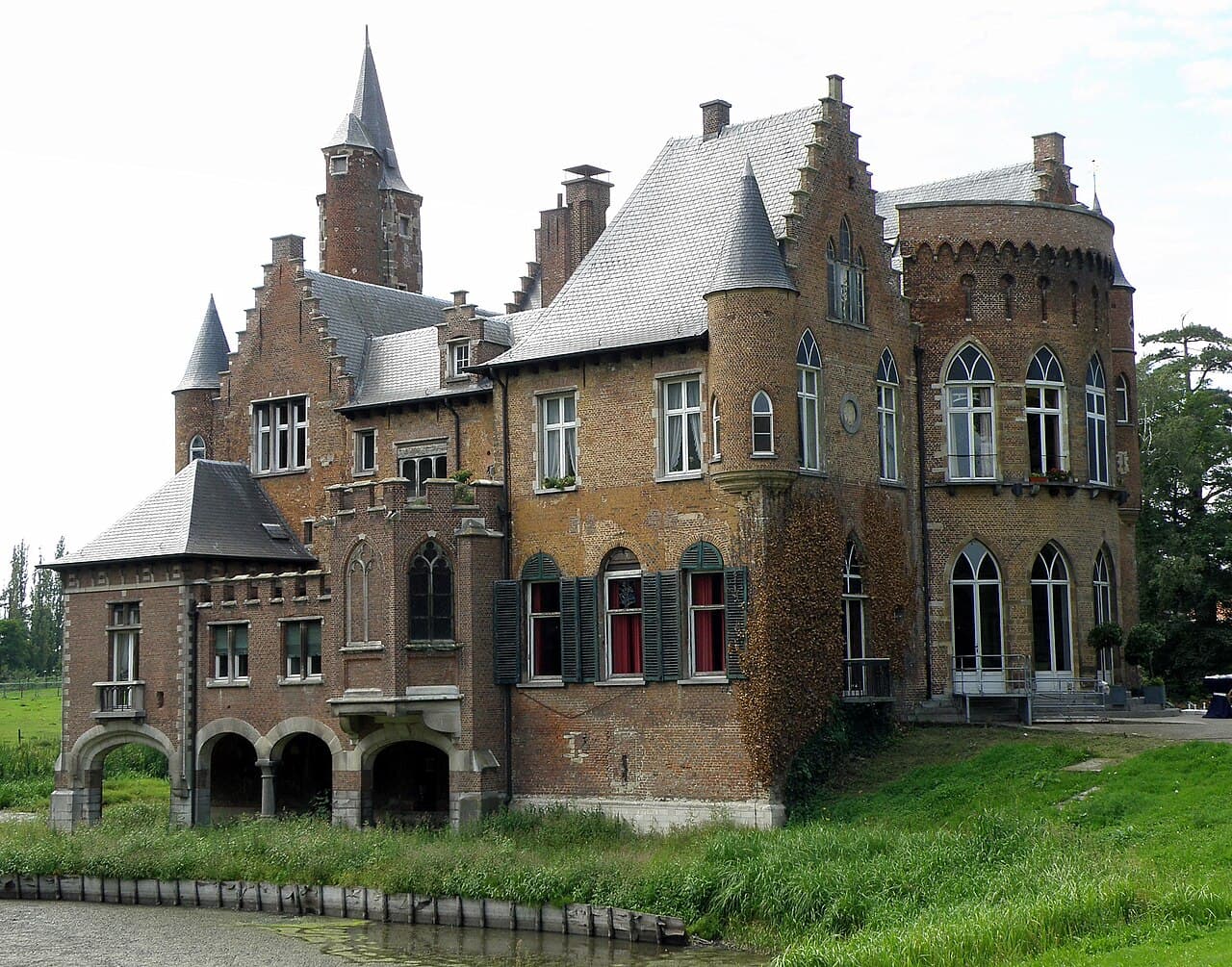
Wissekerke Castle
Wissekerke Castle, locally known as Kasteel Wissekerke, is a prominent historic hill castle located in the village of Bazel within the municipality of Kruibeke, in the province of East Flanders, Belgium. The castle's origins trace back to the 10th century, when an early fortification, likely an earthen structure, was established to defend the area from Viking raids. This initial fortification marked the site as a strategic defensive position in the region.
The current castle structure began to take shape in the 13th century, evolving through successive phases of construction and renovation that reflect the changing needs and tastes of its noble owners. In the early 16th century, the castle was acquired by Lieven van Pottelsberghe, lord of Vinderhoute and councilor to Holy Roman Emperor Charles V. Following his death in 1531, ownership passed to Servaas van Steelant, who undertook significant rebuilding efforts, especially after the castle was partially destroyed in 1583 during a military action led by Marnix de Sainte Aldegonde amid the Dutch Revolt. This reconstruction shifted the castle's design from purely defensive to a more comfortable noble residence, reducing its fortifications.
Medieval origins and early fortifications
The earliest known fortifications at Wissekerke date to the 10th century, likely consisting of earthworks designed to repel Viking incursions. By the mid-12th century, the site had developed into a more substantial stronghold featuring water-filled moats and drawbridges, typical defensive features of medieval castles in the County of Flanders. These elements underscored the castle's strategic importance in controlling local territory and protecting the surrounding lands.
While the original medieval fortifications have largely disappeared, archaeological evidence and surviving structural elements such as a 15th-century basement and a 16th-century main tower attest to the castle's medieval heritage. The main tower, built shortly after the 1583 siege, remains a prominent feature of the castle complex.
Renaissance transformations and noble ownership
In the early 16th century, the castle came under the ownership of the Vilain XIIII family, an influential noble lineage that played a central role in the local governance of Bazel. Members of the Vilain XIIII family served as mayors of the village for an impressive 139 years, highlighting their lasting influence in the region.
During the 16th century, particularly after the partial destruction in 1583, the castle was rebuilt with a focus on residential comfort rather than military defense. This transition reflects broader trends in castle architecture during the Renaissance, where many fortifications were adapted into stately homes.
19th-century neo-gothic revival and landscape design
The 19th century marked a period of significant transformation for Wissekerke Castle. The Vilain XIIII family commissioned extensive renovations that introduced neo-Gothic architectural elements, aligning with the Romantic movement's fascination with medieval styles. The castle's interiors were richly decorated, including an Empire-style salon created by Vicomtesse Sophie-Louise-Zoé de Feltz, reflecting the opulence and artistic tastes of the era.
Alongside architectural enhancements, the estate's landscape was redesigned in the English garden style, emphasizing naturalistic features such as lakes and parks. A notable engineering achievement was the excavation of a 1,400-meter canal connecting the castle's ponds to the nearby Scheldt River, enhancing the estate's picturesque water features.
The iron suspension bridge
One of Wissekerke Castle's most remarkable features is its iron suspension bridge, constructed in 1824 by the Brussels engineer Jean-Baptiste Vifquain. Spanning approximately 20.5 meters, this bridge is recognized as the oldest surviving wrought iron suspension bridge in Europe. Its design was innovative for its time, employing bolted connections instead of traditional carpentry joints and featuring wooden walkways originally.
Although the bridge's deck has been replaced, the original structural columns, portals, chains, and railings remain intact. The bridge underwent restoration in 2012, preserving its industrial and architectural significance as a pioneering example of early 19th-century engineering.
20th-century preservation and cultural role
By the mid-20th century, the Vilain XIIII family ceased residing in the castle, and in 1989, ownership transferred to the municipality of Kruibeke. Since then, the castle has been preserved and adapted for public use, hosting a museum dedicated to the Vilain XIIII family and serving as a venue for cultural activities, exhibitions, and tours.
The castle, gatehouse, suspension bridge, and ancillary structures such as the dovecote were officially listed as protected monuments in 1981, recognizing their historical and architectural value. Ongoing restoration efforts, supported by grants such as a €130,000 award in 2022 from the Flemish Minister of Immovable Heritage, ensure the site's conservation for future generations.
Architectural features and surviving elements
Wissekerke Castle's architecture is a layered palimpsest of styles and periods. The core medieval elements include the main tower and the 15th-century basement, constructed primarily of brick with distinctive brick cross-rib vaults. The 19th-century renovations introduced the neo-Gothic style evident in the castle's façades and the adjacent neotudor gatehouse, commissioned by Viscount Philippe Vilain XIIII.
The castle's interiors feature richly decorated rooms, including the Empire-style salon, which showcase the artistic tastes of the 19th century. The surrounding parkland, with its English garden design and water features, complements the architectural ensemble, creating a harmonious historic estate.
Visiting wissekerke castle today
Today, Wissekerke Castle is open to the public for guided tours and cultural events. Visitors can explore the castle's interiors, including the tower, the gatehouse, and the museum exhibitions dedicated to the Vilain XIIII family. The castle grounds, including the park and the historic suspension bridge, are accessible for leisurely walks and photography.
The castle's combination of medieval origins, Renaissance transformations, and 19th-century neo-Gothic revival make it a unique destination for those interested in European castle architecture and noble history. Its well-preserved suspension bridge adds an industrial heritage dimension, attracting engineering enthusiasts and historians alike.
Frequently asked questions (FAQ)
- How do I visit Wissekerke Castle and what can I see?
- Wissekerke Castle is open to the public for tours and cultural events. Visitors can explore the castle interiors, including the tower and museum exhibitions, as well as the surrounding park and historic suspension bridge.
- What is the historical significance of Wissekerke Castle?
- Wissekerke Castle has origins dating back to the 10th century and played a strategic role in medieval Flanders. It was home to the influential Vilain XIIII family, who shaped its architecture and local governance for centuries.
- When was the iron suspension bridge at Wissekerke Castle built and why is it important?
- The iron suspension bridge was built in 1824 by engineer Jean-Baptiste Vifquain. It is the oldest surviving wrought iron suspension bridge in Europe, notable for its innovative design and industrial heritage value.
- Is Wissekerke Castle accessible for visitors with mobility issues?
- The castle has multiple floors and a tower, which may limit accessibility for visitors with mobility challenges. However, the park and suspension bridge areas are more accessible for leisurely visits.
- What architectural styles are represented at Wissekerke Castle?
- The castle features a blend of medieval, Renaissance, and 19th-century neo-Gothic architectural styles, reflecting its long history and successive renovations.
Photo gallery

Information
Sources & official resources
Verify the information above using these authoritative references.
Loading map...
Visitor reviews
No reviews yet. Been here? Write the first review and help other travelers!
Write the first reviewVisited this castle? Share your experience
Your review helps other travelers and adds first-hand knowledge to our encyclopedia.



