Wilno
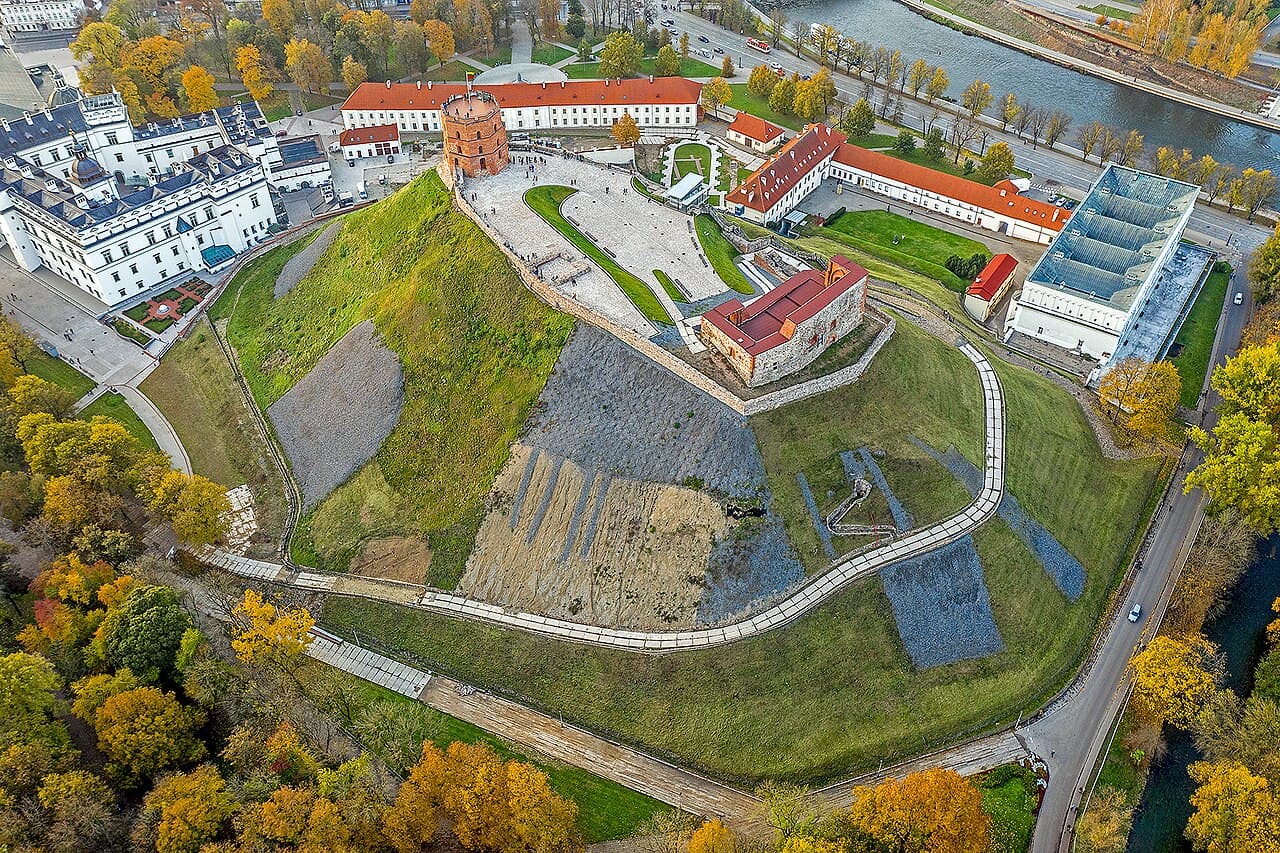
Vilnius Castle Complex, located in the heart of Vilnius, Lithuania, stands as a monumental testament to the region's rich medieval and early modern history. Spanning several centuries, this complex comprises the remnants of the Upper Castle, the Lower Castle with its Royal Palace and Vilnius Cathedral, alongside military structures like the Old and New Arsenals. The site occupies a strategic position on the left bank of the Neris River, near its confluence with the Vilnia River, centered on the prominent Gediminas Hill.
The origins of the castle complex trace back to the 9th and 10th centuries, with the earliest fortifications constructed in wood on Gediminas Hill, an oval plateau that had been inhabited since the Neolithic era. This site evolved into the Upper Castle, which was extensively rebuilt in the Gothic style during the early 15th century under the rule of Grand Duke Vytautas the Great. The Upper Castle featured imposing stone walls, three defensive towers, and a large donjon hall distinguished by its green-glazed roof tiles. It served as a military stronghold and symbol of Lithuanian statehood, although it fell into decline after the 16th century and was ultimately abandoned following the Russian invasion in 1655.
The lower castle and royal palace
The Lower Castle, situated at the foot of Gediminas Hill, developed from early wooden settlements into a fortified complex with stone walls, gates, and towers by the 13th and 14th centuries. This area housed the Royal Palace, which became the principal residence of the Grand Dukes of Lithuania and later the kings of the Polish-Lithuanian Commonwealth. The palace was initially constructed in the 15th century after a devastating fire in 1419, exhibiting Gothic architectural features.
During the 16th century, the palace underwent significant expansions and renovations in the Renaissance style, influenced by Italian architects such as Bartolomeo Berecci and Bernardino de Gianotis Zanobi. Notably, Queen Bona Sforza played a key role in transforming the palace into a grandiose royal residence, adding new wings and ornate arcaded galleries. The palace was further remodeled in the early Baroque style during the reign of King Sigismund III Vasa, reflecting the evolving tastes of the era.
The Royal Palace was a cultural and political hub, hosting royal ceremonies, weddings, and even the first Lithuanian opera in 1634. However, the palace suffered extensive damage during the Russian invasion of 1655 and was subsequently abandoned. In the 19th century, under Russian rule, much of the palace was dismantled, with bricks repurposed and the site left in ruins. Restoration efforts began in the late 20th and early 21st centuries, culminating in the symbolic reopening of the reconstructed palace in 2009, now serving as the seat of the National Museum of Lithuania.
Vilnius cathedral and religious significance
The Vilnius Cathedral, located within the Lower Castle complex, is a site of profound religious and historical importance. Originally a pagan worship site dedicated to the god Perkūnas, it was converted to a Christian cathedral by King Mindaugas in 1251. The cathedral was rebuilt in the Gothic style in 1387 following Lithuania's official Christianization and again after a fire in 1419 under Vytautas the Great.
Over the centuries, the cathedral was remodeled multiple times, acquiring Renaissance and ultimately Neoclassical architectural features during an 18th-century redesign by architect Laurynas Gucevičius. Its 15th-century bell tower, originally part of the Lower Castle's defenses, remains a prominent feature. The cathedral houses the tombs of significant Lithuanian rulers and saints, including Vytautas the Great, Saint Casimir, and members of the Jagiellonian dynasty, underscoring its enduring cultural and spiritual role.
Military architecture and arsenals
The castle complex's military infrastructure included the Old Arsenal, founded under Vytautas in the 15th century, and the New Arsenal, built in the 18th century by Grand Hetman Kazimierz Ogiński. These arsenals housed hundreds of heavy cannons and were integral to the defense of Vilnius. The New Arsenal was integrated into the castle's defensive walls and featured a tower that historically aided navigation along the river.
Both arsenals suffered damage during World War II but have since been partially restored and repurposed as museum spaces. Other surviving buildings within the complex now accommodate branches of the National Museum of Lithuania, including departments dedicated to archaeology, numismatics, and applied arts, preserving and showcasing Lithuania's extensive cultural heritage.
Gediminas tower: symbol of lithuanian statehood
Gediminas Tower, the surviving western tower of the Upper Castle, is an octagonal, three-story structure approximately 20 meters tall. It stands atop Gediminas Hill, which rises about 48 meters above the surrounding terrain, offering panoramic views of Vilnius's Old Town and the confluence of the Neris and Vilnia Rivers. The tower's distinctive green-glazed roof tiles and robust stone and brick construction reflect its medieval origins.
The tower has served various military and symbolic functions throughout its history. It was part of the castle's defensive system and was last used in combat during the 1655 Russian invasion. In the 19th century, the Russian Empire modified the tower for military communication purposes, including the installation of an optical telegraph. Restored in the 20th century, Gediminas Tower now functions as a museum and a potent national symbol.
Most notably, Gediminas Tower was the site where the Lithuanian tricolor flag was first raised on January 1, 1919, symbolizing Lithuania's aspirations for independence and sovereignty. Today, it houses exhibitions related to the castle's history and Lithuanian heritage, attracting numerous visitors annually.
Archaeological research and preservation efforts
Archaeological investigations at the Vilnius Castle Complex have been ongoing since the early 20th century, with significant excavations conducted during the interwar period and renewed efforts beginning in 1987. These studies have uncovered substantial remains of the castle's fortifications, residential buildings, and military installations, informing restoration and conservation projects.
Preservation efforts have focused on stabilizing Gediminas Hill to prevent landslides, restoring surviving structures such as Gediminas Tower, and reconstructing parts of the Royal Palace. The reconstructed palace, opened in 2009, serves as a cultural venue and museum, highlighting Lithuania's medieval and Renaissance heritage.
Today, the Vilnius Castle Complex stands as a multifaceted cultural landmark, embodying the historical evolution of Lithuania's political power, religious life, and military defense. Its combination of Gothic, Renaissance, Baroque, and Neoclassical architectural elements offers a unique window into the region's layered past, making it an essential destination for visitors interested in Baltic history and heritage.
Frequently asked questions (FAQ)
- What are the main attractions within the Vilnius Castle Complex?
- The Vilnius Castle Complex includes the Upper Castle with Gediminas Tower, the Lower Castle with the Royal Palace and Vilnius Cathedral, as well as the Old and New Arsenals. Visitors can explore medieval fortifications, historic palaces, and museums showcasing Lithuanian history.
- When was Gediminas Tower built and what is its significance?
- Gediminas Tower was originally constructed in the early 14th century as part of the Upper Castle. It symbolizes Lithuanian statehood and independence, notably hosting the first raising of the Lithuanian tricolor flag in 1919. Today, it functions as a museum with exhibitions on the castle's history.
- Can I visit the reconstructed Royal Palace?
- Yes, the Royal Palace was reconstructed and symbolically reopened in 2009. It currently houses the National Museum of Lithuania and is open to visitors daily, offering exhibitions on Lithuania's medieval and Renaissance heritage.
- What architectural styles are represented in the Vilnius Castle Complex?
- The complex features a mix of Gothic, Renaissance, Baroque, and Neoclassical architectural styles, reflecting various phases of construction and renovation from the 15th to the 18th centuries.
- Is the Vilnius Castle Complex accessible to visitors year-round?
- The complex, including Gediminas Tower and the Royal Palace, is generally open daily from 10:00 to 18:00. Seasonal variations may occur, so it is advisable to check current opening hours before visiting.
Photo gallery

Information
Opening hours
10:00-18:00, daily
Ticket prices
€5 adult, €3 child
Current owner
National Museum of Lithuania
Website
Visit websiteSources & official resources
Verify the information above using these authoritative references.
Loading map...
Visitor reviews
No reviews yet. Been here? Write the first review and help other travelers!
Write the first reviewVisited this castle? Share your experience
Your review helps other travelers and adds first-hand knowledge to our encyclopedia.