Rokantiskes Castle Ruins
Rokantiškės Castle is a historically significant fortress located east of Vilnius, Lithuania, perched on a prominent hilltop near the Vilnia River. Its origins date back to the 12th century, when it was initially constructed as a wooden stronghold by the Baltic duke Alšis (Holsza). Over the centuries, the castle evolved from a simple wooden hunting lodge into a substantial stone fortress and noble residence, reflecting the region's changing political and military landscape.
The origins and early history of Rokantiškės Castle
The castle’s earliest incarnation was a wooden structure serving as a hunting lodge for local nobility, indicative of the strategic and recreational use of the site during the Early Medieval period. Positioned on a high hill, the location provided natural defensive advantages, overseeing the surrounding terrain and the Vilnia River valley.
In the 15th and 16th centuries, the wooden fortifications were replaced with stone constructions, marking a significant architectural and functional transformation. This period coincided with the castle's transition into the Renaissance style, characterized by robust masonry, brick-lined windows, and more permanent residential features. The transformation reflected the need for enhanced defense as well as the desire for a prestigious noble residence.
The Olshanski family and subsequent ownership
Rokantiškės Castle became the seat of the prominent Olshanski family, including notable members such as Alexander Olshanski, Yuri Olshanski, and Paweł Algimunt Holszański, the last duke of the family and bishop of Vilnius. Upon his death, the castle was inherited by Queen Bona Sforza, the influential consort of the Polish-Lithuanian Commonwealth ruler, reflecting the castle's high status within the nobility.
Later, ownership passed to the Goštautas family and then to King Sigismund Augustus. Eventually, the castle was acquired by the powerful Pac family, one of Lithuania's most influential noble households. Under the Pacs, the castle continued to serve as a significant noble residence and administrative center.
Historical events and decline
One of the castle’s notable historical moments occurred on July 15, 1636, when Stefan Pac, the Lithuanian Vice-Chancellor, hosted King Władysław IV Vasa of Poland and Grand Duke of Lithuania at Rokantiškės. This event underscores the castle's importance as a political and social hub during the early 17th century.
However, the castle's fortunes declined dramatically during the Russo-Polish War. On August 7, 1655, it was burnt down by Cossack forces, leading to its abandonment and gradual decay. Over time, the surrounding forest reclaimed the site, leaving only ruins visible today.
Architectural features and archaeological discoveries
The ruins of Rokantiškės Castle are situated within the Pavilniai Regional Park, offering a glimpse into its former grandeur. Archaeological excavations have revealed a trapezoidal courtyard at the heart of the castle complex, with the foundations of a large palace building measuring approximately 36.5 by 15.6 meters, though some sources suggest dimensions up to 45 by 20 meters. The palace walls were notably thick, reaching up to two meters, and windows were lined with bricks, demonstrating advanced Renaissance masonry techniques.
At the northern corner of the courtyard lies the footprint of a rectangular defensive tower measuring about 6.6 by 5 meters, integral to the castle’s defense system. A long defensive wall approximately 24 meters in length and 0.8 meters thick enclosed parts of the castle, supplemented by adjoining walls that formed a complex of ancillary buildings.
The southern boundary of the courtyard was fortified by a defensive wall, to which casemates—vaulted chambers used for storage or defense—were attached. The southwestern corner featured a gate defense tower, marking the main fortified entrance and controlling access to the castle grounds.
Artifacts recovered during excavations include iron construction elements and kaflės—glazed ceramic roof tiles typical of Renaissance and Baroque architecture. Ceramic shards and bricks found in multiple layers date from the 16th to 18th centuries, confirming the castle's phases of rebuilding and occupation after its medieval origins.
The castle’s setting and surrounding landscape
The castle is surrounded by steep ravines densely covered with spruce forest, enhancing its natural defenses. Nearby lies the historical site of the village of Strielčiukai, believed to have housed the castle’s defenders or workers, indicating a small settlement functionally linked to Rokantiškės.
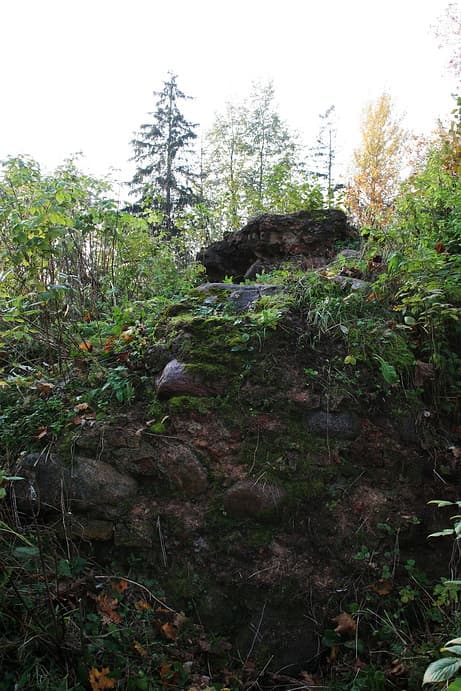
Today, the site consists of foundational remains and fragmentary walls preserved in situ. These ruins offer valuable insight into Lithuania’s medieval and early modern fortification architecture, illustrating the evolution from a wooden hunting lodge to a substantial Renaissance noble residence with significant military features.
Archaeological research and preservation efforts
Interest in Rokantiškės Castle was renewed in the 20th century, with archaeological investigations conducted in 1940 by Włodzimierz and Helena Hołubowicz. Further research took place in 1995 under Albinas Kuncevičius and between 2008 and 2010 by Aušra Zalepūgienė. These excavations have uncovered extensive physical traces of the castle’s historical development, architectural layout, and material culture, contributing significantly to the understanding of Lithuanian noble residences and fortifications.
The ruins remain an important cultural heritage site within Vilnius, attracting historians, archaeologists, and visitors interested in Lithuania’s medieval past. Preservation efforts focus on maintaining the structural remains and protecting the site within the natural landscape of Pavilniai Regional Park.
Frequently asked questions (FAQ)
- How do I get to Rokantiškės Castle ruins from Vilnius city center?
- Rokantiškės Castle ruins are located east of Vilnius city center near the Vilnia River. Visitors can reach the site by car or local bus services heading towards Pavilniai Regional Park. Walking trails from nearby neighborhoods also provide access for hikers and nature enthusiasts.
- What remains can I expect to see at Rokantiškės Castle ruins?
- Visitors will find foundational walls, the footprint of a large palace, a defensive tower, and remnants of fortification walls. The ruins reveal the castle's Renaissance architectural features and defensive structures.
- When was Rokantiškės Castle originally built and by whom?
- The castle was originally built in the 12th century by the Baltic duke Alšis (Holsza), initially as a wooden hunting lodge before evolving into a stone fortress in the Renaissance period.
- Why is Rokantiškės Castle historically significant?
- Rokantiškės Castle is significant as one of Lithuania's earliest castles and a noble residence that witnessed important historical events, including visits by Polish-Lithuanian royalty and its destruction during the Russo-Polish War.
- Is Rokantiškės Castle accessible year-round for visitors?
- The ruins are located within Pavilniai Regional Park, which is generally open year-round. However, accessibility may vary with weather conditions, so visitors should check local park information before planning their visit.
Photo gallery

Information
Loading map...
Visitor reviews
No reviews yet. Been here? Write the first review and help other travelers!
Write the first reviewVisited this castle? Share your experience
Your review helps other travelers and adds first-hand knowledge to our encyclopedia.