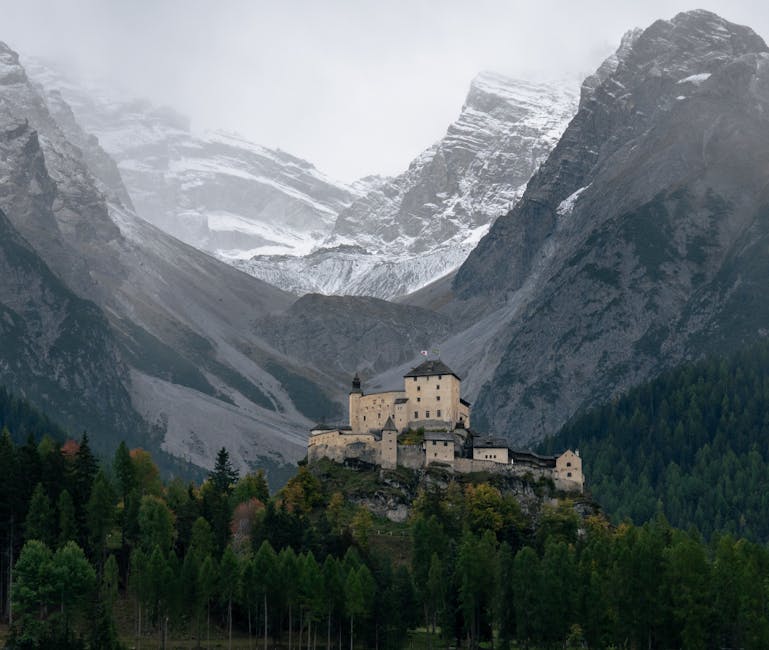
Wildenberg Castle
Wildenberg Castle stands as a remarkable example of a high medieval hill castle located in Zernez, Switzerland. Erected in the late 13th century, it was originally the stronghold of the Wildenberg family, a cadet branch of the influential Greifenstein family of Filisur. The castle's strategic position atop a hill overlooking the surrounding valleys of Graubünden provided both defensive advantages and control over local territories.
The castle first appears in historical records around 1280-1290 as the residence of the Wildenberg family. By 1296, the Bishop of Chur had acquired the right to collect tithes from the estate, pledging these revenues to the Lords of Planta. While it remains uncertain whether the castle itself was included in this pledge, by the 14th century the bishop had assumed ownership of Wildenberg Castle, entrusting it to the Planta family as feudal custodians.
Medieval origins and political significance
The castle played a pivotal role in regional politics during the 14th century. In 1365, representatives from communities surrounding Chur convened at Wildenberg Castle under the auspices of the Planta family. This assembly was motivated by concerns over the growing influence of the County of Tyrol and the mounting debts of the bishop. Their collaboration led to the founding of the League of God's House in 1367, a significant alliance aimed at curbing the bishop's power and protecting local interests.
By around 1400, the Planta family branch residing at Wildenberg had adopted the name von Wildenberg or Planta-Wildenberg, holding the castle as a permanent fief. Their wealth expanded through extensive lands and rights granted by the bishop, as well as an imperial mining concession in the Lower Engadine awarded by Emperor Henry VII. The Planta-Wildenberg family's relationship with the bishopric was complex, alternating between financial support and political opposition. Notably, in 1430, Conradin von Planta-Wildenberg demanded the abdication of Bishop Johann von Chur, resulting in his excommunication.
Conflicts and alliances in the late medieval period
During the late 15th century, the Planta-Wildenberg family aligned with the bishop against the emperor. In 1498, Hans von Planta-Wildenberg signed a treaty between the League of God's House and the Swiss Confederation, aiming to limit imperial power. Tradition holds that Hans personally fought at the Battle of Calven in 1499 during the Swabian War, reportedly killing an imperial knight.
Architectural evolution and reconstruction
By 1570, chronicler Ulrich Campell described Wildenberg Castle as a medieval fortress featuring a central tower and three residential wings. The owner at that time, Balthasar von Planta-Wildenberg, had expanded the family's influence through multiple marriages and offspring, contributing to the castle's prominence.
The early 17th century brought turmoil when Rudolf von Planta-Wildenberg shifted allegiance to the pro-Habsburg faction, angering local villagers and minor nobility. In 1618, this tension culminated in a revolt during which the castle was besieged, captured, and burned. Rudolf and his family escaped but returned in 1622 to rebuild the castle, initiating significant restoration and expansion projects.
The castle's architecture reflects these historical phases. The original 13th-century square tower remains the focal point, with its robust stone walls and defensive features such as keyhole-shaped arrow slits dating from around 1630. The tower's upper portion was crowned with a curved spire in the 18th century, replacing the medieval battlements.
Attached to the tower are two Baroque residential wings arranged in an L-shape, emphasizing comfort over defense. These wings were expanded in the mid-17th and 18th centuries, showcasing the castle's transition from fortress to noble residence. Within the L-shaped courtyard, enclosed gardens and a walled courtyard feature prominently, with the gate adorned by the combined coats of arms of Hartmann and Flandrina von Planta dated 1650.
Additional architectural highlights include an external staircase from circa 1760 bearing the coats of arms of Johann von Planta and Maria Jecklin, and an interior grand staircase connecting the residential wings beneath a richly stuccoed and painted classical ceiling from the 17th century.
Later history and current use
Following Rudolf's death in 1638, the castle passed to the Planta-Aredz cadet line, which continued to hold and expand the property into the 18th century. In 1856, the castle was sold to the Bezzola family, marking the end of centuries of Planta ownership.
In 1956, the municipality of Zernez acquired Wildenberg Castle, repurposing it as the town's administrative center. Restoration work undertaken between 1989 and 1994 preserved the castle's historical fabric while adapting it for modern use. Since 2007, the castle has housed the administration of the Swiss National Park, integrating its heritage with conservation efforts.
Location and surroundings
Wildenberg Castle is situated at the eastern edge of Zernez's historic Runatsch district. It lies in close proximity to both the village's Protestant parish church and Catholic chapel, which notably survived a major fire in 1872 that devastated much of the village. This location underscores the castle's longstanding role within the community and its landscape.
Today, Wildenberg Castle remains a well-preserved high medieval hill castle that embodies centuries of regional history, architectural evolution, and noble lineage. Its combination of medieval fortifications and Baroque residential elements offers a unique glimpse into the transformation of Swiss castles from military strongholds to stately homes.
Frequently asked questions (FAQ)
- How do I visit Wildenberg Castle in Zernez?
- Wildenberg Castle is open to the public as it houses the Swiss National Park administration. Visitors can explore the castle grounds and nearby historic sites in Zernez. It is advisable to check local tourism websites for any guided tours or special visiting hours.
- What is the historical significance of Wildenberg Castle?
- Wildenberg Castle was a key medieval fortress linked to the Planta family and the League of God's House. It played an important role in regional politics, including alliances against the bishop and the Holy Roman Emperor.
- Can I see the original medieval architecture at Wildenberg Castle?
- Yes, the central square tower dates back to the 13th century and retains original defensive features such as arrow slits. The castle also showcases Baroque residential wings added during later renovations.
- When was Wildenberg Castle rebuilt after the 1618 siege?
- After being besieged and burned in 1618, Wildenberg Castle was rebuilt starting in 1622 by Rudolf von Planta-Wildenberg, incorporating Baroque architectural elements.
- Is Wildenberg Castle accessible for people with mobility issues?
- Due to its medieval structure and historic renovations, some areas of Wildenberg Castle may have limited accessibility. Visitors with mobility concerns should inquire locally about access accommodations before visiting.
Information
Website
Visit websiteSources & official resources
Verify the information above using these authoritative references.
Loading map...
Visitor reviews
No reviews yet. Been here? Write the first review and help other travelers!
Write the first reviewVisited this castle? Share your experience
Your review helps other travelers and adds first-hand knowledge to our encyclopedia.