Tarasp Castle
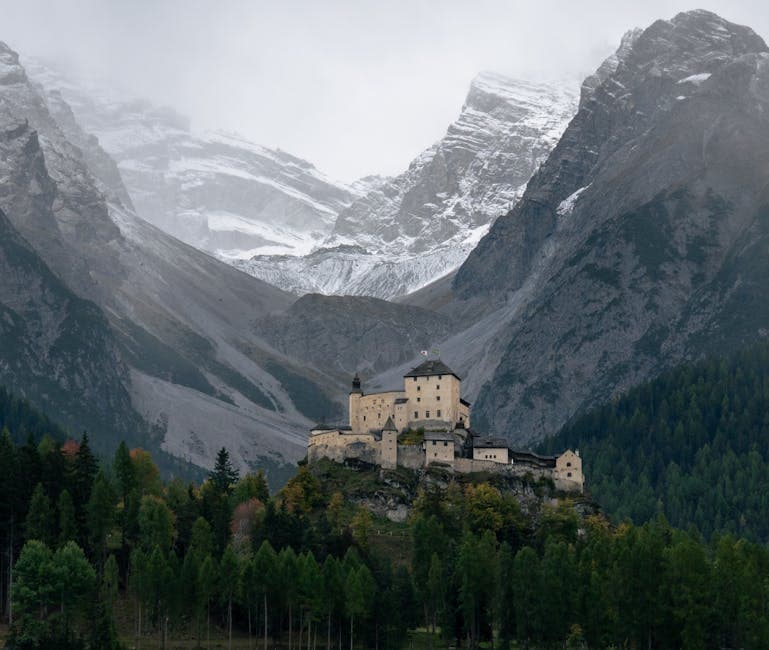
Tarasp Castle stands as a commanding fortress on a rocky hill about 100 meters high, overlooking the Inn river valley in the Lower Engadine region of Graubünden, Switzerland. This high medieval hill castle was probably constructed in the 11th century, with some evidence suggesting origins possibly as early as the 10th century. The castle's name derives from the Latin "terra aspera," meaning "wild earth," reflecting the untamed nature of the surrounding landscape when the castle was established.
The castle's strategic location atop a conical rock provided natural defenses and a vantage point dominating the surrounding valley and the village of Tarasp below. Its position was ideal for controlling the important trade routes and asserting territorial authority in this high alpine region.
Early history and medieval origins
The lords of Tarasp first settled in the area during the early 11th century, migrating from the Lake Como region. The earliest documented mention of the castle dates to 1089, when Ulrich von Tarasp was referenced in a papal mandate. Around this time, the von Tarasp family founded a monastery at Scuol, which later became the Benedictine Marienberg Abbey, underscoring their ecclesiastical ties and regional influence.
The original castle complex consisted of a ring wall and a chapel with a bell tower that doubled as a watchtower. This early fortification was typical of high medieval hill castles, combining military defense with religious functions.
Ownership disputes and feudal conflicts
In 1160, Ulrich II donated his share of Tarasp Castle to the Bishop of Chur. However, his nephew Gerhard, supported by the Count of Tyrol, seized the castle in 1163, leading to a siege by the bishop and allied forces. The conflict ended with a compromise: the castle became the bishop's property, but Gerhard and his descendants held it as a fief, with the condition that it would revert to the bishop if Gerhard died without heirs.
After Gerhard's violent death in 1170 and the death of the last male heir in 1177, the castle passed fully to the bishopric, while the Matsch family inherited other regional holdings. By 1200, the von Reichenberg family served as vogts (stewards) of Tarasp Castle for the bishop. In 1239, Swiker von Reichenberg sold the castle to Albert of Tyrol, sparking further disputes over control.
The matsch family and the tyrolean era
The von Matsch family took possession of Tarasp as vassals of Tyrol from 1273, holding it for about 150 years. Their tenure saw significant development of the castle's medieval structures, including the construction of curtain walls approximately two meters thick and residential wings. The castle's architecture from this period reflects typical high medieval defensive design.
When the lands of the Counts of Tyrol passed to the Habsburgs, the Matschs became their vassals. In 1422, Frederick VII of Toggenburg inherited Tarasp through marriage but died in 1436, returning the castle to the Matsch family. In 1464, Ulrich IX von Matsch sold the castle to Sigmund of Austria, marking the start of Austrian control and the castle's status as an autonomous county.
Conflicts and fortifications in the early modern period
Under Austrian rule, Tarasp Castle became a focal point of tension in the region, especially during the Protestant Reformation. Protestant locals attacked the castle in 1548 and 1578, attempting to capture it. Despite fortifications, the castle was stormed and burned in 1612 by local militia. A lightning strike in 1625 caused further damage and tragically killed the daughter of the Austrian representative.
The castle was expanded and fortified in the 16th century, including the addition of a zwinger (outer courtyard with defensive walls) and half-towers designed to repel attackers. The walls were plastered white and decorated with coats of arms, some of which have been restored.
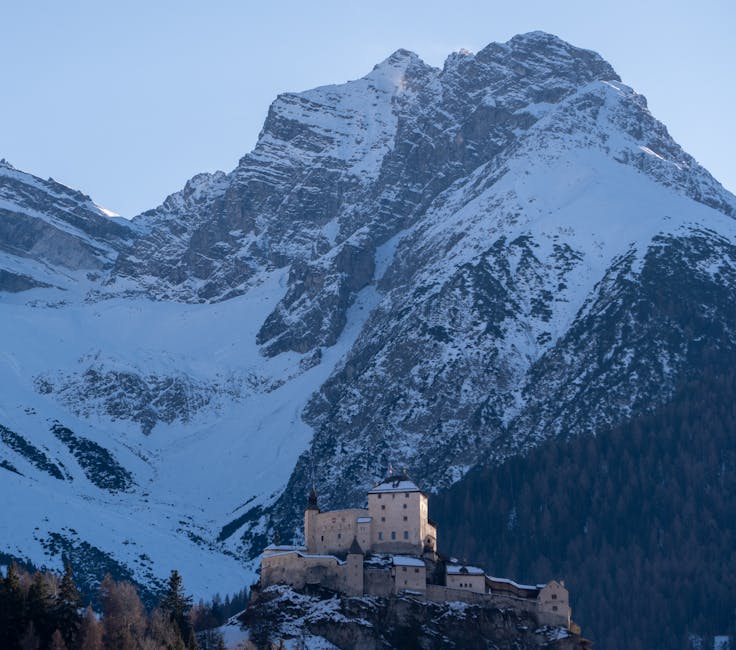
Photo by Oskar Gross
Later history and restoration efforts
Despite the surrounding region gaining independence from Austrian control by the mid-17th century, Tarasp remained an Austrian enclave until 1803. The castle was renovated between 1714 and 1732, updating interiors and structural elements. After the 1803 transfer to the Helvetic Republic and then the Canton of Graubünden, the castle was abandoned around 1815 and fell into ruin.
In 1856, the von Planta family began repairs, replacing the damaged roof. In 1900, Karl August Lingner, the inventor of the mouthwash Odol, purchased Tarasp Castle and undertook a comprehensive restoration from 1906 to 1916. Under the supervision of art historian Kuno Ferdinand von Hardenberg and castle expert Johann Rudolf Rahn, the castle was restored to a noble residence with historical furnishings and a large concert organ installed.
After Lingner's death, ownership passed to Grand Duke Ernest Ludwig of Hesse-Darmstadt, who opened the castle as a museum in 1919. The castle has since hosted public organ concerts and guided tours, showcasing its knights' halls, ballrooms, bedrooms, and chapel with a 2,500-pipe organ.
Architectural features and layout
Tarasp Castle is composed of three main sections: the Upper Castle (Oberburg), the Lower Castle (Unterburg), and a fortified entrance. The Upper Castle contains the main residence, south and north wings, battlements, a water cistern, and residential buildings arranged around an inner courtyard.
The Lower Castle lies on a terrace north of the Upper Castle and includes a guardhouse, powder towers, a gatehouse, a chapel integrated into the defensive wall, and a five-story bell tower topped with a Baroque onion dome. The chapel features a 12th-century apse with fragmentary frescoes.
The castle contains about 100 rooms, with medieval curtain walls about two meters thick. Renovations in the 16th and 17th centuries added vaulted ceilings and new windows carved into the rock. The castle's exterior walls are plastered white with late 15th-century coats of arms.
A remarkable feature is the castle organ built by Jehmlich Orgelbau Dresden between 1915 and 1916. Housed in the former armory, the organ's large pipework extends through several rooms, with sound transmitted through acoustic channels into the ballroom. It has 38 registers and a three-manual console, making it one of Europe's largest private organs.
Cultural significance and current status
Tarasp Castle is one of Switzerland's most prominent hill castles, symbolizing centuries of regional power struggles, religious conflicts, and architectural evolution. Its well-preserved state is largely due to the early 20th-century restoration efforts by Karl August Lingner and subsequent owners.
Since 1919, the castle has been open to the public as a museum, offering visitors a glimpse into medieval and early modern castle life. Public organ concerts and guided tours enhance the cultural experience.
In 2016, Swiss artist Not Vital acquired the castle with plans to develop it as a cultural and tourist site featuring contemporary art and a sculpture park, supported by municipal subsidies through 2030. This new chapter aims to blend the castle's rich historical heritage with modern artistic expression.
Frequently asked questions (FAQ)
- How do I get to Tarasp Castle?
- Tarasp Castle is located in the picturesque village of Tarasp, Switzerland. You can reach it by car or public transportation, with the nearest major town being Scuol, which is accessible by train and bus. Once in Tarasp, the castle is a short hike from the village center.
- What is the historical significance of Tarasp Castle?
- Tarasp Castle dates back to the 11th century and served as an important fortification in the region. It has a rich history that reflects the power struggles and cultural influences of the time. The castle is also a symbol of the local heritage and has been beautifully preserved to showcase its historical importance.
- When was Tarasp Castle built?
- Construction of Tarasp Castle began in the early 11th century, making it one of the oldest castles in the Engadine region. Over the centuries, it underwent numerous renovations and expansions, which contributed to its unique architectural style. The castle's long history is evident in its well-preserved structure and design.
- Can I visit Tarasp Castle year-round?
- Yes, Tarasp Castle is open to visitors year-round, although some areas may have limited access during the winter months due to weather conditions. It is advisable to check the official website for any seasonal changes to opening hours. Visiting during the warmer months allows you to enjoy the stunning views and surrounding landscapes.
- Why is Tarasp Castle an architectural gem?
- Tarasp Castle features a blend of Romanesque and Gothic architectural styles, which reflects its historical evolution over the centuries. The impressive stonework, imposing towers, and beautiful interiors make it a fascinating site for architecture enthusiasts. The castle's location on a hilltop also enhances its majestic appearance against the backdrop of the Swiss Alps.
- Is it possible to take guided tours of Tarasp Castle?
- Yes, guided tours are available at Tarasp Castle, providing visitors with in-depth knowledge about its history and architecture. Tours are typically conducted in multiple languages, making it accessible for international visitors. Booking in advance is recommended during peak tourist seasons to ensure availability.
- What are the opening hours of Tarasp Castle?
- Tarasp Castle generally opens its doors to visitors from late spring to early autumn, with specific hours varying by season. During the peak summer months, the castle typically welcomes guests from 10 AM to 5 PM. Always check the official website for the most current opening hours before planning your visit.
- What are the ticket prices for visiting Tarasp Castle?
- Ticket prices for Tarasp Castle are quite reasonable, making it an affordable attraction for visitors. As of the latest information, adult tickets are around CHF 10, while discounts are available for students and seniors. Children under a certain age often enter for free, so it's worth checking the official site for the latest pricing details.
- What are some nearby attractions to Tarasp Castle?
- Nearby attractions include the beautiful landscape of the Engadine Valley and the charming village of Scuol. Visitors can also explore the mineral springs in Scuol, which are famous for their therapeutic properties. Additionally, numerous hiking trails start from Tarasp, offering stunning views and a chance to experience the natural beauty of the region.
Photo gallery

Photo by Oskar Gross


Information
Website
Visit websiteSources & official resources
Verify the information above using these authoritative references.
Loading map...
Visitor reviews
No reviews yet. Been here? Write the first review and help other travelers!
Write the first reviewVisited this castle? Share your experience
Your review helps other travelers and adds first-hand knowledge to our encyclopedia.