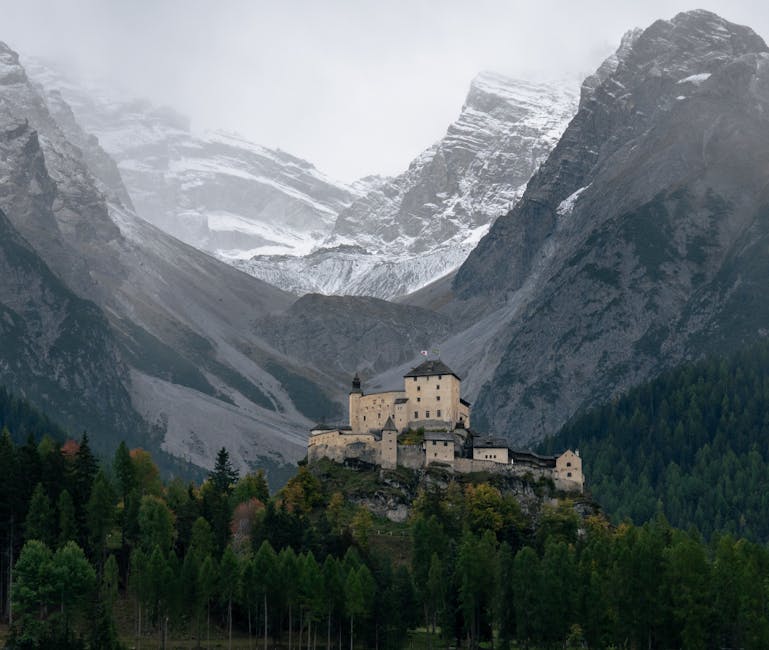
Fortezza Rohan stands as a remarkable example of 17th-century military architecture in the municipality of Zernez, Switzerland. Constructed in 1635 during the early modern period, the fortress was commissioned by the French Duke Henri II de Rohan amidst the turbulent backdrop of the Thirty Years’ War and the regional conflicts known as the Bündner Wirren. This strategic stronghold was designed to assert control over the vital Valtellina territory, contested by Spanish and Austrian forces.
The site originally hosted a medieval castle complex dating back to at least 1578, serving as the ancestral home of the Cazins family. When the Baroque fortress was erected, much of this earlier structure was dismantled and repurposed as building material, effectively erasing visible traces of the medieval castle. The rapid construction of the new fortress was an ambitious feat, completed in just over a week from May 19 to 27, 1635, by approximately 600 workers under the leadership of Captain Borel de la Roque-Servière and local leader Jörg Jenatsch.
Historical context and construction
The fortress's creation was driven by the military exigencies of the Thirty Years’ War, a period marked by widespread conflict across Europe. The Bündner Wirren, a series of local uprisings and power struggles, further underscored the need for robust fortifications in the region. The fortress's rapid construction was facilitated by the use of locally sourced materials: stone from the ruins of the former medieval castle, sand from a nearby natural deposit, and swamp lime sourced from community and church stores. These procurement efforts, however, caused some tensions with local inhabitants, as documented in correspondence from Jenatsch.
In the 20th century, the fortress grounds underwent additional military modifications. A rectangular building present until the 1930s was demolished during World War II to accommodate modern defenses linked to the Susch-Zernez defensive line. These later fortifications have since been removed, restoring the site closer to its 17th-century appearance.
Architectural design and features
Fortezza Rohan is distinguished by its star-shaped layout, a hallmark of Baroque military architecture designed to withstand the era's evolving artillery technology. The fortress walls remain partially standing, with heights ranging from 2.5 to 5 meters and thicknesses between half a meter and one and a half meters, reflecting the robust construction techniques of the period.
The walls were originally topped with wooden battlements, which provided protected walkways for defenders. These battlements were carefully restored in the 1990s using durable larch wood, replacing the original horizontal support beams. Surrounding the fortress, numerous wooden stakes angled upwards served as defensive obstacles to prevent attackers from placing ladders against the walls. Restoration efforts reinstated about eighty percent of these stakes, preserving the fortress's defensive character.
Notable structural elements
At the southwest corner stands a prominent two-story round tower featuring a cellar room and a platform likely intended for mounting artillery. This tower added a vertical defensive advantage, allowing for effective coverage of the surrounding approaches. The fortress is bisected by a central wall with a passageway linking its two halves, emphasizing its strategic internal organization.
The main entrance, located on the southeastern side, was a critical access point. Restoration work based on 1675 drawings reconstructed parts of the battlements above this gate, offering visitors an authentic glimpse of the original design. Additional restoration included rebuilding the connecting gate between the outer fortifications and the main fortress, repairing fallen gate arches, and reconstructing a gun embrasure on the round tower.
Preservation and cultural significance
Since 1985, the Pro Fortezza Rohan association has led efforts to preserve and stabilize the fortress ruins. Investigations during restoration, notably in 1990 under expert Felix Nöthiger, confirmed the feasibility of the fortress's rapid construction and provided valuable insights into 17th-century building methods. These preservation activities have been crucial in maintaining the structural integrity and historical authenticity of the fortress.
Today, Fortezza Rohan stands as a tangible reminder of the region's military history and the architectural ingenuity of the Baroque period. Its distinctive star-shaped design, robust walls, and restored defensive features offer visitors a unique opportunity to explore a fortress that played a pivotal role in the complex geopolitical struggles of early modern Europe.
Visiting fortezza rohan
Visitors to Fortezza Rohan can appreciate the fortress's impressive defensive architecture and learn about its historical context through onsite information displays. The restored battlements and tower provide vantage points for viewing the surrounding landscape, enhancing the educational and cultural experience. Preservation efforts ensure that the site remains accessible and informative for those interested in military history and Baroque architecture.
Location and accessibility
Located in the scenic Engadin valley, Fortezza Rohan is accessible from the nearby town of Zernez, which serves as a gateway to the Swiss National Park. The fortress's hilltop position offers commanding views and a strategic vantage point that underscores its historical military purpose.
Frequently asked questions (FAQ)
- How do I get to Fortezza Rohan?
- Fortezza Rohan is located in Switzerland, easily accessible by public transportation or car. If you are traveling by train, the nearest station is a short bus ride away, and there are well-marked signs to guide you to the castle.
- What is the historical significance of Fortezza Rohan?
- Fortezza Rohan dates back to the 16th century and played a critical role in the defense of the region. Its strategic location allowed it to serve as a military stronghold, reflecting the rich history and architectural evolution of castles in Switzerland.
- When was Fortezza Rohan built?
- Fortezza Rohan was constructed in the late 1500s, during a time of significant military development in the region. The castle showcases the architectural styles of its era, with features that have been preserved for visitors to explore.
- Can I take a guided tour of Fortezza Rohan?
- Yes, guided tours of Fortezza Rohan are available and highly recommended for a deeper understanding of its history and architecture. The tours are conducted by knowledgeable guides who share fascinating stories and insights about the castle.
- Why is Fortezza Rohan a popular tourist attraction?
- Fortezza Rohan is popular due to its stunning architecture, historical importance, and breathtaking views of the surrounding landscape. Visitors enjoy exploring the castle's well-preserved interiors and learning about its role in Swiss history.
- Is it possible to host events at Fortezza Rohan?
- Yes, Fortezza Rohan offers facilities for hosting various events, including weddings and corporate gatherings. The picturesque setting and historical ambiance provide a unique backdrop for any occasion.
- What are the opening hours of Fortezza Rohan?
- Fortezza Rohan is typically open to visitors from 10 AM to 5 PM, but hours may vary seasonally. It is advisable to check the official website for the most up-to-date information before your visit.
- What are the ticket prices for visiting Fortezza Rohan?
- Ticket prices for Fortezza Rohan are generally reasonable, with discounts available for students and seniors. Children under a certain age may enter for free, making it an accessible option for families.
- When is the best time to visit Fortezza Rohan?
- The best time to visit Fortezza Rohan is during the spring and early fall when the weather is mild and the landscape is particularly beautiful. These seasons allow for a comfortable exploration of the castle and its surroundings.
- Are there nearby attractions to visit along with Fortezza Rohan?
- Yes, there are several nearby attractions, including scenic hiking trails and charming villages that showcase Swiss culture. Visitors often combine their trip to Fortezza Rohan with visits to local museums and natural parks for a full day of exploration.
Information
Loading map...
Visitor reviews
No reviews yet. Been here? Write the first review and help other travelers!
Write the first reviewVisited this castle? Share your experience
Your review helps other travelers and adds first-hand knowledge to our encyclopedia.