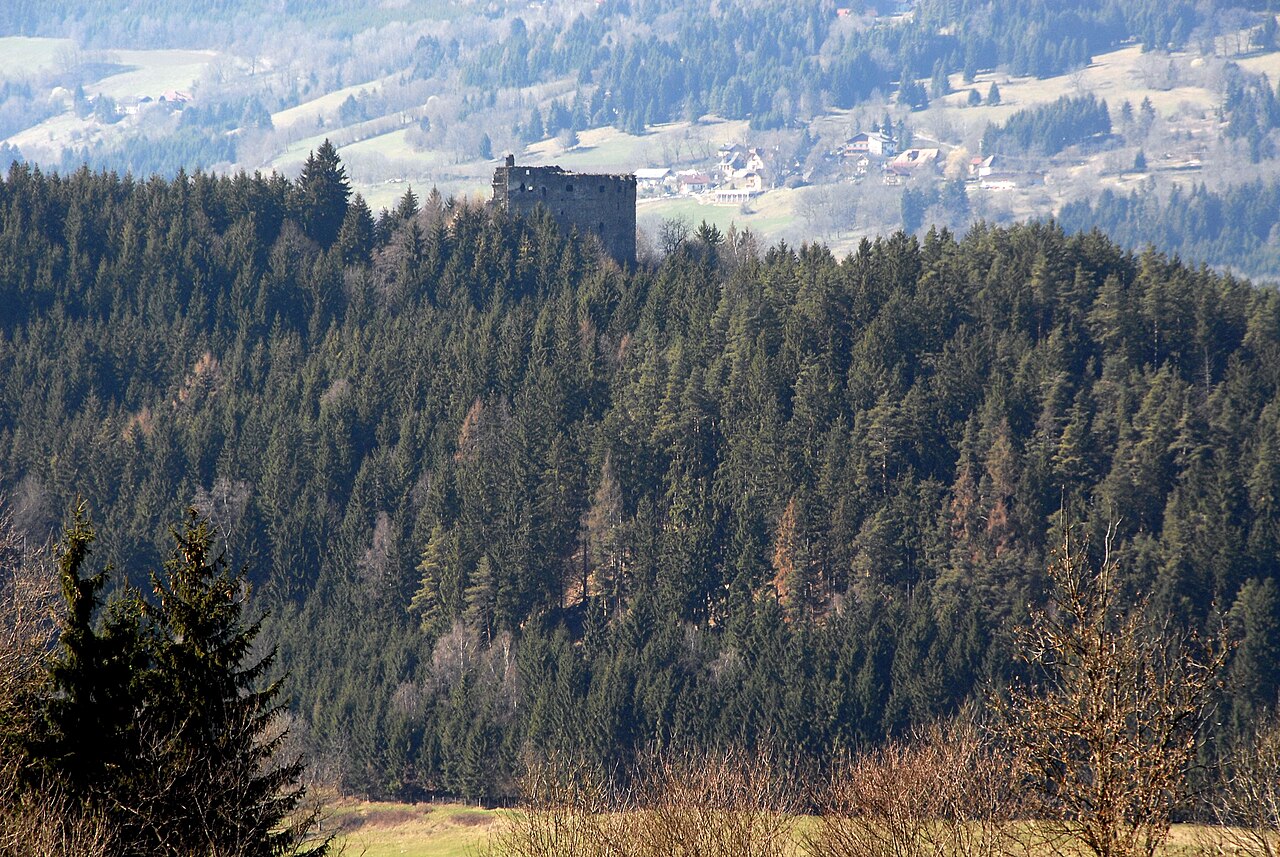
Wiesberg Castle
Wiesberg Castle is a remarkable medieval hill castle situated in the picturesque region of Carinthia, Austria. Perched strategically above the Trisanna River at the confluence of the Paznaun and Stanzer valleys, this historic fortress has witnessed centuries of regional power struggles, noble ownership, and military significance. The castle’s origins trace back to the 13th century, making it a valuable example of high medieval defensive architecture that evolved over time with Renaissance and later modifications.
Constructed initially by the Hochstift Chur, an influential ecclesiastical principality, Wiesberg Castle served as a key stronghold controlling important trade and military routes through the alpine valleys. The earliest documented owner, Hugo von Wiesberg, appears in records from 1271, confirming the castle’s medieval heritage. Over the centuries, it passed through the hands of several noble families, including the Ramüss ministeriales, the Counts of Tyrol, and the Rottenberger family, who held it until the early 15th century.
Historical significance and ownership
Throughout its history, Wiesberg Castle played a multifaceted role, serving both as a noble residence and a military fortress. During the Swabian War of 1499, the castle was a strategic defensive point for the Bündner and Swiss armies, underscoring its importance in regional conflicts and diplomacy. The castle’s ownership changed frequently in the 16th and 17th centuries, involving noble families such as the Schenk von Schenkenstein, von Freysing, von Haidenreich, and von Clary-Aldringen. These transitions reflect the castle’s contested status between ecclesiastical authorities like the Bishop of Chur and secular rulers in Tyrol.
In the early 19th century, during the Napoleonic Wars, the castle’s vicinity was a site of local militia defense against Bavarian and French troops in 1809. Later in the 19th century, ownership became complex with leasing and sales, including a notable transaction involving the Austrian State Railways for infrastructure development near the castle grounds.
In the final days of World War II, May 1945, Wiesberg Castle served as a base for armistice negotiations between the German Wehrmacht Army High Command 24 and American forces. Post-war, it remained under Allied supervision until 1950. Since the late 19th century, the castle has been privately owned by the Landfried family, who have undertaken significant preservation efforts.
Architectural features and layout
Medieval fortifications
The castle occupies a strategic rocky outcrop, commanding views of the surrounding valleys and river below. Its main defensive structure is the medieval curtain wall, locally known as the "Bering", constructed in the mid-13th century. This trapezoidal wall, built primarily of rubble stone with sections of distinctive opus spicatum (herringbone brickwork) on the western façade, reaches thicknesses of up to 2.7 meters, underscoring its defensive purpose.
Bergfried and residential buildings
Dominating the castle complex is the bergfried, a massive main tower with an almost square base measuring approximately 7.8 by 8.4 meters. The lower third of the bergfried consists of original medieval granite blocks, while the upper portions were restored and heightened in 1908, capped with a pyramid-shaped roof blending medieval and early 20th-century architectural elements.
Adjacent to the bergfried is the palas, a residential building dating from the 15th century. This structure provided living quarters for the castle’s noble occupants and is situated within the inner courtyard, which was protected by the surrounding curtain walls.
Defensive additions and chapel
Additional defensive features include a zwinger, an outer courtyard designed to trap attackers, which contains a rondel—a circular defensive tower—and embrasures dating from around 1500. Over time, the curtain wall was raised, concealing the original castle gate, now visible only from the exterior side.
Historically, the castle also housed a chapel in the northwest corner of the ring wall, constructed circa 1420. This chapel was deconsecrated in the late 19th century and demolished to make way for railway expansion, reflecting the impact of industrial development on historic sites.
Cultural importance and preservation
Wiesberg Castle stands as a testament to the medieval and Renaissance heritage of Carinthia. Its enduring structures illustrate the evolution of castle architecture from defensive stronghold to noble residence. The castle’s role in significant historical events, including the Swabian War and Napoleonic conflicts, highlights its strategic importance over centuries.
Today, the castle remains in private ownership by the Landfried family and is not open to the public. However, its well-preserved medieval walls, towers, and courtyard can be viewed from the nearby Silvretta-Hochalpenstraße, attracting interest from historians, architects, and visitors fascinated by alpine fortifications.
Extensive restoration efforts in the late 19th and early 20th centuries have helped maintain the castle’s structural integrity, particularly the bergfried and curtain walls. These efforts ensure that Wiesberg Castle continues to represent a significant cultural landmark within the alpine landscape of Carinthia.
Frequently asked questions (FAQ)
- Is Wiesberg Castle open to the public for visits?
- Wiesberg Castle is privately owned and not open to the public. However, visitors can view the castle from nearby vantage points such as the Silvretta-Hochalpenstraße.
- What is the historical significance of Wiesberg Castle?
- Wiesberg Castle played important roles in regional defense and diplomacy, notably during the Swabian War of 1499 and the Napoleonic Wars. It also served as a site for World War II armistice negotiations.
- What are the main architectural features of Wiesberg Castle?
- The castle features a medieval curtain wall with opus spicatum brickwork, a massive bergfried tower, a 15th-century palas residential building, and defensive structures like a zwinger and rondel.
- Where is Wiesberg Castle located and how can it be seen?
- Wiesberg Castle is located above the Trisanna River in Carinthia, Austria, at the junction of the Paznaun and Stanzer valleys. It can be seen from the Silvretta-Hochalpenstraße road.
- When was Wiesberg Castle built and by whom?
- Wiesberg Castle was built in the 13th century, likely by the Hochstift Chur, an ecclesiastical principality that controlled the region at the time.
Information
Current owner
Private owner
Loading map...
Visitor reviews
No reviews yet. Been here? Write the first review and help other travelers!
Write the first reviewVisited this castle? Share your experience
Your review helps other travelers and adds first-hand knowledge to our encyclopedia.