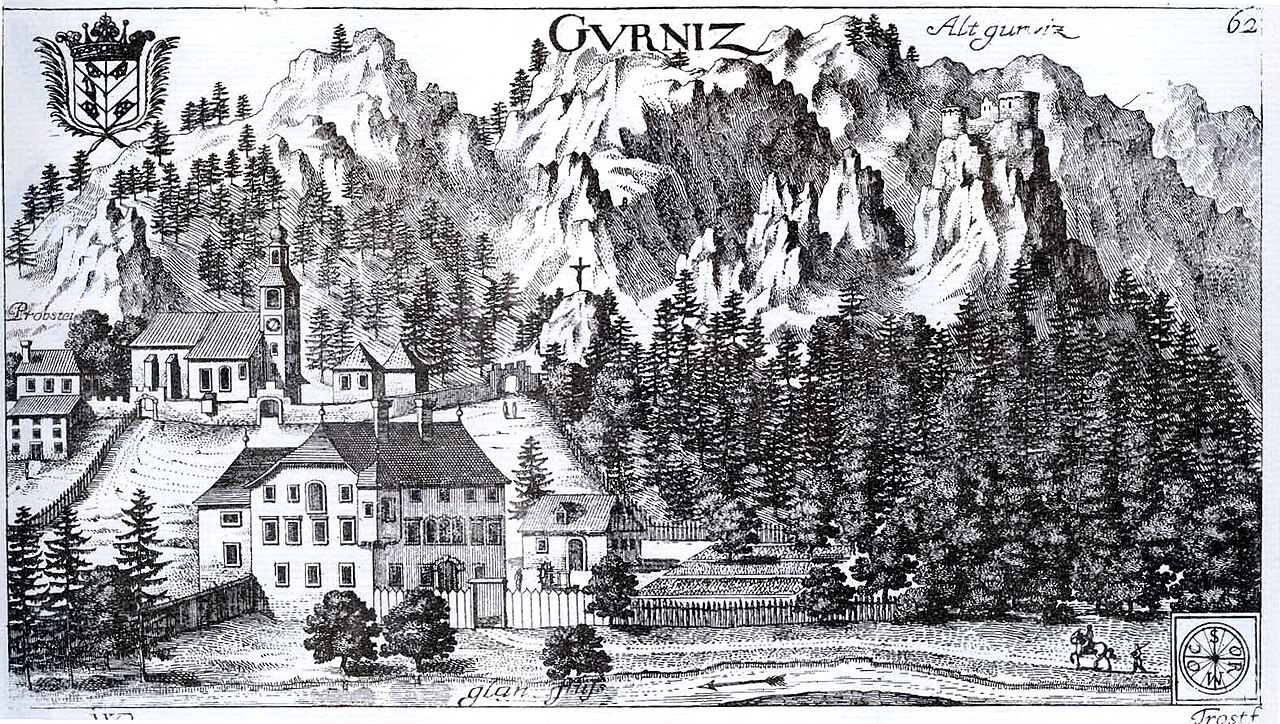
Burgruine Zeiselberg
Burgruine Zeiselberg is a notable medieval hilltop fortress located above the village of Čilberk within the municipality of Zeiselberg, Austria. Built in the 13th century, this castle served as a fortified residence for a local noble family during the High Medieval period. Its strategic position atop a hill approximately 600 meters above sea level provided commanding views over the surrounding landscape, including the village and agricultural fields below.
The history of Burgruine Zeiselberg
The earliest records link the castle to the noble family known as the Zeiselbergers (Čilberžani), who were ministeriales—unfree knights in service to the Dukes of Carinthia. This family, documented as early as 1202, was related to the prominent Freiberger lineage. The fortress itself is first mentioned in historical documents dating to 1250, confirming its ownership by the Zeiselberger lords.
Albert de Zeyselberg, son of Heinricus Ziesel, played a significant role in the castle's development during the latter half of the 13th century. He undertook substantial reconstruction efforts, enhancing the fortress's defensive and residential features. Albert was a prominent figure in Carinthian society, holding important offices such as ducal cupbearer and supreme judge between 1267 and 1269.
The male line of the Zeiselberg family ended in the 1270s. After Albert's death, his widow Aleiza was compelled to return certain properties alienated by her husband, a process completed before her own death. In 1292, Aleiza's sons-in-law participated in a rebellion against the ruling Habsburg dynasty. The uprising was suppressed, and in May 1293, the castle was besieged and destroyed. Historical evidence suggests that Burgruine Zeiselberg was not rebuilt after this event.
By the 15th century, the site came under the ownership of the Mordax family, a group of emerging local nobles. Later, in 1493, Emperor Frederick III granted the estate to the Siegendorfer family. Following this transfer, references to the castle cease, indicating that it likely fell into disuse and ruin during this period.
Modern preservation efforts began in 1989 under the stewardship of Kurt Zechner, the current landowner. Local organizations have supported archaeological excavations and conservation work, which have greatly enhanced understanding of the castle's historical significance and architectural layout.
Architectural features and layout
The ruins of Burgruine Zeiselberg occupy a compact hilltop site with a defensive design typical of High Medieval hill castles. The fortress is enclosed by an irregular oval ring wall that gives the site an egg-like shape. This wall was complemented by a wide neck ditch on the northern and western sides, which cut off direct access and enhanced the natural defensive advantages of the hill.
Entry was controlled through a gate on the eastern side, leading into a modest courtyard. Adjacent to this entrance stood the palas, a residential building composed of two main rooms. This structure served as the primary living quarters within the castle.
Supporting buildings surrounded the palas, fulfilling domestic and economic functions. To the northwest lay a smithy for metalworking, a critical activity for maintaining weapons and tools. Nearby was a cistern equipped with a filtration system, an advanced feature for securing clean water supply within the fortress walls.
Opposite the main gate, the castle's bergfried tower was positioned prominently. This tall fortified tower functioned both as a lookout point and a final refuge in case of attack. Although the original walls survive only up to knee height, reconstructions have restored the tower to approximately eight meters.
The western side of the castle featured a second smithy, underscoring the importance of metalworking in the castle's economy. Additional buildings were arranged near the eastern gate, supporting the daily operations of the fortress.
An external chapel was attached to the ring wall, accessible via two staircases. This chapel likely served the spiritual needs of the inhabitants while maintaining separation from the main residential areas.
Archaeological findings and cultural significance
Excavations at Burgruine Zeiselberg have uncovered a wealth of artifacts that provide insight into the daily life of its medieval occupants. Finds include horseshoes, belt buckles, and crossbow bolts, reflecting the martial and domestic activities within the castle.
One of the most remarkable discoveries is a distillation apparatus (alembic), suggesting that the castle's inhabitants engaged in early forms of medicine or alchemy. The relatively short period of occupation and limited later disturbance have preserved these artifacts in excellent condition, offering a rare snapshot of 13th-century castle life.
Burgruine Zeiselberg stands as a valuable cultural heritage site, illustrating the architectural and social history of medieval Carinthia. Its ruins, defensive structures, and archaeological record contribute significantly to the understanding of regional noble life, military architecture, and medieval craftsmanship.
Visiting Burgruine Zeiselberg
Today, the castle ruins are accessible to visitors interested in medieval history and archaeology. The site offers panoramic views from its elevated position and a tangible connection to the turbulent history of the region. Preservation efforts continue to maintain the ruins and facilitate educational opportunities for the public.
Frequently asked questions (FAQ)
- How do I get to Burgruine Zeiselberg?
- Burgruine Zeiselberg is located above the village of Čilberk in the municipality of Zeiselberg, Austria. Visitors can reach the site by hiking trails from the village, enjoying scenic views along the way. It is advisable to check local maps or guides for the best access routes.
- What is the historical significance of Burgruine Zeiselberg?
- Burgruine Zeiselberg was a 13th-century hilltop fortress belonging to the Zeiselberger noble family, who served the Dukes of Carinthia. Its destruction in 1293 following a rebellion against the Habsburgs marks an important episode in regional medieval history.
- Can I explore the ruins of Burgruine Zeiselberg?
- Yes, the ruins are accessible to visitors. While the site is mostly in ruins, some reconstructed sections like the bergfried tower offer insight into the castle's original structure. Visitors should wear appropriate footwear and be cautious on uneven terrain.
- When is the best time to visit Burgruine Zeiselberg?
- The best time to visit is during late spring to early autumn when weather conditions are favorable for hiking and outdoor exploration. This period also offers the most pleasant views of the surrounding landscape.
- Is there an entrance fee to visit Burgruine Zeiselberg?
- There is no entrance fee to visit the ruins of Burgruine Zeiselberg. It is an open site accessible to the public year-round, although visitors should verify local conditions before planning their trip.
Information
Current owner
Private owner
Loading map...
Visitor reviews
No reviews yet. Been here? Write the first review and help other travelers!
Write the first reviewVisited this castle? Share your experience
Your review helps other travelers and adds first-hand knowledge to our encyclopedia.