Whittington Castle
Whittington Castle stands as a remarkable example of a high medieval hill castle located in the village of Whittington, England. Originally established as a motte-and-bailey fortress, it was extensively rebuilt in the 13th century into a stone castle featuring a courtyard enclosed by a curtain wall, reflecting the evolving military architecture of the period. The castle's strategic position near the Welsh border, adjacent to the historic Offa's Dyke, underscores its importance as a defensive stronghold during centuries of Anglo-Welsh conflict.
The earliest fortifications likely date from around 1138, during the civil war known as The Anarchy, when William Peverel constructed defenses supporting Empress Matilda against King Stephen. Although the site may have had some form of fortified presence earlier, no conclusive evidence exists for prehistoric or Anglo-Saxon occupation beyond documentary references to a "castle" in the late 8th and 9th centuries. The Domesday Book of 1086 records Whittington (then Wititone) as a royal manor with agricultural assets but makes no mention of a castle.
Medieval origins and the fitzwarin legacy
The castle's definitive history begins in the 12th century, when it was a timber motte-and-bailey structure, possibly with a strong tower keep. By the late 12th century, under the reign of Henry II, the castle was repaired and fortified, with Roger de Powys receiving royal aid in 1173 for its upkeep. In 1204, the lordship passed to the FitzWarin family, who would control the castle for over two centuries. The FitzWarins were a prominent noble family with estates across England, including the nearby Alberbury Castle, which shares architectural similarities with Whittington.
In 1221, a Licence to Crenellate was granted, permitting the FitzWarins to fortify the castle with stone walls and towers. This led to the construction of a substantial stone inner bailey, featuring five towers on a raised platform surrounded by a moat, and an outer gatehouse or barbican. These enhancements significantly improved the castle's defensive capabilities against Welsh raids and sieges.
Sieges and border conflicts
The castle endured significant military challenges, notably the siege and partial destruction by Llywelyn the Great in 1223. Despite this, Whittington was restored and remained a key border fortress throughout the 13th century. In 1265, it briefly came under the control of Llewelyn, Prince of Wales, before returning to English hands in 1282 following Edward I's conquest of Wales.
Throughout the late medieval period, the castle's military importance waned as the border stabilized. The FitzWarins transitioned the castle into a noble residence, although maintenance declined over time. Reports from the 14th and early 15th centuries describe the castle in need of repair, with intermittent attacks during Welsh uprisings, including the rebellion of Owain Glyndŵr around 1405.
Post-medieval decline and changes in ownership
After the death of the last male FitzWarin in 1420, ownership passed through marriage to the Hankeford and later the Bourchier families. By the mid-16th century, under John Bourchier, 2nd Earl of Bath, the castle was exchanged with King Henry VIII, who likely allowed it to fall into disuse. A survey from this era noted significant decay, and the castle ceased to be a permanent residence.
During the English Civil War in the 1640s, the castle was attacked by Parliamentarian forces using cannon fire. The damage was severe, and no restoration followed. Subsequently, parts of the castle were dismantled for local building projects, including road repairs and forge construction. By the 18th century, several towers had collapsed, and the site was partially landscaped as a garden with pebble walks and ornamental structures.
Restoration and modern preservation
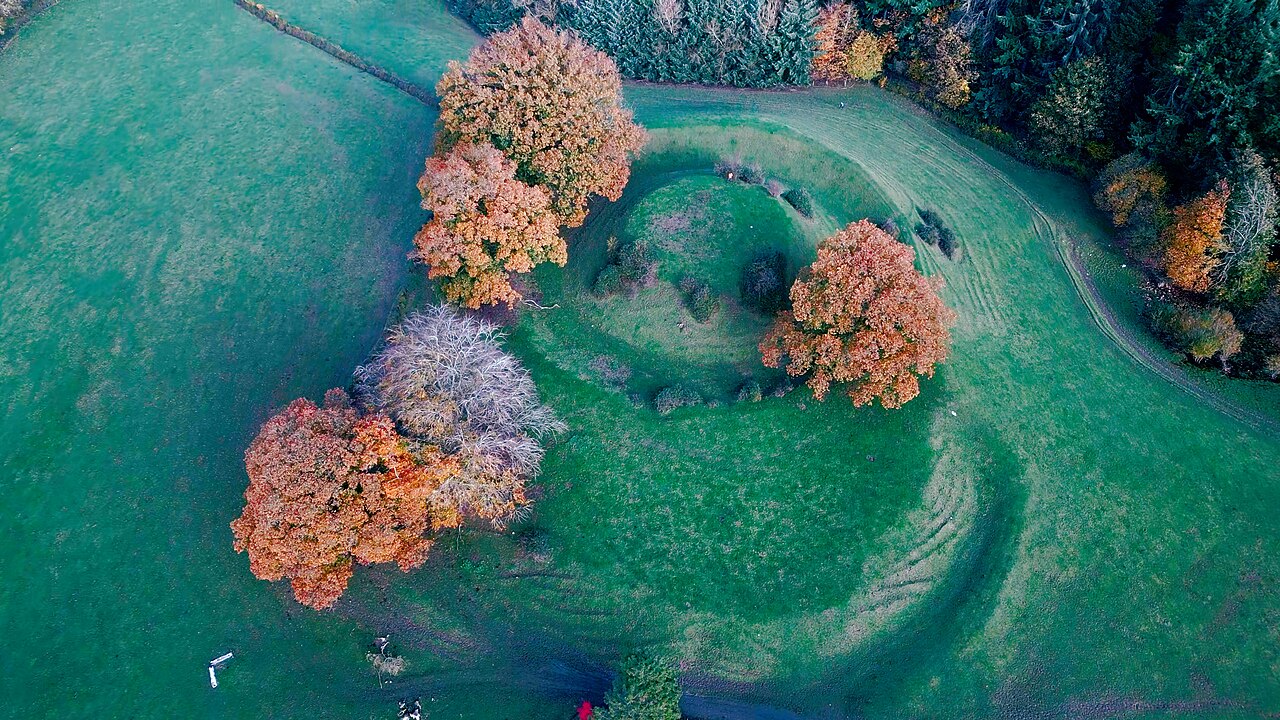
In the early 19th century, the gatehouse was restored by the Lloyd family, who acquired the property in the 17th century and remain its owners. The gatehouse served as a farmhouse and later a private residence. Excavations in 2003 uncovered the remains of two 14th-century water-surrounded gardens within the outer bailey, notable for their advanced design and a central viewing mound, possibly the oldest known in England.
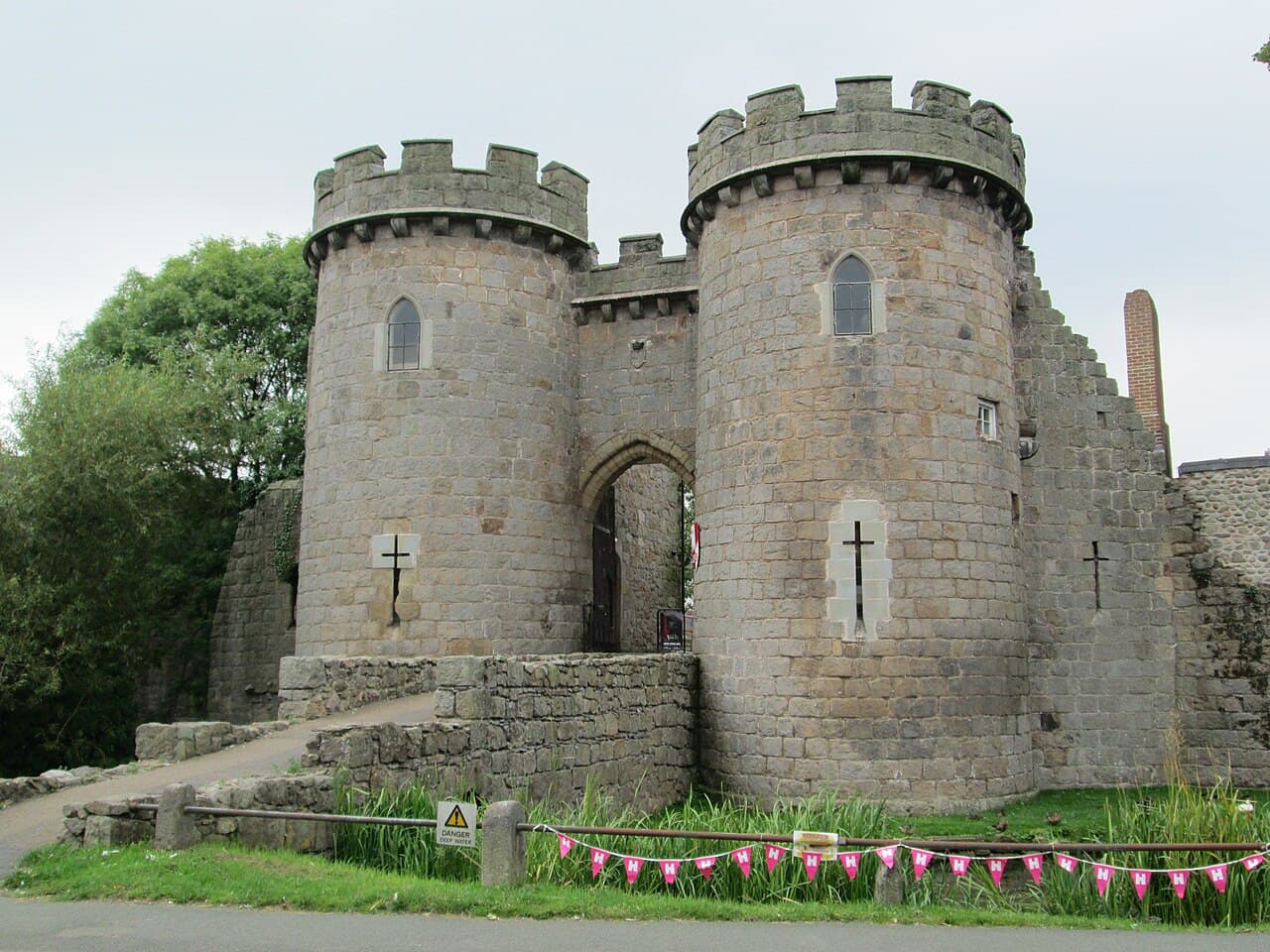
Today, Whittington Castle is a partially preserved ruin encompassing approximately twelve acres. Conservation efforts by the Whittington Castle Preservation Trust have stabilized key structures, including the gatehouse and curtain walls. The FitzWarin family coat of arms remains prominently displayed above the castle archway, symbolizing the enduring historical identity of the site.
Architectural features and layout
The castle's 13th-century stone reconstruction replaced the earlier timber motte-and-bailey with a more formidable design. The inner bailey was enclosed by a curtain wall incorporating five towers strategically positioned on a raised platform. A moat surrounded this inner ward, enhancing its defense. The outer gatehouse or barbican controlled access to the castle, reflecting typical border fortress architecture.
The discovery of the water gardens within the outer bailey reveals a sophisticated approach to landscaping and leisure, uncommon for English castles of the period. These gardens, enclosed by water channels, included a central mound used for viewing, reflecting a blend of military and domestic functions within the castle complex.
Legend and cultural significance
A notable legend associates Whittington Castle with the Holy Grail, purportedly kept in a private chapel during the time of Sir Fulk FitzWarin. While this story remains part of local folklore, it highlights the castle's cultural resonance beyond its military and residential roles. The FitzWarin coat of arms displayed above the castle archway continues to connect the site with its medieval heritage.
Visiting and conservation today
Whittington Castle remains a significant heritage site in England's borderlands, attracting visitors interested in medieval history, architecture, and legends. The site is accessible to the public, with ongoing preservation efforts ensuring the stability of its ruins. Visitors can explore the gatehouse, curtain walls, and the surrounding grounds, gaining insight into the castle's strategic importance and the lifestyle of its medieval inhabitants.
Interpretive materials and guided tours often highlight the castle's role in border conflicts, its architectural evolution from timber to stone, and its connection to the FitzWarin family. The preservation trust continues to work on maintaining the site, balancing public access with conservation needs.
Frequently asked questions (FAQ)
- When was Whittington Castle originally built?
- Whittington Castle was originally constructed as a motte-and-bailey castle around 1138 during the civil war known as The Anarchy.
- What architectural style characterizes Whittington Castle?
- The castle primarily exhibits high medieval military architecture with stone curtain walls, towers, and a moat typical of 13th-century border fortresses.
- Can visitors explore the interior of Whittington Castle?
- Visitors can explore the ruins including the gatehouse, curtain walls, and grounds, but much of the castle remains a partially preserved ruin without full interior access.
- Is there any legend associated with Whittington Castle?
- Local legend claims the Holy Grail was kept in a private chapel at Whittington Castle during Sir Fulk FitzWarin’s time, adding cultural mystique to the site.
- What is the best time of year to visit Whittington Castle?
- Spring through early autumn offers the best visiting conditions with mild weather and open grounds suitable for exploring the castle ruins.
- Are there any conservation efforts ongoing at Whittington Castle?
- Yes, the Whittington Castle Preservation Trust actively maintains and stabilizes the ruins to preserve the site for future generations.
- How can I get to Whittington Castle?
- Whittington Castle is located in the village of Whittington, England, accessible by local roads and public transport from nearby towns such as Oswestry.
Photo gallery

Information
Sources & official resources
Verify the information above using these authoritative references.
Loading map...
Visitor reviews
No reviews yet. Been here? Write the first review and help other travelers!
Write the first reviewVisited this castle? Share your experience
Your review helps other travelers and adds first-hand knowledge to our encyclopedia.