Chirk Castle
Chirk Castle is a remarkable Grade I listed medieval fortress situated near the town of Chirk in Wales. Constructed in 1295 by Roger Mortimer de Chirk, the castle was part of King Edward I's chain of fortresses designed to consolidate English control over northern Wales. Its strategic location guards the entrance to the Ceiriog Valley, a key border area during the turbulent medieval period. The castle's imposing stone walls, towers, and defensive features illustrate the military architecture of the High Medieval era, while later additions and restorations reflect evolving tastes and functions through the centuries.
Owned by the National Trust, Chirk Castle is open to the public and renowned not only for its impressive fortifications but also for its extensive and beautifully maintained gardens. These gardens include clipped yew hedges, herbaceous borders, rock gardens, and terraces, all set within an 18th-century parkland that was originally laid out as a deer park in the 14th century. The surrounding landscape features significant historic elements such as Offa's Dyke, an ancient earthwork marking the Anglo-Welsh border, which runs close to the castle grounds.
Medieval origins and strategic importance
The origins of Chirk Castle trace back to a wooden fortification established around 1157 under the reign of King Henry II. This early stronghold was held by the Welsh prince Iorwerth Goch and was part of the contested borderlands between England and Wales. The timber defenses were renewed in 1212 during King John's campaigns, but the wooden castle eventually gave way to the stone fortress commissioned by Roger Mortimer de Chirk in 1295. This stone castle was a vital component of Edward I's military strategy, designed to secure English dominance in Wales through a network of formidable castles.
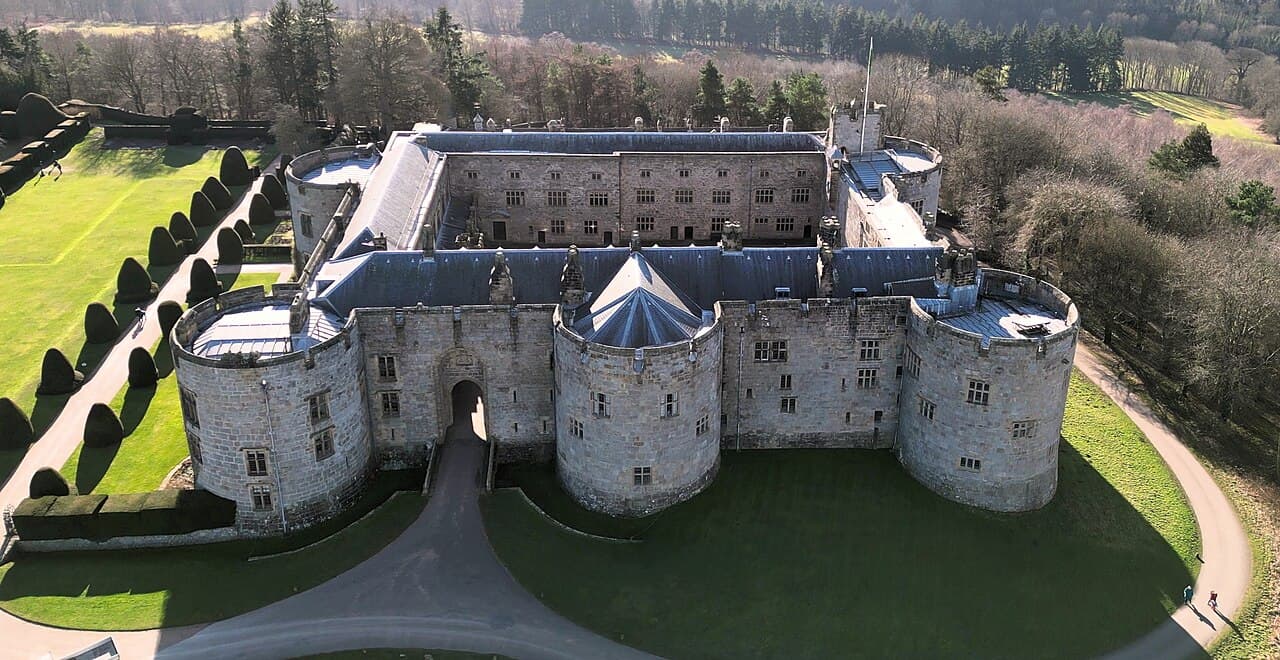
The design of Chirk Castle is believed to have been influenced by the royal architect James of St. George, who was responsible for several of Edward I's Welsh castles, including the nearby Beaumaris Castle. The castle's rectangular layout is enclosed by thick curtain walls, rounded corner towers, and semicircular towers along the sides, providing strong defensive capabilities typical of the High Medieval period.
Castle layout and defensive features
The castle's curtain walls form a robust perimeter with five finished towers on the northern half, including the notable Adam's Tower with walls up to five meters thick housing the original dungeon. The southern half of the castle was left incomplete and later sealed off with a straight wall around 1400. Unlike many contemporaneous fortresses, Chirk Castle lacks a massive gatehouse, instead featuring a simple northern gateway protected by portcullises and flanked by defensive towers, controlling access to the inner courtyard.
Residential buildings developed progressively along the interior faces of the curtain walls. Medieval latrines remain on the western side, marking where timber-framed houses once stood. The southeast corner contains a late 14th-century stone chapel and adjoining hall, restored in the 19th century and later converted into a music room. The south wing, originally timber-framed and dating to around 1529, was remodeled in the 18th century, while the north wing, built circa 1600 by Sir Thomas Myddelton, includes halls, kitchens, and salons suitable for country living.
Historical significance and ownership
Chirk Castle served as the administrative center of the Marcher Lordship of Chirkland, a critical border territory during medieval times. It witnessed conflict such as its capture by the Welsh leader Gruffydd Llwyd in 1322. Ownership passed to the Myddelton family in 1595, when Thomas Myddelton, a prominent London merchant and founding member of the East India Company, acquired the castle and adapted it for residential use.
The castle endured significant damage during the English Civil War in the mid-17th century. The son of Thomas Myddelton switched sides, leading to the castle's siege and partial destruction by artillery and fire in 1659. After the restoration of the monarchy, the Myddeltons rebuilt the damaged structures, adding an east wing with a long gallery and arcaded courtyard between 1672 and 1678. Architect William Wynde contributed to these renovations, which balanced defensive needs with domestic comfort.
Subsequent centuries saw further modifications, including Georgian-era updates and a Gothic Revival makeover in the 19th century. The renowned Victorian architect Augustus Pugin was involved in the 1845 remodeling, introducing medieval-inspired details that enhanced the castle's historic character.
20th-century use and preservation
In the 20th century, the castle was leased by Thomas Scott-Ellis, 8th Baron Howard de Walden, from 1911 to 1946, who supported Welsh cultural activities. During World War II, parts of the castle served as shelter for evacuees. In 1978, ownership transferred to the National Trust, ensuring its preservation and public accessibility, while the Myddelton family retained some surrounding lands.
Architectural and interior highlights
The castle's interiors reflect its layered history. The Cromwell Hall, originally a dining hall, features renovations from the Georgian and Gothic Revival periods and houses an important collection of Civil War-era weapons. The interior also includes a stone staircase with an ornate wrought-iron balustrade designed by Joseph Turner in the late 1770s.
Notable rooms include a Georgian dining room and salon decorated with tapestries and a coffered ceiling painted by George Mullins, a drawing room remodeled in 1845, and the Long Gallery, a 30-meter-long passage typical of grand country houses from the late 17th century.
Gardens and parkland
The castle is surrounded by formal gardens spanning approximately two hectares. These gardens feature clipped yew hedges, shaped shrubs, flower beds, and a wooded pleasure ground. A 17th-century sundial stands in the rose garden, while an 18th-century ha-ha on the eastern terrace provides unobstructed views over the landscape towards Cheshire and historic Salop.
The broader estate covers about 194 hectares of parkland, including ancient oak woods, pasturelands supporting wild ponies and sheep, and well-preserved sections of Offa's Dyke. Several garden buildings from the 18th and 19th centuries remain, such as the thatched Hawk House, Deerpark Lodge, and two New Hall Lodges.
The main eastern entrance to the estate is marked by an impressive set of wrought-iron gates and a decorative screen crafted between 1712 and 1719 by Robert and John Davies of Bersham. Originally located at the castle's main gate, these gates were relocated in 1888 and display the Myddelton family coat of arms along with ornate motifs. Their craftsmanship rivals the famous ironwork of Hampton Court Palace by Jean Tijou.
Nearby, the Llwyn-y-cil Lodge, a Tudor-style half-timbered building constructed in 1888, stands as a Grade II listed structure, adding to the estate's historic charm.
Archaeological and cultural significance
The proximity of Offa's Dyke to the castle grounds highlights the site's long-standing role as a frontier between England and Wales. Excavations by the Clwyd-Powys Archaeological Trust in 2017 and 2018 uncovered substantial remains of the dyke, preserved in part by the parkland landscaping. The nearby Oak at the Gate of the Dead commemorates the 1165 Battle of Crogen, underscoring the area's rich martial history.
Chirk Castle remains a vital cultural and historical landmark, embodying centuries of military, architectural, and social evolution. Its preservation by the National Trust allows visitors to explore a well-maintained example of High Medieval military architecture blended with later residential adaptations and exquisite gardens, offering a comprehensive glimpse into Welsh and English border history.
Frequently asked questions (FAQ)
- How do I get to Chirk Castle?
- Chirk Castle is easily accessible by car, located just off the A5 road in Chirk, Wales. If you're traveling by public transport, the nearest train station is Chirk, which is approximately a 20-minute walk from the castle.
- What is the historical significance of Chirk Castle?
- Chirk Castle was built in the late 13th century as a border fortress by Roger Mortimer. It played a vital role in the conflicts between England and Wales and has since been a family home for over 700 years, showcasing its rich history.
- When was Chirk Castle built?
- Chirk Castle was constructed between 1295 and 1310, making it one of the last great medieval fortresses in Britain. Its design reflects the military architecture of the time, adapted for defense against Welsh attacks.
- Can I take guided tours of Chirk Castle?
- Yes, guided tours of Chirk Castle are available, providing visitors with insights into its history, architecture, and the stories of the families who lived there. Audio guides are also available for those who prefer to explore at their own pace.
- Why is Chirk Castle famous for its architecture?
- Chirk Castle is renowned for its impressive medieval architecture, including its thick stone walls, impressive towers, and beautiful gardens. The castle’s design blends functionality with aesthetic appeal, showcasing the craftsmanship of the era.
- Is it possible to access the gardens at Chirk Castle?
- Yes, the gardens at Chirk Castle are accessible to all visitors and are a highlight of the estate. The landscaped gardens feature stunning views, formal gardens, and a woodland area, perfect for a leisurely stroll.
- What are the opening hours for Chirk Castle?
- Chirk Castle is typically open to visitors from 10 AM to 5 PM, but hours may vary seasonally. It is advisable to check the official website for the most current opening times before your visit.
- What are the ticket prices for visiting Chirk Castle?
- Ticket prices for Chirk Castle vary depending on age and visitor category, with discounts available for families and groups. It is best to purchase tickets online in advance to secure your entry and take advantage of any special offers.
- When is the best time to visit Chirk Castle?
- The best time to visit Chirk Castle is during the spring and summer months when the gardens are in full bloom and the weather is generally pleasant. Additionally, various events and activities are often scheduled during this time, enhancing the visitor experience.
- Are there any nearby attractions to Chirk Castle?
- Yes, there are several nearby attractions including the stunning Pontcysyllte Aqueduct and the scenic Ceiriog Valley. Visitors can also explore the historic town of Llangollen, known for its picturesque views and vibrant arts scene.
Photo gallery

Information
Website
Visit websiteSources & official resources
Verify the information above using these authoritative references.
Loading map...
Visitor reviews
No reviews yet. Been here? Write the first review and help other travelers!
Write the first reviewVisited this castle? Share your experience
Your review helps other travelers and adds first-hand knowledge to our encyclopedia.