Castell Dinas Bran
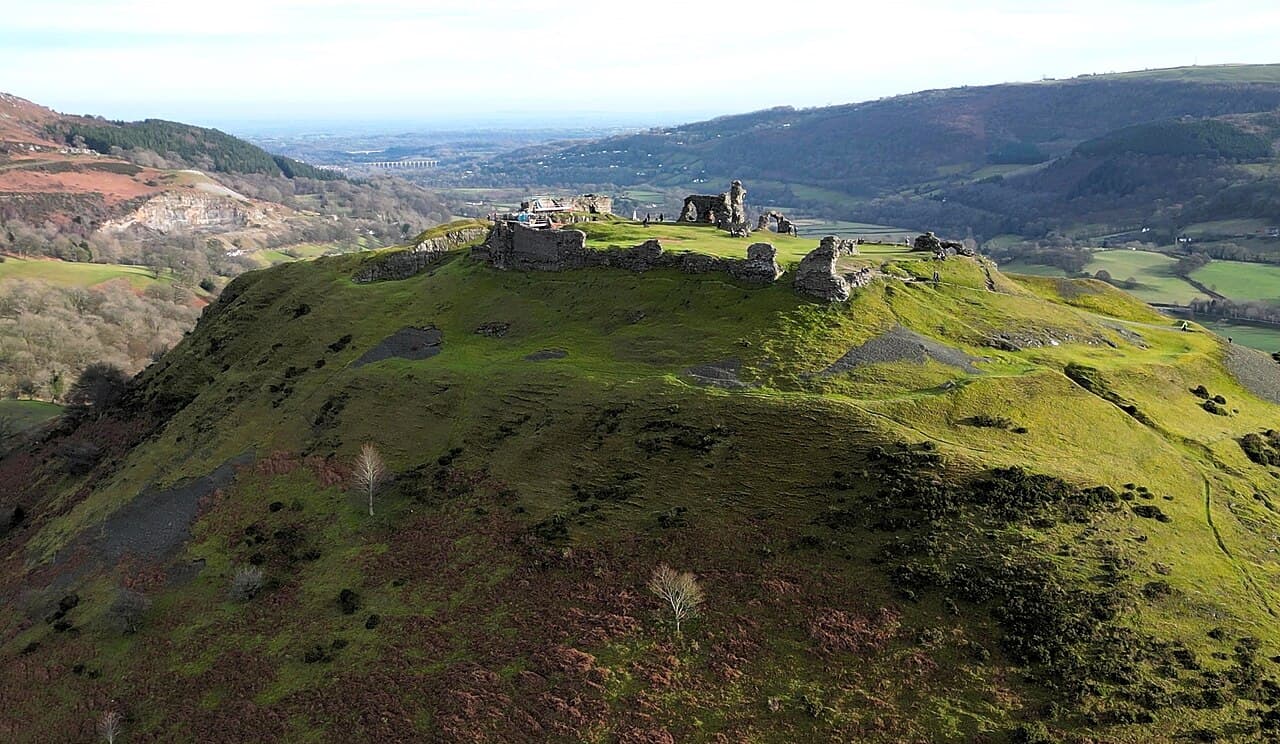
Castell Dinas Bran stands as a striking medieval fortress perched atop a prominent hill overlooking the town of Llangollen in Denbighshire, Wales. Its evocative ruins tell a story that stretches back over two millennia, from its origins as an Iron Age hillfort to its role as a 13th-century stronghold of the Welsh princes. The castle's name, often translated as "The City of Crows," is a subject of historical debate, with interpretations ranging from "the crow's fortress" to references to legendary Welsh figures or local geography. This rich tapestry of meanings reflects the castle's deep cultural and historical significance in the Welsh landscape.
Early history and iron age origins
The site of Dinas Bran was first fortified around 600 BCE by the Celtic tribe known as the Ordovices. This early hillfort featured extensive earthworks and wooden defenses that utilized the natural topography to protect the southern slopes of the hill. The location's strategic importance was recognized early, commanding panoramic views of the surrounding valleys and controlling key routes through the landscape.
During the early medieval period, the site is believed to have hosted a wooden fortification linked to Elisedd ap Gwylog, a Romano-British ruler credited with founding the kingdom of Powys. Although no direct archaeological remains from this era have been uncovered, historical tradition and the Pillar of Eliseg inscription suggest a continuity of occupation and defensive use through the 8th century.
Construction and architectural features of the medieval castle
The stone castle visible today was constructed in the 1260s by Gruffydd Maelor II, prince of Powys Fadog. This period was marked by political tension as Welsh princes sought to maintain autonomy against the expanding power of the English crown under Edward I. The castle served both as a military stronghold and an administrative center within the border principality.
Castell Dinas Bran is classified as a hill castle, strategically utilizing the natural defenses of the hill. The castle's layout is a rectangular enclosure aligned along an east-west axis. The northern side benefits from a sheer cliff dropping several hundred feet, providing a formidable natural barrier. In contrast, the southern and eastern sides feature a deep, approximately 20-foot rock-cut ditch and an earthen counterscarp bank, enhancing the man-made defenses.
The castle walls, built from locally quarried stone, enclose several key structures. The keep, located at the south-eastern corner, is a robust two-storey stone building overseeing the most accessible approach from the River Dee valley. Adjacent to the keep on the north-eastern corner is the gatehouse, flanked by two towers. This gatehouse was originally accessed via a wooden bridge spanning the defensive ditch, allowing defenders to control entry effectively.
The gatehouse passage was covered and featured defensive elements such as arrow slits, enabling archers to protect the entrance. Along the southern curtain wall lies the Great Hall, distinguished by enlarged windows facing the valley, which provided light and commanding views. At the western end of the hall, an arched gateway leads to the former kitchens, situated beneath the adjacent Welsh Tower.
The Welsh Tower is a distinctive D-shaped (apsidal) tower projecting into the defensive ditch. Rising three stories, it contained living quarters and offered a clear line of fire along the southern wall, enhancing the castle's defensive capabilities. In the south-west corner, a postern gate served as a sally port, a secret exit used during sieges. Remnants of its arch and door drawbar slot remain visible today.
Within the walls, wooden buildings such as stables, workshops, storage facilities, and possibly a chapel once stood, though no above-ground traces survive. Local tradition also mentions a tower at Tower Farm, about a mile from the castle, which may have functioned as an outwork, though this remains unconfirmed archaeologically.
Historical significance and decline
The castle's construction by Gruffydd Maelor II coincided with the height of Welsh resistance to English expansion. Following his death around 1270, his four sons inherited the castle. In 1277, during Edward I's campaign to conquer North Wales, the defenders abandoned Dinas Bran, setting it ablaze to prevent its use by English forces. The English repaired the castle and garrisoned it briefly until the Treaty of Aberconwy later that year.
The castle's role during the subsequent 1282 conflict is less documented, but it likely fell under English control. The nearby Holt Castle on the Flintshire-Cheshire border became the preferred stronghold, leading to Dinas Bran's gradual abandonment. Over the centuries, it fell into ruin, ceasing to function as a military or residential site.
Despite its ruinous state, Castell Dinas Bran inspired Romantic artists such as J. M. W. Turner and Richard Wilson, who captured its dramatic silhouette overlooking the Dee Valley, cementing its place in cultural heritage.
Geology and natural setting
The castle is situated on a hill rising over 300 meters above sea level, composed primarily of Silurian marine mudstones. The stone used in the castle's construction was quarried on site, integrating the fortress seamlessly into its natural environment. The defensive ditches, cut directly into the rock, served as formidable obstacles to attackers.
The surrounding geology is notable for preserving fossils of ancient sea creatures, including nautiloids, brachiopods, and trilobites. These fossils can sometimes be found in the rubble below the castle slopes, adding a unique paleontological dimension to the site.
Visiting castell dinas bran today
Today, Castell Dinas Bran is a popular destination for visitors interested in Welsh history, medieval architecture, and scenic landscapes. The castle's ruins offer spectacular views over the Dee Valley and the surrounding countryside. The site is accessible by footpaths from Llangollen, with the crow statue along the path serving as a modern homage to the castle's evocative name.
Visitors can explore the remains of the walls, towers, gatehouse, and other defensive features, gaining insight into medieval military architecture and the turbulent history of the Welsh Marches. The castle's elevated position and dramatic setting make it a favored subject for photographers and history enthusiasts alike.
Frequently asked questions (FAQ)
- How do I get to Castell Dinas Bran?
- Castell Dinas Bran is located just outside Llangollen, in Wales. You can reach it by car, with nearby parking available, or by taking a scenic walk from the town center, which takes about 30 minutes. Public transport options are limited, so driving or walking are the best ways to visit.
- What is the historical significance of Castell Dinas Bran?
- Castell Dinas Bran dates back to the 13th century and was built by the Welsh prince Gruffudd ap Gwenwynwyn. It played a crucial role in the struggles between the Welsh and the English during its time. The castle is not only a symbol of Welsh heritage but also offers stunning views of the surrounding landscape, reflecting its strategic importance.
- When was Castell Dinas Bran built?
- Construction of Castell Dinas Bran began in the late 1200s, specifically around 1260. The castle was established to control the surrounding area and to serve as a stronghold for the local lord. Though it fell into ruin over the centuries, its remains still tell the story of its tumultuous past.
- Can I visit Castell Dinas Bran year-round?
- Yes, Castell Dinas Bran is open to visitors year-round, but be aware that access may be restricted during adverse weather conditions for safety reasons. The best time to visit is during spring and summer when the weather is generally milder and the views are most spectacular. Always check local weather updates before your visit.
- Why is Castell Dinas Bran a popular tourist attraction?
- Castell Dinas Bran is popular due to its rich history, breathtaking views, and picturesque setting. Visitors are drawn not only to its historical significance but also to the surrounding natural beauty of the Welsh countryside. The castle's dramatic ruins and hiking opportunities make it a favorite for both history enthusiasts and nature lovers.
- Is it possible to access the castle with limited mobility?
- The path to Castell Dinas Bran involves a steep walk, which may be challenging for visitors with limited mobility. While the castle itself is not fully accessible, there are viewpoints along the way that offer beautiful scenery without the steep ascent. It is advisable to check with local visitor centers for further accessibility options.
- What are the opening hours for Castell Dinas Bran?
- Castell Dinas Bran is accessible at all times, as it is an open site. However, visitor facilities and information centers in Llangollen may have specific opening hours that vary seasonally. It is recommended to plan your visit during daylight hours for the best experience.
- Are there any ticket prices for visiting Castell Dinas Bran?
- There is no admission fee for visiting Castell Dinas Bran, as it is a heritage site maintained by the local community. However, donations are appreciated to help with the upkeep of the site. This makes it an affordable option for families and history buffs alike.
- What nearby attractions should I visit while in Llangollen?
- While in Llangollen, you can explore the beautiful River Dee, the Llangollen Railway, and the stunning Pontcysyllte Aqueduct, which is a UNESCO World Heritage site. Additionally, the town offers charming shops, cafes, and the historic Llangollen Town Hall. Each of these attractions complements a visit to Castell Dinas Bran, providing a full day of exploration.
Photo gallery

Information
Website
Visit websiteSources & official resources
Verify the information above using these authoritative references.
Loading map...
Visitor reviews
No reviews yet. Been here? Write the first review and help other travelers!
Write the first reviewVisited this castle? Share your experience
Your review helps other travelers and adds first-hand knowledge to our encyclopedia.