White Castle
White Castle is a prominent Norman hill castle located near the village of Llantilio Crossenny in Wales, United Kingdom. It stands on a commanding low hill overlooking the Monnow valley, approximately 157 meters above sea level, and is renowned for its distinctive white-rendered exterior walls which inspired its modern name. The castle forms part of the historic "Three Castles" alongside Grosmont and Skenfrith, which together played a crucial role in controlling the volatile Welsh Marches during the Middle Ages.
Originally established in the wake of the Norman invasion of England in 1066, White Castle was likely commissioned by William fitz Osbern, Earl of Hereford, to secure the strategic route between Wales and the English town of Hereford. The initial fortification was a classic motte-and-bailey style earth and timber castle, comprising three large earthworks with timber defenses. These early fortifications were designed to assert Norman control over the region and to defend against Welsh uprisings.
Historical development and strategic importance
In 1135, following a major Welsh revolt, King Stephen organized the defense of this border area by grouping White Castle with Grosmont and Skenfrith to form the "Three Castles" lordship. This triad of fortresses was intended to strengthen English authority and provide a defensive network against Welsh attacks. Throughout the 12th and 13th centuries, White Castle changed hands multiple times, reflecting the turbulent politics of the Welsh Marches.
In 1201, King John granted the castle to the influential royal official Hubert de Burgh. Over the subsequent decades, ownership alternated between Hubert de Burgh, the powerful de Braose family, and the Crown, each contributing to the castle's fortifications and upkeep. The castle's military significance remained high during this period, particularly as the threat from Welsh princes intensified.
Rebuilding in stone and architectural evolution
During the 13th century, White Castle underwent substantial reconstruction, replacing the original timber defenses with formidable stone curtain walls, mural towers, and gatehouses. Scholars debate whether this rebuilding occurred during Hubert de Burgh's tenure (1229–1239) or slightly later under Prince Edward (the future Edward I). Notably, the castle's main entrance was reoriented from the south side to the northeast, reflecting strategic and tactical adaptations.
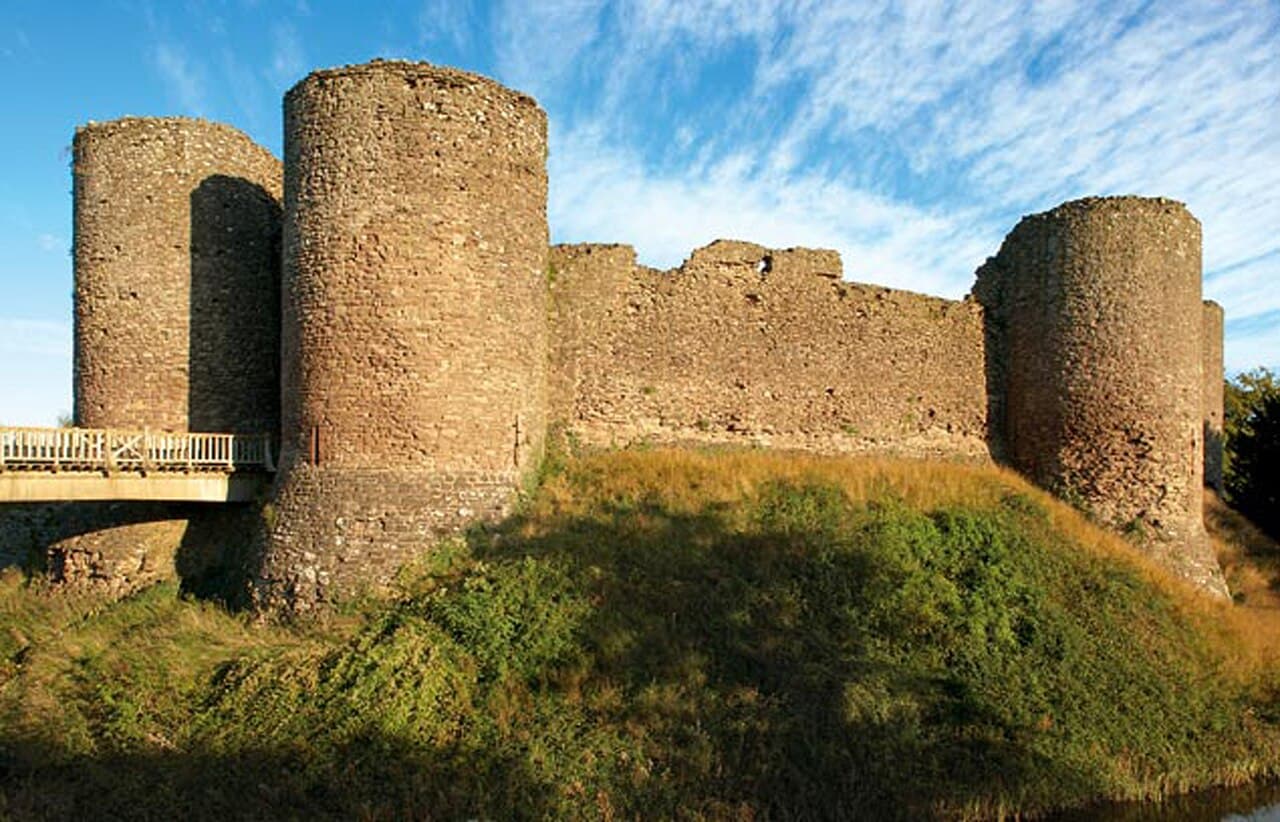
The castle's defensive complex comprises three principal sections: a central inner ward, a crescent-shaped southern hornwork, and a large northern outer ward. The entire complex is constructed primarily from red sandstone, which gives the walls a distinctive reddish hue beneath the white render still visible in places.
Architectural features and layout
Outer ward and fortifications
The outer ward is roughly 98 by 52 meters in size and is enclosed by a robust curtain wall featuring four mural towers—three circular and one rectangular. The rectangular tower served as official lodgings, while the curtain wall was reinforced by a dry ditch and an eastern gatehouse. This gatehouse, which survives up to five meters high, originally included a portcullis and a drawbridge, enhancing its defensive capabilities.
Historically, the outer ward housed a large barn measuring approximately 35 by 20 meters, along with smaller ancillary buildings, though these structures have not survived intact. The outer ward was originally larger, extending further east, but only limited traces of these earthworks remain today.
Inner ward and main defenses
The inner ward, measuring about 46 by 34 meters, is protected by a deep moat cut through the rock and retaining water, providing formidable defense. Its curtain wall is reinforced by four circular towers rising four stories high. The main gatehouse here is flanked by two circular towers and originally featured a portcullis and drawbridge as well.
Within the inner ward lie the foundations of key domestic buildings, including the hall, quarters for the castle constable, kitchen facilities, and the castle chapel, part of which was integrated into one of the towers. Early remains of the original Norman keep are also visible in this area.
Southern hornwork
The crescent-shaped southern hornwork was initially accessible from the inner ward by a wooden bridge spanning the intervening defenses. It was mainly protected by timber fortifications and towers, though some stonework was added later. Today, much of this section survives only in traces, offering insight into the castle’s extended defensive arrangements.
Distinctive arrow loops and defensive innovations
One of White Castle’s most striking architectural features is its distinctive cross-shaped arrow loops with vertically offset arms. These narrow openings were designed to provide archers with improved firing angles and enhanced protection, though experimental studies suggest they remained vulnerable to incoming attacks. These arrow loops exemplify the castle's role as a military fortress rather than a noble residence.
Later history and preservation
After the conquest of Wales by King Edward I in 1282, White Castle's military importance declined. It remained in the possession of Edmund, Earl of Lancaster, from 1267 and later became part of the Duchy of Lancaster holdings until 1825. By the 16th century, the castle had fallen into disuse and ruin, though it briefly regained some strategic relevance during the Welsh rebellion led by Owain Glyndŵr around 1404–1405.
In the 19th and early 20th centuries, the estate passed through several private hands, including the Duke of Beaufort and Sir Henry Mather Jackson, who undertook efforts to conserve the remaining structures. Official state protection began in 1922, and today the castle is managed by Cadw, the Welsh government's historic environment service. It is designated as a Grade I listed building and a Scheduled Monument, reflecting its cultural and historic significance.
White Castle is currently a ruin but remains one of the most impressive examples of Norman military architecture in the Welsh Marches. Its combination of earthworks, stone fortifications, and distinctive defensive features make it a valuable site for understanding medieval castle design and border warfare.
Visiting and accessibility
White Castle is accessible to visitors, with entry through the late 13th-century gatehouse leading into the outer ward. From there, visitors can cross a wooden bridge over the water-filled moat to reach the inner gatehouse. Climbing the towers offers panoramic views of the surrounding countryside and a close-up look at the castle's defensive structures.
While the castle is a ruin, it is well-preserved enough to convey the scale and complexity of its original design. Informational signage and guided tours provide historical context, making it a popular destination for those interested in medieval military history and architecture.
Frequently asked questions (FAQ)
- How do I get to White Castle?
- White Castle is located near Llantilio Crossenny in Wales. It is accessible by car via local roads from nearby towns such as Abergavenny and Monmouth. Parking is available near the site.
- What is the best time to visit White Castle?
- The best time to visit White Castle is during the spring and summer months when the weather is mild and the grounds are more accessible. The castle is open daily from 10:00 to 16:00.
- Is White Castle suitable for families?
- Yes, White Castle is suitable for families. The site offers open spaces for children to explore, and the historical features provide educational opportunities. However, visitors should be cautious around uneven ground and ruins.
- Can I explore the towers of White Castle?
- Visitors can climb the surviving towers of White Castle to enjoy panoramic views of the surrounding countryside. The towers provide insight into the castle's defensive architecture.
- Why is White Castle historically significant?
- White Castle is historically significant as part of the 'Three Castles' defensive network controlling the Welsh Marches. Its Norman origins and well-preserved medieval fortifications make it an important example of military architecture.

Information
Sources & official resources
Verify the information above using these authoritative references.
Loading map...
Visitor reviews
No reviews yet. Been here? Write the first review and help other travelers!
Write the first reviewVisited this castle? Share your experience
Your review helps other travelers and adds first-hand knowledge to our encyclopedia.