Wettin Castle
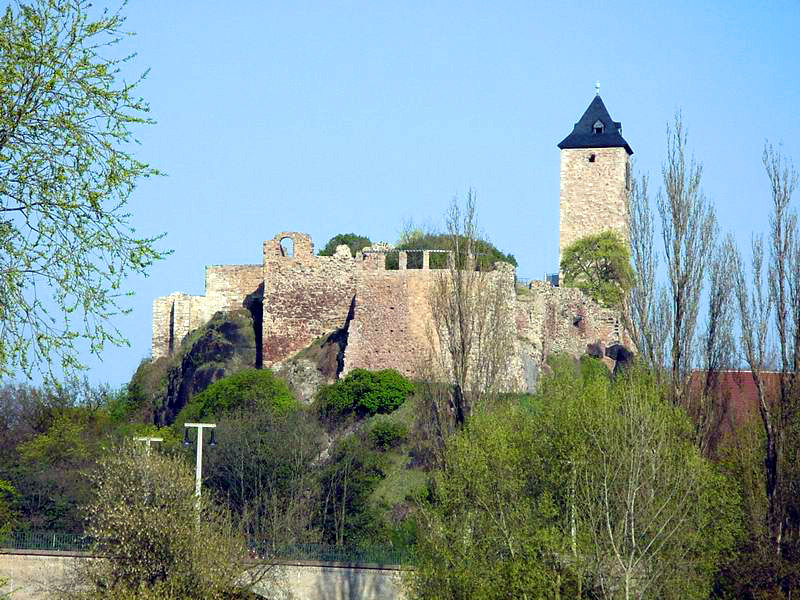
Wettin Castle stands as a remarkable testament to the complex history and architectural evolution of medieval fortifications in Germany. Located in Wettin-Löbejün on a prominent rocky promontory overlooking the Saale River, this hill castle originated as a fortified Slavic settlement during the early medieval period. Its strategic position marked the frontier between Slavic and Germanic tribes during the Carolingian era, laying the groundwork for its enduring political and military significance.
The castle's earliest documented mention dates back to 961 AD in a letter from Emperor Otto I, referring to "Vitin civitas" as a castle district responsible for tithes to the monastery of St. Maurice in Magdeburg. This highlights Wettin's early role as a center of regional power. Over the centuries, the castle passed through the hands of influential figures such as Margrave Rikdag, Dedo, and the ruling family line culminating with Conrad the Great, who in 1123 appointed the von Schochwitz family as ministeriales and castlekeepers. The construction of the Upper Castle (Oberburg) under Henry, Conrad's son, marked a significant phase in the castle's architectural development.
Historical development and political significance
Wettin Castle's history is intertwined with the rise and fall of noble families and shifting political allegiances. After the original Wettin lineage ended in 1217, control transferred to the Counts of Brehna, and subsequently to the Archbishop of Magdeburg in 1288, who transformed the castle into an administrative center. The castle's division into various fiefs around 1300 led to frequent changes in ownership among noble families such as the von Trotha and von Schraplau. The latter's lands were eventually absorbed by Brandenburg in 1592.
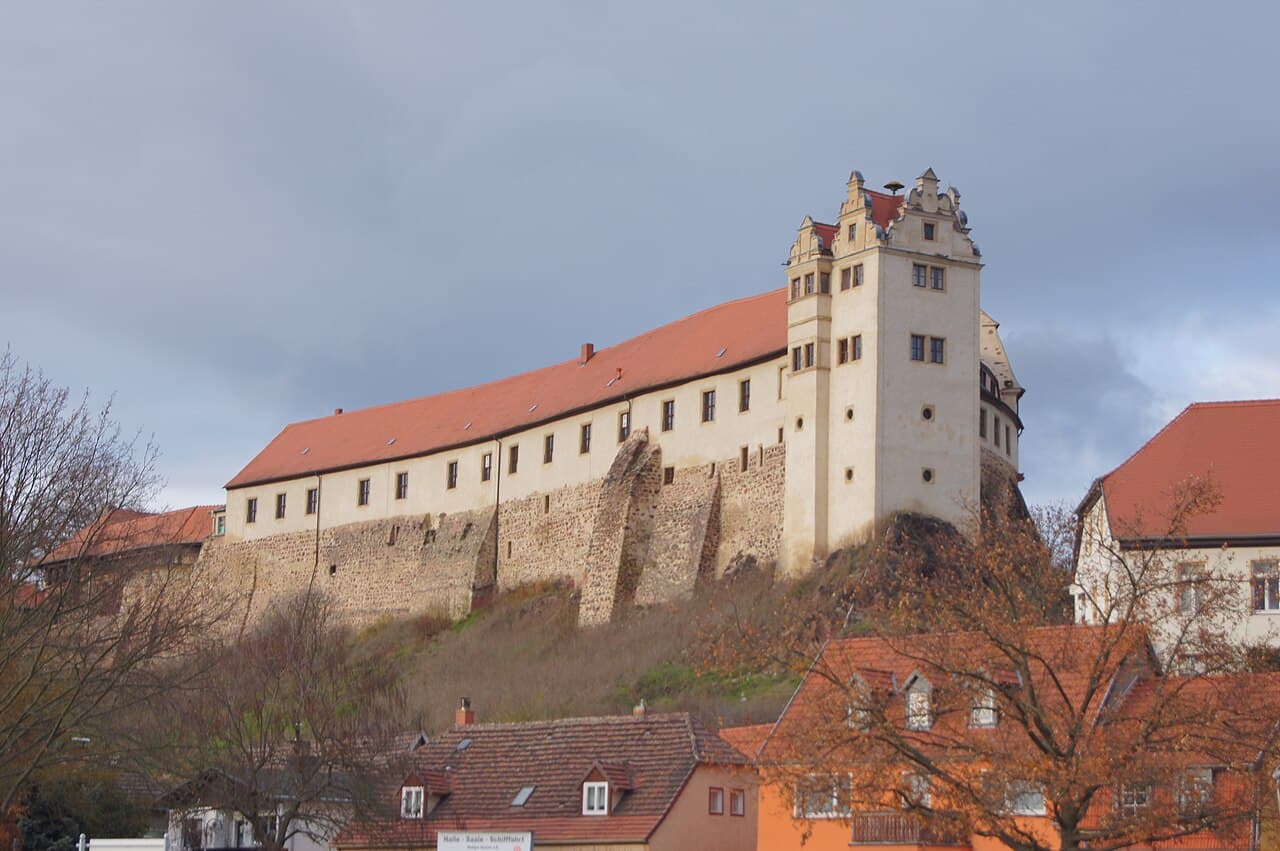
The castle endured significant challenges, including a devastating fire in 1660 that damaged the Upper Castle, leading to its partial dismantling by 1697. Meanwhile, the Lower Castle experienced extensive reconstruction around 1600 under Christoph aus dem Winckel, who introduced Baroque gables and the distinctive Winkelturm tower completed in 1606. Further alterations in the early 19th century under Louis Ferdinand of Prussia reflected changing architectural tastes and functional needs.
Architectural features and castle sections
The lower castle
The Lower Castle (Unterburg) is the oldest part of the complex, confirmed by archaeological excavations led by Paul Grimm in the early 20th century. These investigations uncovered stone walls dating back to the 10th century, including a substantial ring wall approximately two meters thick, dated to around 1100 AD. The Lower Castle was historically divided between the Ammendorf and von Winckel families, with the latter eventually acquiring full ownership and renovating the estate extensively.
The upper castle
The Upper Castle (Oberburg) once featured a towering bergfried — a tall main tower typical of medieval fortifications — depicted in a 1640 engraving by Matthäus Merian. Although already in ruins by then, the bergfried was completely dismantled by 1697 after the 1660 fire. The Upper Castle also had a notable gatehouse built in 1565, which has since been lost.
The middle castle
The Middle Castle (Mittelburg) lies between the Upper and Lower sections and has seen significant 20th-century development, including educational buildings constructed during the castle's use as a school complex. Recent archaeological excavations since 2018 have shed new light on the castle's phased construction and historical transformations.
Later uses and modern adaptations
During the 19th and 20th centuries, Wettin Castle's function shifted from military and noble residence to industrial and educational uses. The Lower Castle hosted a brewery and distillery, which led to the removal of some medieval structures and the addition of utilitarian buildings. During the Nazi era, the castle served as a party school for the NSDAP, prompting significant alterations to the gates in the 1930s.
After World War II, the castle accommodated agricultural and agrochemical schools, evolving into an engineering school by the late 1960s. This period saw the construction of dormitories and laboratories, further transforming the castle grounds. Since 1991, Wettin Castle has been home to the Burg-Gymnasium Wettin, a boarding school specializing in art history and practical art education, in cooperation with a nearby university in Halle.
Architectural and archaeological significance
Wettin Castle's layered history is reflected in its complex architectural fabric, which includes remnants from the early medieval Slavic fortifications to Baroque renovations and 20th-century educational buildings. The castle's ring wall, bergfried, gatehouses, and Winkelturm tower illustrate evolving defensive and residential needs over centuries. Archaeological work continues to reveal details about the castle's original layout and subsequent adaptations, enhancing understanding of medieval frontier fortifications in central Germany.
Today, Wettin Castle stands as a valuable cultural heritage site, embodying over a millennium of history. Its preservation and adaptive reuse as an educational institution demonstrate the dynamic relationship between historical architecture and contemporary functions, making it a unique destination for those interested in medieval history, castle architecture, and German cultural heritage.
Frequently asked questions (FAQ)
- When was Wettin Castle first mentioned in historical records?
- Wettin Castle was first mentioned in a letter from Emperor Otto I in 961 AD, referred to as "Vitin civitas." This document highlights its early significance as a castle district responsible for tithes to the monastery of St. Maurice in Magdeburg.
- What are the main sections of Wettin Castle?
- Wettin Castle comprises three main sections: the Upper Castle (Oberburg), the Middle Castle (Mittelburg), and the Lower Castle (Unterburg), each with distinct historical backgrounds and architectural features.
- What architectural styles are represented at Wettin Castle?
- Wettin Castle features a mix of architectural influences, including early medieval fortifications, Baroque renovations, and 19th- and 20th-century modifications reflecting changing functional needs.
- Can visitors see archaeological excavations at Wettin Castle?
- Ongoing archaeological excavations have been conducted since 2018, revealing important details about the castle's phased construction and historical evolution. Visitors may learn about these findings through local museum displays or educational programs.
- What is the current use of Wettin Castle?
- Since 1991, Wettin Castle has housed the Burg-Gymnasium Wettin, a boarding school focused on art history and practical art education, collaborating with a nearby university in Halle.
Photo gallery

Information
Sources & official resources
Verify the information above using these authoritative references.
Loading map...
Visitor reviews
No reviews yet. Been here? Write the first review and help other travelers!
Write the first reviewVisited this castle? Share your experience
Your review helps other travelers and adds first-hand knowledge to our encyclopedia.