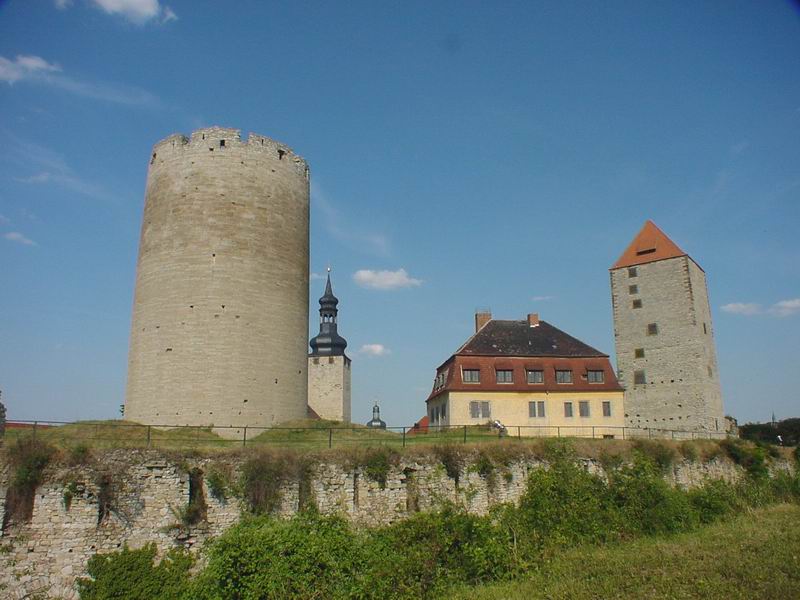
Burg Schraplau
Burg Schraplau is a significant hill castle ruin located in the municipality of Schraplau, in the German state of Saxony-Anhalt. This historic site dates back to the early medieval period, with origins traced to the ninth century, making it an important example of early Germanic fortification architecture. The castle’s history and remains provide insight into the evolution of medieval defensive structures and noble residences in central Germany.
Early history and origins
The earliest documentary mention of the site appears around the year 845 in the Hersfeld tithe register, where it is referred to as “Scrabanloh,” a name likely describing a wooded area. By 881, the site is listed in the Hersfeld castle register as “Scrabenlebaburg,” indicating its recognition as a fortified location. At this time, Burg Schraplau consisted primarily of a ring wall and accompanying ditch, typical of early medieval fortifications designed to protect local rulers and their territories.
The initial construction phase is believed to have been commissioned by King Louis the German or one of his sons, placing the castle under royal domain. This early fortification served as a strategic point in the region, reflecting the broader Carolingian efforts to secure borderlands and control local populations.
Development through the tenth and eleventh centuries
By the late tenth century, the site had evolved into a fortified settlement known as “Scroppenlevaburch.” It neighbored the older Altenburg castle, which featured advanced earthworks reinforced with stone masonry, signifying the transition from simple earthen defenses to more durable stone fortifications. Archaeological excavations at Altenburg revealed two distinct phases of dry stone walls, highlighting cycles of destruction and rebuilding.
Finds of Slavic artifacts in the area indicate the presence of Sorb communities living under Frankish rule, illustrating the cultural and political complexities of the region during this period. Burg Schraplau itself was held by imperial immediate lords, likely descended from the noble Querfurt family, including notable figures such as Thimo and Egeloff von Schraplau. The death of Egeloff in 1196 marked the end of this direct lineage.
Transition to ecclesiastical control and architectural changes
Around the year 1200, control of Burg Schraplau passed to the Archbishopric of Magdeburg. The archbishopric constructed a Romanesque-style castle in the western part of the Altenburg site, reflecting the ecclesiastical authority’s influence and the architectural trends of the time. This castle featured typical Romanesque stone construction, characterized by robust walls and rounded arches.
The castle and its lands were granted as a fief to the burgraves of Magdeburg, nobles from the Querfurt family faction, who appointed officials known as vogts to administer the territory. Records from 1242 mention a knight named Rudolf von Schrapelo serving as a vassal to the burgrave, illustrating the feudal hierarchy in place.
The querfurt family and later medieval developments
From 1267 onward, Burchard I von Schraplau, a member of a Querfurt cadet branch, resided in the castle. His descendant, Burchard II, known as "the Lapp", officially held the title of burgrave of Schraplau. During the thirteenth century, the family expanded their holdings, acquiring territories such as Nebra, lands near Röblingen am See, and shares in Querfurt and the Halle valley.
Burchard III von Schraplau rose to prominence as Archbishop of Magdeburg in 1307. His tenure was marked by significant conflicts aimed at consolidating archiepiscopal power, culminating in his capture and violent death in 1325 during a feud involving the cities of Halle and Magdeburg.
Following these events, heavy debts forced Burchard III’s successors to sell the Schraplau lordship in 1335 to the Counts of Mansfeld. The original Schraplau family retreated to holdings within the Wettin domain.
Mansfeld ownership and architectural transformation
Throughout the fourteenth and fifteenth centuries, various branches of the Mansfeld family controlled the castle. In 1484, Ernst and Albrecht von Mansfeld undertook repairs to the medieval structures, preserving elements of the original fabric.
The lordship was divided in 1501, with the upper district containing the castle passing to Count Gebhard von Mansfeld-Mittelort. During the Schmalkaldic War in 1547, imperial forces seized and extensively damaged the castle.
Between 1574 and 1591, Count Christoph I von Mansfeld-Mittelort replaced earlier fortifications with a more palace-like residence, reflecting the period's shift from military defense to noble habitation. Despite this, by 1571, the castle was described as largely deserted, indicating a decline in its strategic importance.
After the Mansfeld-Schraplau line ended, the lordship passed to the Mansfeld-Hinterort counts. In 1637, Count Johann Georg von Mansfeld-Vorderort moved his seat to the palace. The upper district, including the castle, was sold in 1683 to the Hake family, who took residence there.
Decline and ruin
In 1713, Amtmann Sylvester Brachvogel removed the roof from the bergfried, the main tower, accelerating the castle's decay. Despite hosting a small Prussian garrison of 22 men in 1730, the castle was in poor condition. Its last recorded use was as an archive and court chamber in 1732.
By 1736, the castle had fallen into ruin and was repurposed as a quarry. Today, only limited remains survive, scattered across private properties. The site includes fragments of exterior walls and foundations, offering a glimpse into its former medieval complexity.
Architectural features and archaeological findings
The original Burg Schraplau featured a defensive ring wall and accompanying ditch, characteristic of hill castles from the ninth century. This early layout reflects the transition from simple earthworks to more permanent stone fortifications.
Excavations at the nearby Altenburg site revealed a high earth rampart reinforced with dry stone masonry and an outer ditch. Two successive dry stone walls indicate periods of destruction and rebuilding, underscoring the site's strategic significance.
The Romanesque castle built by the Archbishopric of Magdeburg around 1200 shows typical stone construction with robust walls and rounded arches, although its ruins are scarcely accessible and little known outside specialist circles.
Later repairs in the late fifteenth century preserved medieval elements, while the sixteenth-century palace-like residence introduced Renaissance influences, marking a shift from military fortification to noble dwelling.
No inscriptions, mosaics, or decorative elements have been documented, but the site’s archaeological record contributes valuable knowledge about medieval fortifications and noble residences in central Germany.
Frequently asked questions (FAQ)
- How do I get to Burg Schraplau?
- Burg Schraplau is located in the municipality of Schraplau, Saxony-Anhalt, Germany. It is accessible by local roads, but as the site is on private property, visitors should seek permission before visiting.
- What is the historical significance of Burg Schraplau?
- Burg Schraplau dates back to the ninth century and reflects early medieval fortification techniques. It played a role in regional power struggles and was controlled by notable families such as the Querfurts and Mansfelds.
- Can I visit the ruins of Burg Schraplau?
- The ruins of Burg Schraplau are limited and lie on private land. Public access is restricted, so visitors should verify access rights and respect private property.
- When was Burg Schraplau built?
- The castle was originally constructed in the ninth century, with significant developments during the tenth to thirteenth centuries, including Romanesque additions around 1200.
- What architectural styles are present at Burg Schraplau?
- The castle features early medieval defensive structures and a Romanesque-style castle built by the Archbishopric of Magdeburg, along with later Renaissance palace-like modifications.
- Why is Burg Schraplau in ruins?
- The castle fell into decline after damage during the Schmalkaldic War and the removal of the bergfried roof in 1713. It was abandoned and used as a quarry by the mid-18th century.
Information
Current owner
Private owner
Loading map...
Visitor reviews
No reviews yet. Been here? Write the first review and help other travelers!
Write the first reviewVisited this castle? Share your experience
Your review helps other travelers and adds first-hand knowledge to our encyclopedia.