Giebichenstein Castle
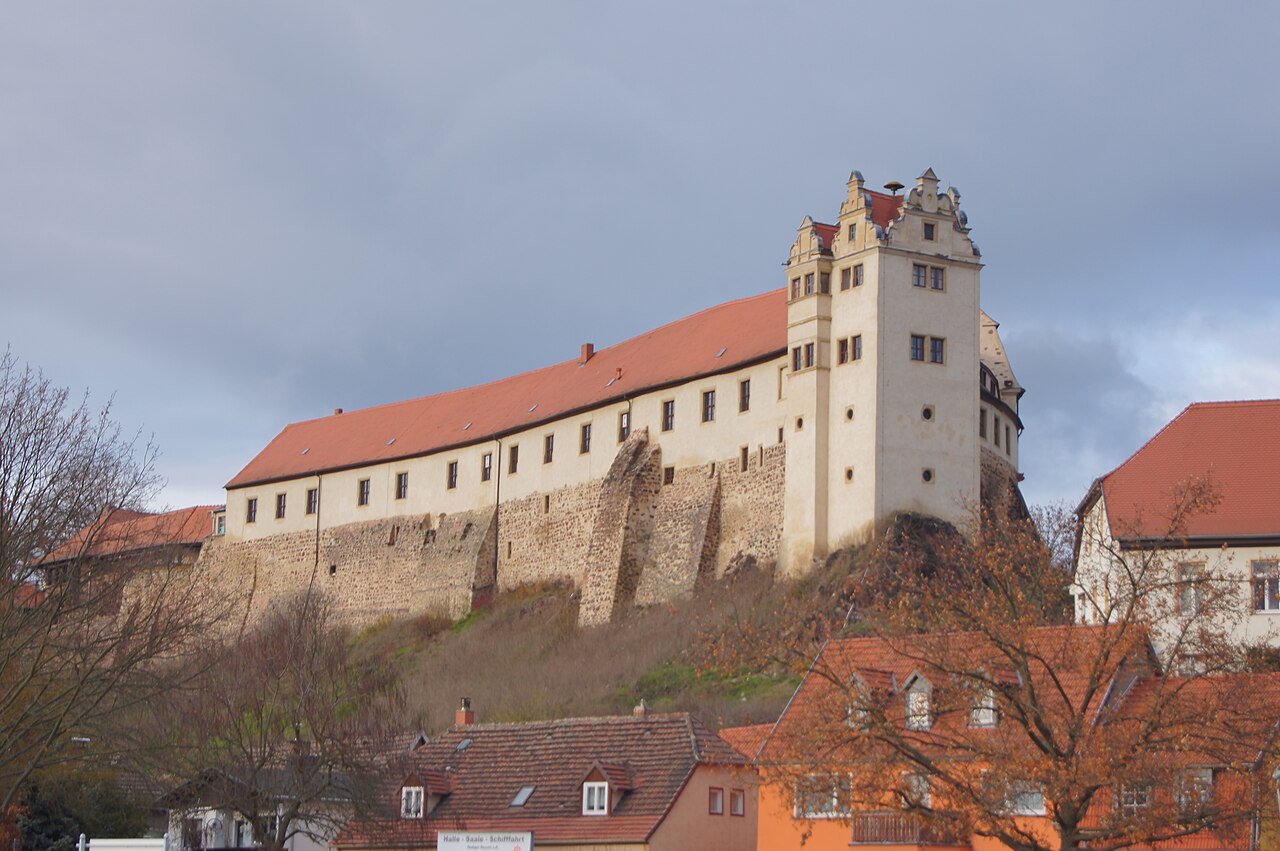
Giebichenstein Castle stands prominently in the Giebichenstein district of Halle, located in the federal state of Saxony-Anhalt, Germany. Perched at approximately 87 meters above sea level, the castle occupies a strategic hilltop overlooking the Saale River valley. This location underlines its historic role as a fortified stronghold controlling important regional routes and trade paths. The castle's origins trace back to the early medieval period, reflecting its longstanding significance in both secular and ecclesiastical history.
The earliest documented mention of Giebichenstein dates to 961, when King Otto I granted the surrounding Neletici region, including the castle site, to the Moritz Monastery in Magdeburg. This grant marks the first recorded reference to the site as a fortified settlement or burgward, indicating its early defensive and administrative importance. Archaeological evidence suggests the initial fortification was likely a palisaded earthwork with ditches, constructed in the 10th century on a nearby site known as Alte Burg or Amtsgarten, east of the present castle location.
Medieval origins and early fortifications
By 1116, documentary evidence refers explicitly to the castle as "castrum Givekenstein", including mention of a castle chapel. This confirms the site's status as a fortified residence by the early 12th century. Excavations have revealed Bronze and early Iron Age layers beneath the castle grounds, though no Roman or Migration Period occupation has been identified, highlighting the site's continuous but regionally specific historical occupation.
The current upper castle (Oberburg) primarily dates from the 12th and 13th centuries, with significant expansions in the 14th century. This period saw the construction of the castle's core defensive and residential structures in the Romanesque architectural style. The castle played a vital role in the power dynamics of the Holy Roman Empire, serving both ecclesiastical and imperial functions. Notably, three bishops—Adalbert (d. 981), Taginos, and Walthard (d. 1012)—were buried here, underscoring its religious importance.
Imperial residence and political significance
Giebichenstein Castle was also a royal residence and prison. For example, in 1004, Henry of Schweinfurt, a high-ranking noble, was imprisoned here. The castle hosted emperors such as Henry IV in 1064 and Frederick I Barbarossa, who convened a princes’ assembly at the castle in 1157. These events highlight the castle's role as a center of imperial authority and political negotiation during the High Middle Ages.
In 1215, the castle was besieged by Emperor Frederick II amid the conflict between the Welf and Staufen dynasties. While the outcome of this siege is not clearly recorded, it reflects the castle's strategic importance in dynastic struggles of the period.
Archiepiscopal residence and later transformations
From 1382, Giebichenstein Castle became the primary residence of the Archbishops of Magdeburg. The castle served as the administrative and ceremonial heart of their rule, with most official charters issued from here starting in 1369. Several archbishops died at the castle after 1402, further cementing its status as a significant ecclesiastical seat.
Following the completion of Moritzburg Castle in Halle in 1503, Giebichenstein's role shifted from a residence to administrative and economic uses. It housed a brewery and distillery, reflecting its adaptation to changing needs. However, the castle fell into decline during the 16th century, culminating in a devastating fire in 1637 during the Thirty Years’ War while under Swedish occupation. The upper castle was subsequently abandoned.
Architectural features of the upper castle
The upper castle comprises robust Romanesque stone construction featuring a massive gate tower, a ring wall at least 4.5 meters high, a south tower, and a second entrance on the east side. Historical images from the 16th and 17th centuries depict the ring wall with two stacked battlements, likely added after the initial construction phase.
A highlight is the late Romanesque residential tower (Wohnturm) on the north side, measuring about 11 by 11 meters. It includes built-in staircases and chimneys, with decorative elements such as a hollow pillar featuring quatrefoil-shaped openings whose exact purpose remains a subject of scholarly interest. The Wohnturm’s entrance faces the castle chapel, which stood freely in the courtyard and was richly decorated, comparable to nearby monastery and collegiate churches.
The Palas, or main residential building, lies on the north side and measures roughly 36 by 11 meters. It contains five rooms opening onto the courtyard and features a front arcade providing access to the upper floors. Its architectural design closely resembles the Palas buildings at Runneburg and Wartburg castles, indicating shared regional stylistic influences.
West of the chapel and Wohnturm, a complex of several buildings existed, with surviving foundations and two cellar rooms, though their precise functions remain unclear.
Lower castle and later developments
The lower castle (Unterburg) was constructed between 1445 and 1464 under the direction of Archbishops Günther II and Friedrich III. It features a ring wall with flanking towers, a moat, and internal buildings arranged in a planned layout. The eastern ring wall remained free of buildings except for the gatehouse.
Within the lower castle courtyard, a tithe barn was built during Archbishop Johannes’s tenure. Later additions included a brewery in the west building and a distillery conversion of the northern refectory around 1500. These adaptations reflect the castle's evolving economic functions.
In 1706, a Baroque manor house was constructed on the east side of the lower castle. A stone bridge replaced an earlier wooden bridge, and the moat and castle grounds were landscaped into a park, enhancing the site's aesthetic and recreational appeal.
Modern use and preservation
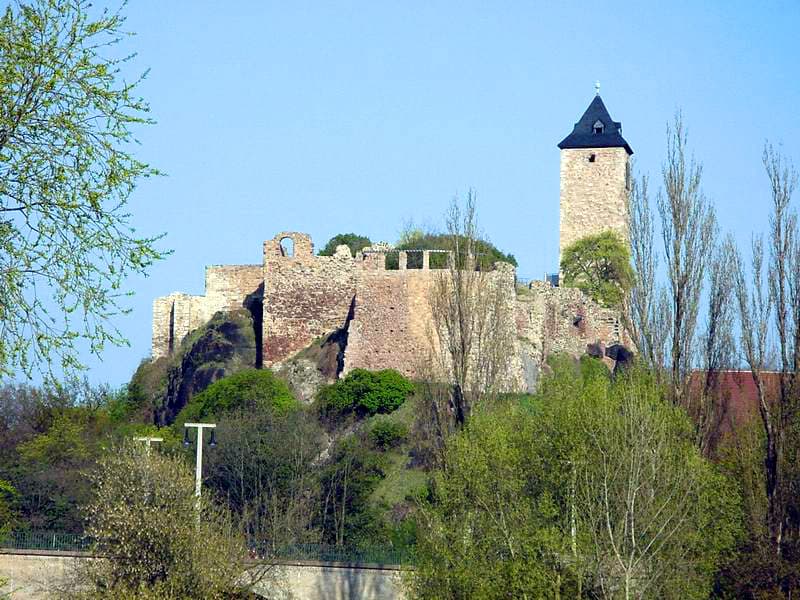
The upper castle, largely destroyed by fire in 1637, remains in ruins but was extensively excavated in 1961, fully exposing its foundations. These excavations enabled the creation of an open-air museum and cultural venue, offering visitors panoramic views over the Saale valley and insight into medieval castle architecture.
The lower castle buildings have been adapted for modern use and currently house the Burg Giebichenstein University of Art and Design. Founded in 1915, the university is linked to the Deutscher Werkbund and Bauhaus movements, emphasizing craft, design, and artistic innovation. This contemporary use continues the castle's legacy as a site of cultural and educational importance.
Legends and cultural significance
A local legend associates the castle with Ludwig the Springer, a Thuringian landgrave reputed to have been imprisoned here and escaped by leaping into the Saale River. However, this story lacks historical evidence and likely arises from a misinterpretation of Ludwig’s Latin nickname.
Overall, Giebichenstein Castle embodies a rich tapestry of medieval history, architectural evolution, and cultural transformation. Its Romanesque structures, strategic location, and role in both imperial and ecclesiastical affairs make it a significant heritage site in Germany. Today, it stands as a testament to the region’s layered past and ongoing commitment to preserving and celebrating its historical monuments.
Frequently asked questions (FAQ)
- What is the historical significance of Giebichenstein Castle?
- Giebichenstein Castle is a medieval fortress built in the 10th century, playing a vital role in the defense of Halle and the surrounding regions. It served as a royal residence and has witnessed significant events throughout German history, including the rise and fall of various dynasties.
- When was Giebichenstein Castle built?
- The construction of Giebichenstein Castle began around the year 1000 AD, making it one of the oldest castles in the region. Over the centuries, it has undergone various renovations and expansions, reflecting the architectural styles of different eras.
- Can I visit Giebichenstein Castle?
- Yes, Giebichenstein Castle is open to visitors throughout the year. The castle offers guided tours that provide insights into its rich history and architectural features, making it an engaging experience for all ages.
- What are the opening hours for Giebichenstein Castle?
- Giebichenstein Castle is typically open from 10 AM to 6 PM, but it's advisable to check the official website for any seasonal variations or special events that might affect these hours. Visiting in the afternoon often provides a quieter experience.
- Is it possible to access Giebichenstein Castle with public transport?
- Yes, Giebichenstein Castle is accessible by public transport, with several bus and tram lines serving the area. Visitors can easily reach the castle from the city center of Halle, making it convenient for those relying on public transportation.
- What is the best time to visit Giebichenstein Castle?
- The best time to visit Giebichenstein Castle is during the spring and early fall when the weather is pleasant and the surrounding gardens are in full bloom. Additionally, the castle often hosts special events and exhibitions during these seasons, enhancing the visitor experience.
- Are there any nearby attractions to Giebichenstein Castle?
- Yes, nearby attractions include the historic city center of Halle, the River Saale, and several museums such as the Kunstmuseum Moritzburg. These sites provide additional cultural and historical context, making for a well-rounded visit.
- What are the ticket prices for Giebichenstein Castle?
- Ticket prices for Giebichenstein Castle are generally affordable, with discounts available for students and seniors. It's best to check the castle's official website for current pricing and any special offers that may be available.
Photo gallery

Photo by Mewes•Public domain
Information
Sources & official resources
Verify the information above using these authoritative references.
Loading map...
Visitor reviews
No reviews yet. Been here? Write the first review and help other travelers!
Write the first reviewVisited this castle? Share your experience
Your review helps other travelers and adds first-hand knowledge to our encyclopedia.