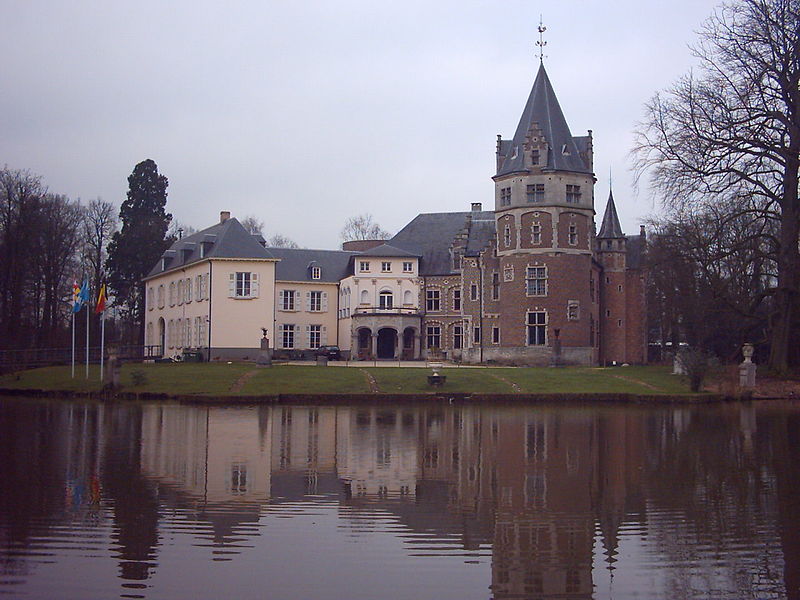
Westmalle Castle
Westmalle Castle, known locally as Kasteel Westmalle, is situated just north of the village of Westmalle in the province of Antwerp, within Belgium's Flemish Region. Although often referred to as a castle, its origins differ from typical medieval fortresses. The estate began as a substantial farmstead around the early 12th century, specifically circa 1100, and retained this agricultural character until the mid-15th century.
Origins and early history
Originally called "Hoeve ten Driesse", the estate served as the residence for representatives of the Dukes of Brabant. This connection highlights its administrative importance despite its modest beginnings as a farm. In 1449, the estate changed hands when it was sold by the Duke of Brabant to Henri van der Moelen, a prominent member of the city council of nearby Antwerp. This transfer marked the start of its evolution from a farm into a more formal residence.
Transformation into a castle
The estate later passed by marriage into the family of De Cottereau. It was Evrard de Cottereau who initiated the construction of the present castle structure in 1561. This building phase reflects the architectural trends of the 16th century in the region, transitioning from purely agricultural buildings to more fortified and representative residences. The castle's design incorporated elements typical of Flemish Renaissance architecture, including robust stonework and symmetrical layouts, although it was never intended as a military fortress.
Ownership changes and restorations
In 1702, the castle was claimed by creditors of the De Cottereau family but was later returned through legal proceedings. The property was purchased in 1743 by JB. Powis, whose family maintained residence until 1847. Subsequently, the estate was acquired by Lord Bovie, a diamond merchant from Antwerp, who undertook significant restoration work and established a formal castle park, reflecting 19th-century tastes for landscaped grounds.
Further restoration took place after 1878 when Baron E. de Turck bought the castle. He is credited with giving Westmalle Castle much of its current appearance, blending historical elements with contemporary 19th-century styles. The castle remained in the hands of the Van de Straeten-Waillet family from 1914 until 2024, after which ownership passed to the local municipality.
Current status and public access
Today, Westmalle Castle is under the ownership of the municipality, which has expressed intentions to restore the building. Currently, the castle itself is not accessible to the public due to its condition and ongoing restoration planning. However, the castle park surrounding the estate is freely accessible, offering visitors a chance to appreciate the landscape design and view the castle's exterior.
Architectural and cultural significance
While Westmalle Castle does not fit the traditional definition of a medieval fortress, it represents an important example of a Flemish estate that evolved over centuries from agricultural roots into a stately residence. Its architecture showcases elements of 16th-century Flemish Renaissance style, later influenced by 19th-century restoration efforts that added parkland and aesthetic enhancements. The castle's history reflects the social and economic changes in the region, from feudal administration to private ownership by notable local families.
The estate's layered history, including its connection to the Dukes of Brabant and prominent Antwerp citizens, adds to its cultural value. Its ongoing restoration efforts underscore the local commitment to preserving regional heritage sites, even those that diverge from the classic image of a medieval castle.
Frequently asked questions (FAQ)
- Can I visit Westmalle Castle?
- Currently, Westmalle Castle itself is not open to visitors due to restoration plans. However, the surrounding castle park is freely accessible to the public for walks and viewing the exterior.
- When was Westmalle Castle originally built?
- The estate began as a farm around 1100, but the present castle structure was built in 1561 by Evrard de Cottereau.
- What architectural style characterizes Westmalle Castle?
- Westmalle Castle exhibits elements of Flemish Renaissance architecture from the 16th century, with later 19th-century restorations influencing its current appearance.
- Who owned Westmalle Castle historically?
- The estate was originally owned by representatives of the Dukes of Brabant, then sold to Henri van der Moelen in 1449, later passing to the De Cottereau family, JB. Powis, Lord Bovie, Baron E. de Turck, and most recently the Van de Straeten-Waillet family before municipal ownership.
- Is there public access to the castle park?
- Yes, the castle park surrounding Westmalle Castle is open to the public and provides a pleasant setting for visitors to enjoy the landscape and views of the castle exterior.
Information
Current owner
Municipality
Address
Kapselstraat, Belgium
Loading map...
Visitor reviews
No reviews yet. Been here? Write the first review and help other travelers!
Write the first reviewVisited this castle? Share your experience
Your review helps other travelers and adds first-hand knowledge to our encyclopedia.