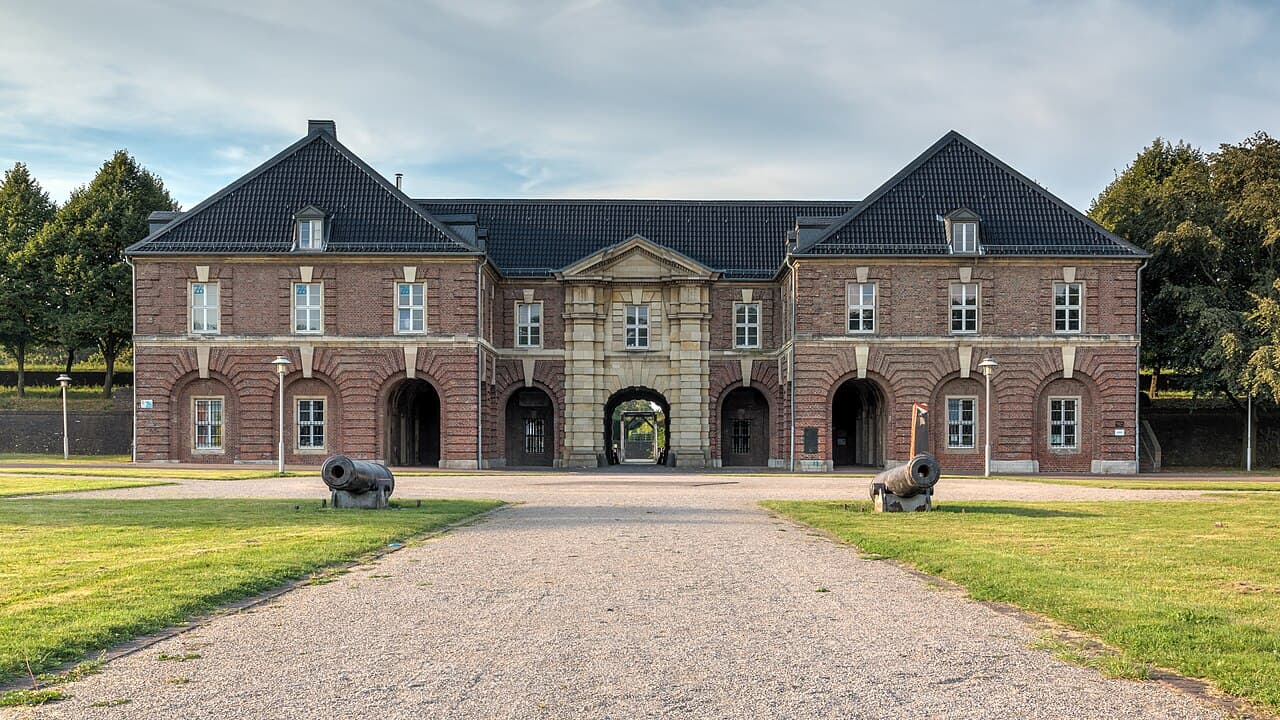
Wesel citadel
The Wesel Citadel stands as the largest intact bastioned fortress in the Rhineland, Germany. Constructed between 1688 and 1722, this monumental fortification was designed by the military engineer Johan de Corbin and exemplifies the post-Renaissance military architecture that dominated European fortress design in the late 17th and early 18th centuries.
Architectural design and fortification features
The citadel is laid out in the form of a pentagonal star, a classic design of the bastioned fortress style. Each of the five points of the star features a bastion, which are angular protrusions intended to provide overlapping fields of fire and minimize blind spots for defending artillery. This design was a response to advances in siege warfare and artillery technology, allowing defenders to cover the walls with crossfire and better withstand prolonged attacks.
The walls of the Wesel Citadel are thick and robust, constructed with earthworks and masonry to absorb cannon fire effectively. Surrounding the fortress is a system of moats and ravelins, detached triangular fortifications that further protected the main walls and complicated enemy approaches. The layout reflects the principles of the Vauban style, named after the famous French military engineer Sébastien Le Prestre de Vauban, who popularized the star fort design across Europe.
Historical context and strategic importance
Wesel was a critical military and trading hub on the Rhine River, and its fortress played a significant role in regional defense. The citadel formed the core of the extensive fortress of Wesel, which was a key stronghold in the shifting political and military landscape of the Rhineland during the late 17th and early 18th centuries. The construction period coincided with the aftermath of the Thirty Years' War and the ongoing conflicts between European powers, including the War of the Spanish Succession.
The fortress helped control river traffic and served as a defensive bulwark against invasions. Its strategic location allowed it to monitor and protect the surrounding territories, contributing to the military security of the region.
Later use and current status
After its military significance declined, the Wesel Citadel underwent various adaptations. Today, it is well preserved and functions as a cultural centre, hosting exhibitions, events, and public gatherings. The preservation of its bastions, walls, and internal structures offers visitors a tangible connection to the post-Renaissance military architecture and the historical role of fortifications in the Rhineland.
The citadel's large open courtyards and robust defensive works make it an outstanding example of bastioned fortress design that has survived largely intact, unlike many other European fortresses which have been lost or heavily altered.
Architectural elements and visitor experience
Visitors to the Wesel Citadel can explore its extensive bastions, curtain walls, and the intricate layout of its defensive works. The star-shaped plan is clearly visible from aerial views, illustrating the precision and strategic thinking behind its construction.
Inside the fortress, there are various chambers and halls that once served military purposes but now accommodate cultural activities. The citadel’s design emphasizes both defense and functionality, with features such as gun embrasures, for troops, and secure storage areas for munitions.
Significance in military architecture history
The Wesel Citadel is an important example of post-Renaissance bastioned fortresses, reflecting the evolution of military architecture in response to gunpowder artillery. Its preservation provides insight into the defensive strategies of the period and the engineering expertise required to build such complex fortifications.
As one of the most complete examples of its kind in Germany and the Rhineland, it offers valuable educational opportunities for historians, architects, and visitors interested in military history and fortress design.
Photo gallery

Information
Loading map...
Visitor reviews
No reviews yet. Been here? Write the first review and help other travelers!
Write the first reviewVisited this castle? Share your experience
Your review helps other travelers and adds first-hand knowledge to our encyclopedia.



