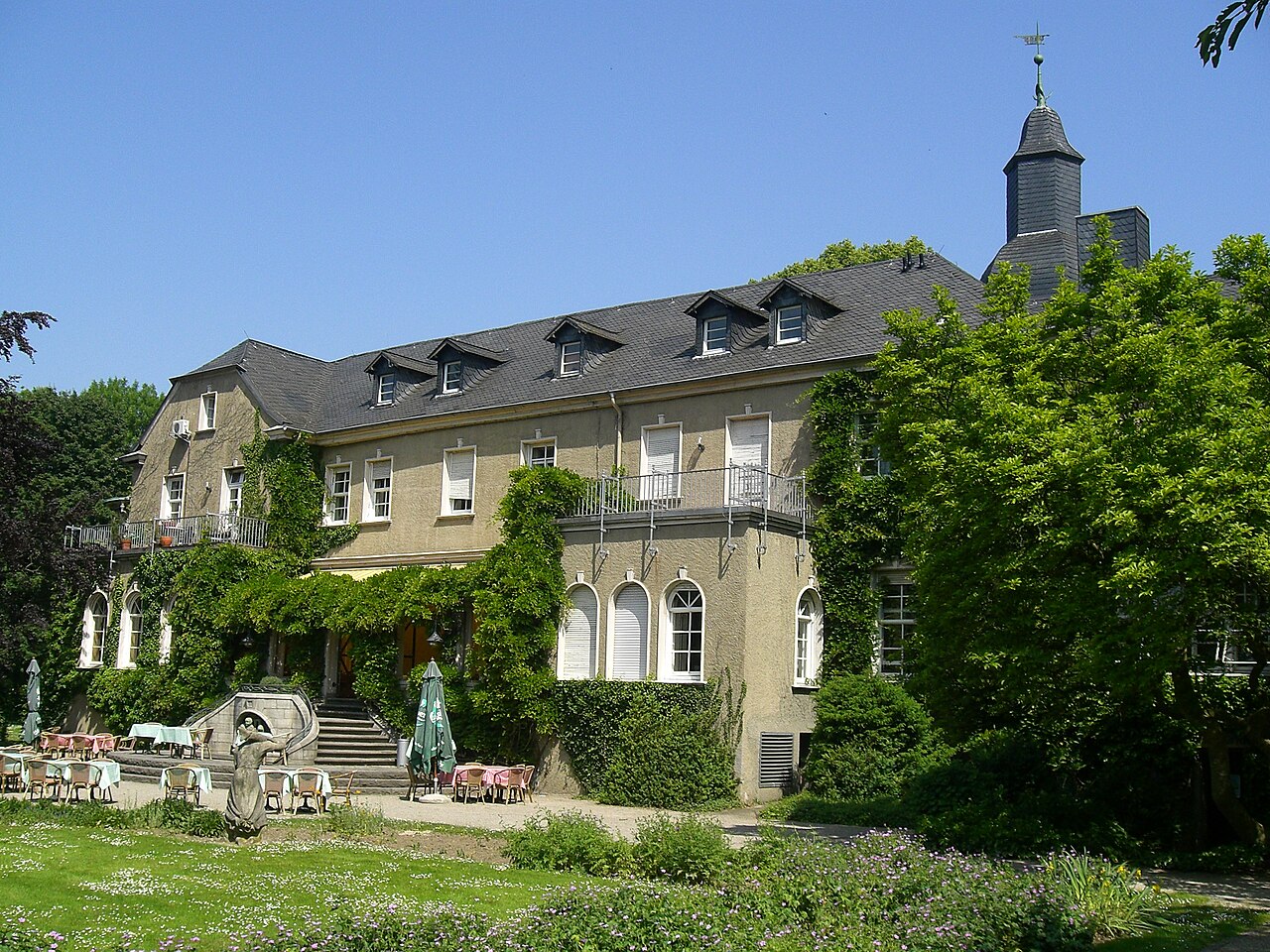
Kastell Holten
Kastell Holten stands as a significant example of a medieval water castle in Oberhausen, Germany, with origins tracing back to the late 12th century. Founded by the Counts of the Mark in the early 14th century, the castle was strategically established as a border fortress along the contested frontier with the nearby County of Cleves. Its location was carefully chosen for natural defense, surrounded by swamp on three sides, enhancing its security and military importance during the High and Late Medieval periods.
Early history and foundation
The earliest documented references to the site date from 1188, 1243, and 1250, mentioning a predecessor fortification known as Burg Holte. This early castle was associated with the Archbishopric of Cologne, indicating the site's longstanding strategic and ecclesiastical significance. Around 1299, the estate passed into the hands of Engelbert II of the Mark through his marriage to Mechthild von Holte of the Arenberg family. Engelbert II is credited with founding the water castle in 1307, marking a pivotal moment in the site's transformation into a formidable defensive stronghold.
Following its foundation, the settlement of Holten was granted town rights in 1310 under Engelbert II, reflecting the growing importance of both the castle and the surrounding community. By 1355, control shifted when Holten became a fief under the Duchy of Cleves, which diminished the castle's strategic prominence relative to neighboring fortresses such as Dinslaken.
Ownership and military significance
From 1445 to 1557, Kastell Holten was pledged to the noble von Loë family, who maintained stewardship and likely influenced the castle's upkeep and modifications during this period. The castle's military role was tested during the 16th and 17th centuries, as it endured multiple occupations amid the turbulent conflicts of the Eighty Years’ War and the Thirty Years’ War.
Spanish forces occupied the castle twice, in 1586 and 1598, demonstrating its continued strategic value. The Thirty Years’ War brought further upheaval with occupations by troops from Ansbach and Anhalt in 1623, followed by Hessian forces in 1634. The castle suffered significant damage by 1640 and remained in disrepair for decades. A brief occupation by French troops occurred in 1672, underscoring the castle's ongoing military relevance during this era.
Political transitions and later uses
Throughout the centuries, Kastell Holten's political allegiance shifted multiple times. From 1609 to 1701, it was governed by Brandenburg, which became the Kingdom of Prussia in 1701, incorporating Holten into Prussian territory. During the Napoleonic Wars, between 1806 and 1813, the castle fell under the jurisdiction of the Grand Duchy of Berg, before reverting to Prussian control following the Congress of Vienna in 1815.
In the 19th century, the castle's function shifted from military to civilian. It entered private ownership in 1818 and was repurposed as a school from 1842. Post-World War II neglect led to the demolition of the south wing in 1961. Since 1968, the surviving eastern wing has housed the local shooting society, the Bürgerschützengilde Holten von 1308, maintaining the castle's communal role.
Architectural features and surviving structures
The original Kastell Holten featured a main castle complex and an outer bailey, both surrounded by moats and substantial earthen ramparts. These defensive earthworks remain partially visible today, marking the castle's former fortified perimeter. The natural swamp bordering the site on three sides enhanced its defensive capabilities.
The extant structure primarily comprises the east wing of the main castle building, rebuilt in the 16th century. This wing is well preserved and constructed mainly from masonry typical of the period, though it lacks ornate decoration. The robust construction has allowed it to endure while other parts of the castle have been lost.
In response to evolving military technology, the castle was adapted in the 16th century with the addition of casemates—fortified chambers designed to protect defenders and provide firing positions for firearms. These adaptations reflect the broader shift in castle architecture during the introduction of gunpowder weapons.
Previously, a four-story residential tower stood on the north side, offering elevated living quarters and surveillance capabilities, complemented by a stair tower on the west side for internal access. Both towers have since been demolished, leaving no above-ground traces.
The former outer bailey has been transformed into a park area with a playground, preserving the footprint of the castle's extended defensive zone and providing a public space that honors the site's heritage.
Cultural heritage and preservation
Kastell Holten is classified as a protected historic monument, recognizing its cultural and historical significance in the region. Documentation efforts including photographs and 3D models have been undertaken to capture its current condition and historical appearance, supporting ongoing preservation and educational initiatives.
The castle's enduring presence offers valuable insight into the evolution of medieval fortifications, the impact of military conflicts on regional power dynamics, and the adaptive reuse of historic structures in modern times.
Frequently asked questions (FAQ)
- What is the best time to visit Kastell Holten?
- The best time to visit Kastell Holten is during the warmer months from late spring to early autumn when the weather is pleasant for exploring the castle grounds and surrounding park.
- Can I visit the interior of Kastell Holten?
- Access to the interior of Kastell Holten may be limited as the surviving east wing currently houses the local shooting society. Visitors should check ahead for any public tours or events.
- What historical periods does Kastell Holten represent?
- Kastell Holten primarily represents the High Medieval period with significant architectural modifications in the 16th century reflecting adaptations to gunpowder weaponry.
- Is Kastell Holten wheelchair accessible?
- Due to the historic nature of Kastell Holten and its partial preservation, wheelchair accessibility may be limited. Visitors with mobility concerns are advised to inquire locally before visiting.
- Are there guided tours available at Kastell Holten?
- Guided tours may be available occasionally, especially during local cultural events. It is recommended to contact the local tourist office or the shooting society for current information.
Information
Website
Visit websiteSources & official resources
Verify the information above using these authoritative references.
Loading map...
Visitor reviews
No reviews yet. Been here? Write the first review and help other travelers!
Write the first reviewVisited this castle? Share your experience
Your review helps other travelers and adds first-hand knowledge to our encyclopedia.