Wemyss Castle
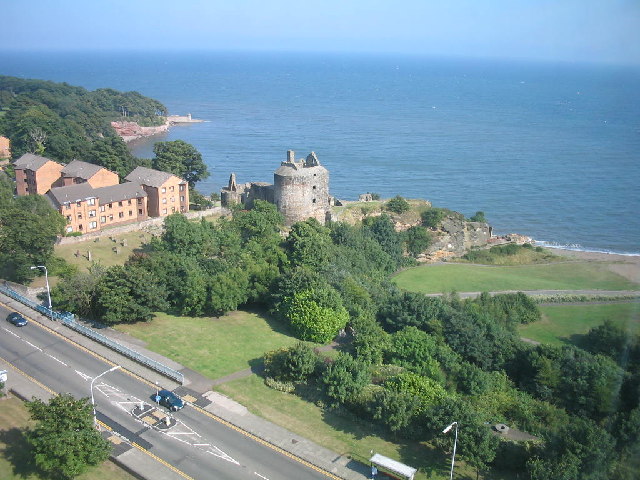
Wemyss Castle stands prominently on the rugged sea cliffs between the villages of East Wemyss and West Wemyss in Scotland. Constructed around 1421 by Sir John Wemyss, the castle was built to replace an earlier fortification destroyed in 1402 by the Duke of Rothesay at Kilconquhar. This historic fortress has served as the ancestral seat of the Earls of Wemyss and their families for centuries, embodying both defensive and residential functions typical of a late medieval Scottish castle.
The castle's strategic location atop cliffs overlooking the Firth of Forth provides commanding views of the surrounding coastline and sea approaches. Its position was crucial for defense against seaborne threats and for asserting control over the region. The castle's architecture reflects adaptations over time, with elements dating to earlier structures incorporated into later renovations, highlighting the complex building history of Wemyss Castle.
Historical significance and royal connections
Wemyss Castle is historically notable for its association with important figures of Scottish history. Most famously, it was here in 1565 that Mary, Queen of Scots met her future husband, Lord Darnley. This meeting marked a pivotal moment in Scottish royal history, intertwining the fates of two influential figures.
In addition, on 11 May 1590, a delegation of Danish commissioners led by Peder Munk and the Scottish lawyer John Skene stayed at the castle. Their mission was to inspect and take legal possession (sasine) of several royal palaces, including Falkland Palace, Dunfermline Palace, and Linlithgow Palace. These properties had been granted to Anne of Denmark by James VI of Scotland as a morning gift, a customary royal tradition.
The castle also played a role in the intrigues of the late 16th century Scottish court. In April 1591, Lilias (or Sophia) Ruthven, daughter of William Ruthven, 1st Earl of Gowrie, was confined at Wemyss Castle by royal order to prevent her marriage to Ludovic Stewart, 2nd Duke of Lennox. Despite this, Lennox succeeded in freeing her, and they married shortly thereafter at Dunkeld. After ten days, King James VI permitted the couple to join his court.
In 1592, the castle provided refuge for Margaret Winstar, a Danish lady-in-waiting to the queen, whose partner John Wemyss of Logie was implicated in a plot against the king alongside Francis Stewart, 5th Earl of Bothwell. This episode underscores the castle's role as a secure stronghold during times of political unrest.
Architectural features and unique elements
The castle's architecture is a blend of medieval defensive design and later residential adaptations. It is characterized by its imposing position on the cliffs and its use of earlier structural components. Notably, one of the towers from a previous building phase was repurposed as a windmill and later as a dovecote, illustrating the evolving functional use of the castle's spaces.
Another remarkable feature is the castle's oval-shaped dungeon, which is connected to the main building by a distinctive 30-meter zigzag passage. This unusual design likely served both security and practical purposes, providing a secure holding area difficult for captives to escape from or for attackers to access.
Restoration and current status
Wemyss Castle underwent significant restoration during the 1950s, which helped preserve its structural integrity and historical character. The castle remains a private residence but continues to attract interest due to its rich history and dramatic location. Members of the British Royal Family, including Queen Elizabeth II, have visited the castle, underscoring its ongoing cultural significance.
The Wemyss estate and local development
In the late 19th century, the surrounding lands of Wemyss Castle were developed to support the burgeoning coal mining industry. The nearby Coaltown of Wemyss was established as an estate village to house workers employed in the local mines. This development reflects the economic shifts in the region and the castle's role as a landowner overseeing industrial expansion.
Today, Wemyss Castle stands not only as a monument to Scotland's medieval past but also as a witness to the social and economic transformations of the area over several centuries.
Frequently asked questions (FAQ)
- When was Wemyss Castle built and by whom?
- Wemyss Castle was built around 1421 by Sir John Wemyss to replace an earlier castle destroyed in 1402.
- What is the historical significance of Wemyss Castle?
- The castle is known for its royal connections, including Mary, Queen of Scots meeting Lord Darnley there in 1565, and hosting important diplomatic visitors in 1590.
- Can visitors tour Wemyss Castle?
- Wemyss Castle is a private residence and is not regularly open to the public, though it remains an important historical site visible from the surrounding area.
- What unique architectural features does Wemyss Castle have?
- The castle features a tower reused as a windmill and dovecote, and an oval-shaped dungeon connected by a 30-meter zigzag passage, highlighting its medieval defensive design.
- How did Wemyss Castle contribute to the local economy?
- The castle's estate established the Coaltown of Wemyss in the 1890s to house coal miners, reflecting its role in regional industrial development.
Information
Loading map...
Visitor reviews
No reviews yet. Been here? Write the first review and help other travelers!
Write the first reviewVisited this castle? Share your experience
Your review helps other travelers and adds first-hand knowledge to our encyclopedia.