Ravenscraig Castle
Ravenscraig Castle, located near the town of Kirkcaldy in Scotland, stands as a remarkable example of late medieval military architecture. Constructed around 1460, it is widely recognized as one of the earliest, if not the very first, castles in Scotland designed specifically to withstand cannon fire and incorporate artillery defenses. Commissioned by King James II of Scotland (reigned 1437-1460) as a residence for his wife, Mary of Guelders, Ravenscraig represents a significant leap in fortress design during a period when the use of gunpowder weaponry was revolutionizing warfare.
The castle's construction was overseen by master mason Henry Merlioun and master carpenter Friar Andres Lesouris, under the direct involvement of King James II, who took a personal interest in the innovative defensive features. Tragically, James II died in 1460 due to an accident involving a cannon during the Siege of Roxburgh Castle, and the initial phase of Ravenscraig's construction was completed by his widow, Mary of Guelders. She lived in the castle until her death in 1463, by which time only the east tower and the basement of the central section had been built.
Historical development and ownership transitions
Following Mary of Guelders' death, ownership passed to their son, James III (reigned 1460-1488). In a notable political and territorial exchange in 1471, James III traded Ravenscraig Castle and its lands to William Sinclair, Earl of Orkney and Caithness, in return for the Earldom of Orkney and associated territories recently annexed from Norway. The Sinclairs, a family with a keen interest in artillery fortifications, completed the castle's construction, enhancing its cannon-resistant features and artillery platforms.
Ravenscraig played host to prominent figures such as King James V and his consort Mary of Guise during their visit in 1540. In 1598, the castle welcomed the Duke of Holstein alongside William Schaw, a significant Scottish official responsible for royal building works. The castle endured military action during the mid-17th century when it was attacked and damaged during Oliver Cromwell's invasion of Scotland (1650-1651), yet it remained under Sinclair family control.
In the 18th century, the Sinclairs built the nearby Dysart House (1755-1756) on the estate. Later, ownership passed to the Sinclair-Erskine family, the Earls of Rosslyn. The estate remained with the family until 1896, when it was sold to linoleum magnate Sir Michael Nairn, who resided at Dysart House. During the First World War, Ravenscraig was repurposed as an ammunition storehouse, underscoring its enduring strategic importance.
The Nairn family donated much of the property, including the castle, to the local community of Kirkcaldy in 1929 for use as a public park. In 1955, Ravenscraig Castle was placed under state care and has been managed by Historic Environment Scotland since 1971. It is protected as a Scheduled Ancient Monument and is open to the public, offering visitors a glimpse into pioneering artillery castle design.
Architectural features and defensive innovations
Location and natural defenses
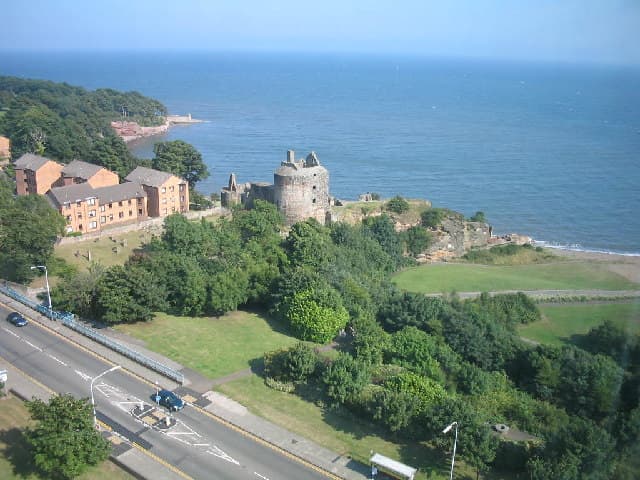
Ravenscraig Castle is strategically situated on a narrow, rocky promontory overlooking the Firth of Forth. The site benefits from natural defenses, with steep cliffs on three sides plunging directly into the sea. This geography allowed the castle's builders to focus their fortifications on the northern, landward side, which was the most vulnerable to attack.
Castle layout and structural design
The castle's core consists of two imposing D-plan towers connected by a central block. The outer walls of these towers are exceptionally thick, measuring approximately 4.25 metres, engineered specifically to resist the impact of cannonballs. These towers flank the main entrance, which is housed within the central block. This block contains a vaulted entrance passage, flanked by vaulted cellars and a guardroom, all supporting an artillery platform above.
The artillery platform is a defining feature of Ravenscraig, equipped with inverted keyhole-shaped gun holes that allowed defenders to fire artillery pieces while remaining protected. This design was innovative for the late 15th century and represents one of the earliest known examples of purpose-built artillery defenses in Scotland.
Towers and internal arrangements
The west tower rises to four storeys, with each floor containing a single small room. The ground floor includes a vaulted cellar, topped by a hall accessed via an outside stone staircase known as a forestair. A spiral staircase within the tower connects the upper floors, although the original timber floors have not survived. Multiple chimneys pierce the walls, contributing to the castle's distinctive silhouette.
The east tower is slightly lower, with three storeys and its base set deeper into the cliff face. It contains a well at the lowest level, providing a vital water source during sieges. Each upper floor hosts a single chamber, connected by a straight stair embedded within the thickness of the west wall. Like the west tower, the east tower lacks its original timber floors.
Both towers are windowless on the landward side to maximize defense, but feature windows with stone seats facing the sea, allowing natural light and ventilation while maintaining security.
External defenses and ancillary structures
Surrounding the castle is a deep, rock-cut ditch that acts as a moat, accessible only by a bridge leading to the main entrance. This ditch adds a formidable obstacle to potential attackers. Beyond the main fortified block, only the foundations of other buildings remain on the promontory, hinting at a once more extensive complex.
Cultural significance and legacy
Ravenscraig Castle is a pioneering example of the transition in military architecture during the late medieval period, reflecting the growing importance of artillery in warfare. Its design influenced subsequent Scottish fortifications and stands as a testament to the adaptation of castle construction to new military technologies.
The castle also holds cultural resonance, inspiring literary works such as Sir Walter Scott's poem Lay of the Last Minstrel, which includes the ballad "Rosabelle," drawing on stories associated with the Sinclair family and Ravenscraig's history.
Today, Ravenscraig remains a significant heritage site, offering insight into 15th-century military innovation and Scottish history. Its preservation under Historic Environment Scotland ensures that visitors can explore its unique architecture and appreciate its role in the evolution of castle design.
Frequently asked questions (FAQ)
- How do I get to Ravenscraig Castle in Kirkcaldy?
- Ravenscraig Castle is located near Kirkcaldy in Fife, Scotland. It is accessible by local roads and is a short drive from the town center. Public transport options include buses to Kirkcaldy, from where the castle is a brief taxi or walk away.
- What makes Ravenscraig Castle architecturally significant?
- Ravenscraig Castle is one of Scotland's earliest artillery fortresses, featuring thick walls over 4 meters thick and inverted keyhole gun holes designed to withstand and deploy cannon fire. Its innovative design marks a key transition in late medieval military architecture.
- When was Ravenscraig Castle built and by whom?
- The castle was commissioned around 1460 by King James II of Scotland and constructed under the supervision of master mason Henry Merlioun and master carpenter Friar Andres Lesouris. Construction continued under Mary of Guelders and later the Sinclair family.
- Is Ravenscraig Castle open to the public?
- Yes, Ravenscraig Castle is managed by Historic Environment Scotland and is open to visitors. While specific opening hours may vary, it has been accessible to the public since 1971 as a historic site.
- What remains of Ravenscraig Castle today?
- Today, Ravenscraig Castle is partially preserved, with its two D-plan towers, central block, rock-cut ditch, and artillery platform still visible. Some original timber floors are missing, but the stone structures provide a clear sense of its historic defensive design.
Photo gallery

Information
Sources & official resources
Verify the information above using these authoritative references.
Loading map...
Visitor reviews
No reviews yet. Been here? Write the first review and help other travelers!
Write the first reviewVisited this castle? Share your experience
Your review helps other travelers and adds first-hand knowledge to our encyclopedia.