Macduff's Castle
Macduff's Castle stands as a significant medieval ruin near East Wemyss in Scotland, closely linked to the powerful MacDuff Earls of Fife. The site has deep historical roots, with origins possibly dating back to the 11th century during the reign of King Macbeth of Scotland (d. 1057). Although no physical remains survive from this earliest phase, tradition holds that the MacDuff Mormaers established a stronghold here, marking the site as an important seat of power in early medieval Scotland.
The castle as it is known today primarily reflects construction from the 14th century onwards, initiated by the Wemyss family, descendants of the MacDuffs. This lineage underscores the continuity of noble occupation and influence in the region. The Wemyss built the earliest surviving parts of the castle, including a four-storey tower constructed of local stone, designed for both defense and residence.
Historical significance and ownership
Macduff's Castle played a notable role during the turbulent period of the Wars of Scottish Independence. In 1304, King Edward I of England stayed at the castle while it was under the ownership of Sir Michael Wemyss. However, the Wemyss family's allegiance shifted to support Robert the Bruce, leading Edward I to order the castle's destruction as part of his military efforts in Scotland.
Despite this, the Wemyss family maintained their presence in the area, eventually relocating to the nearby Wemyss Castle. Ownership of Macduff's Castle later passed to the Livingstone family before being acquired by the Colville family in 1530. The Colvilles made significant architectural enhancements, including the addition of a second five-storey tower to the south-west and a gatehouse enclosing the courtyard, reflecting the evolving defensive needs and status symbols of the period.
In 1637, Sir John Wemyss of West Wemyss repurchased the castle from Lord Colville of Culross, and by 1651 the lands of East and West Wemyss were united into a single barony. Since then, the castle and its estate have remained under the stewardship of the Wemyss Estate, preserving the site's historical legacy.
Architectural features and evolution
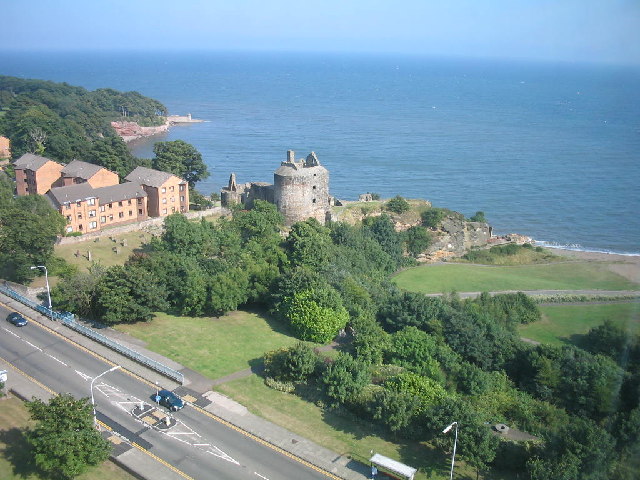
The surviving ruins of Macduff's Castle reveal a complex architectural history spanning from the 14th to the 17th centuries. The original four-storey tower from the 14th century served as the main defensive and residential structure. Built from robust local stone, it was designed to withstand sieges and provide secure living quarters.
The 16th-century expansion under the Colvilles introduced a larger five-storey tower connected to the original structure by a gatehouse range. This gatehouse enclosed the courtyard, creating a controlled access point that enhanced the castle’s defensive capabilities. The courtyard would have served as a central space for daily activities and gatherings.
Architectural adaptations to changing military technology are evident in the 17th-century walls, which incorporate gun loops. These narrow slits allowed defenders to fire firearms while remaining protected, illustrating the castle's evolution in response to the increasing use of gunpowder weapons in warfare.
Demolition and loss of structures
In 1967, the castle's eastern 16th-century tower was demolished by Fife County Council following an incident where a child was injured after falling from the structure. This removal significantly altered the castle's silhouette and reduced the extent of visible ruins.
Additionally, a 16th-century dovecote once stood near the shore to the south of the castle. This structure was used to house pigeons or doves, which were valuable for meat and eggs. Unfortunately, the dovecote was lost to coastal erosion in the 1970s, further diminishing the site’s historical fabric.
Cultural heritage and preservation
Today, Macduff's Castle is recognized as a Scheduled Ancient Monument, underscoring its importance within Scotland's cultural and archaeological heritage. The ruins provide insight into the defensive strategies and domestic arrangements of Scottish noble estates from the medieval to early modern periods.
The castle is also associated with local folklore, including tales of a Grey Lady ghost, believed to be Mary Sibbald, who was reportedly found guilty of theft and died within the castle walls. Such stories contribute to the site's cultural significance and visitor interest.
Despite the partial loss of structures, the castle remains under the ownership of the Wemyss Estate, ensuring ongoing stewardship and protection. The site continues to attract visitors interested in Scottish history, medieval architecture, and the legacy of the MacDuff Earls of Fife.
Visitor information and accessibility
While Macduff's Castle is primarily a ruin, it offers a tangible connection to Scotland's medieval past. Visitors can explore the remaining walls and towers, gaining an understanding of the castle's layout and historical context. The site’s location near East Wemyss makes it accessible for those interested in exploring Fife's rich heritage.
As a protected monument, visitors are encouraged to respect the fragile nature of the ruins. Information panels and guided tours in the region provide additional historical background and architectural insights to enhance the visitor experience.
Frequently asked questions (FAQ)
- How do I get to Macduff's Castle?
- Macduff's Castle is located near East Wemyss in Fife, Scotland. It can be reached by car or local bus services from nearby towns. The site is accessible via public footpaths from the village center.
- What is the historical significance of Macduff's Castle?
- Macduff's Castle was originally established by the MacDuff Earls of Fife, a powerful medieval Scottish family. It played a role during the Wars of Scottish Independence and reflects architectural developments from the 14th to 17th centuries.
- Can visitors enter the castle ruins?
- Visitors can explore the exterior ruins of Macduff's Castle. Due to safety concerns and preservation efforts, access inside the remaining structures is restricted. Visitors should follow all posted guidelines and respect the fragile ruins.
- When is the best time to visit Macduff's Castle?
- The castle is best visited during the warmer months from late spring to early autumn when weather conditions are favorable for walking and outdoor exploration. Daylight hours are longer, allowing more time to appreciate the site.
- Are there any guided tours available at Macduff's Castle?
- While there are no regular guided tours at Macduff's Castle itself, local heritage organizations in Fife offer tours that include the castle as part of broader historical and architectural itineraries.
- Is Macduff's Castle accessible for people with mobility issues?
- Due to the uneven terrain and ruinous state of the castle, accessibility for visitors with mobility issues is limited. Visitors are advised to contact local tourist information centers for assistance and alternative heritage sites.
Information
Sources & official resources
Verify the information above using these authoritative references.
Loading map...
Visitor reviews
No reviews yet. Been here? Write the first review and help other travelers!
Write the first reviewVisited this castle? Share your experience
Your review helps other travelers and adds first-hand knowledge to our encyclopedia.