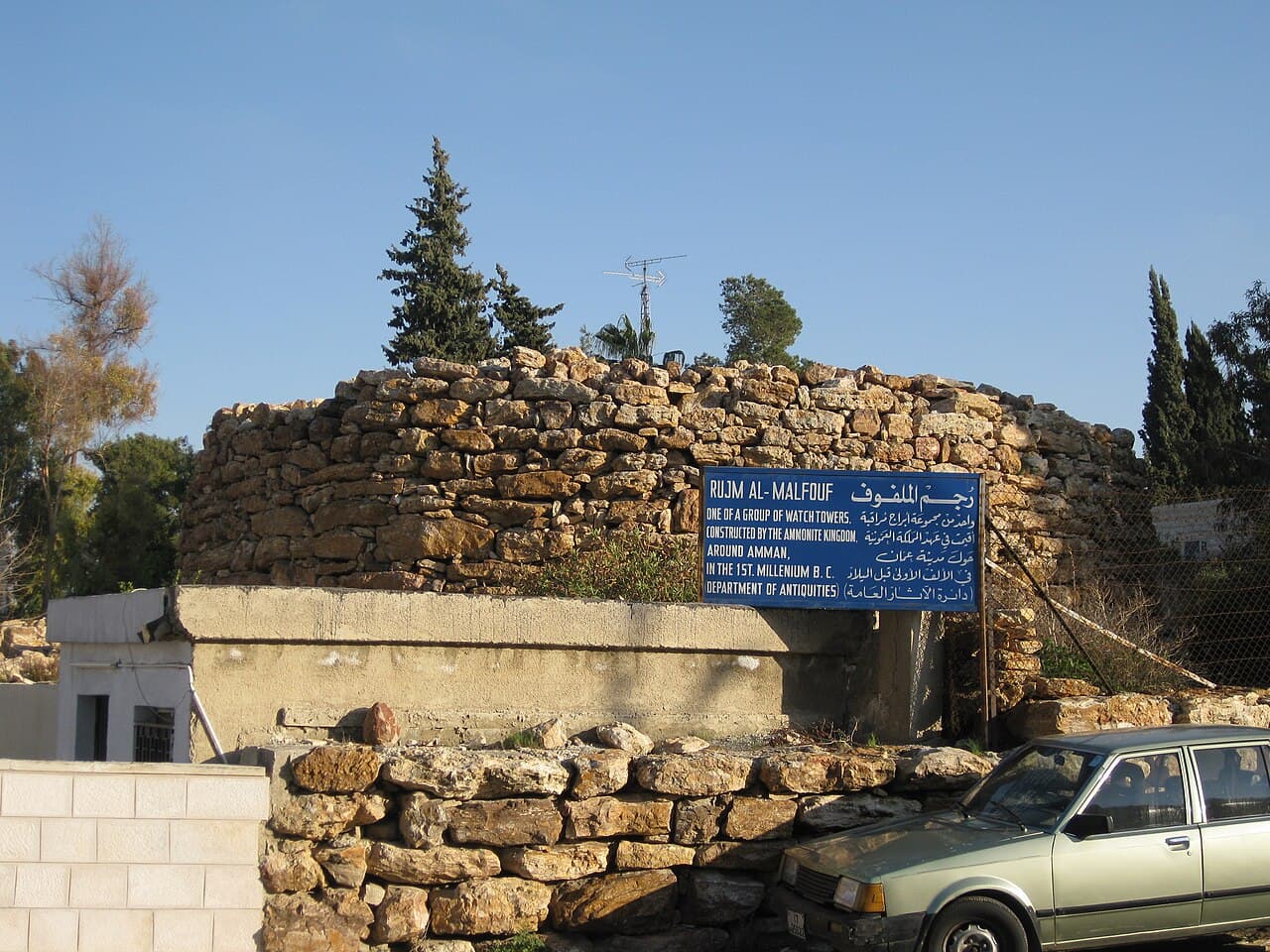
Watchtower in Rujm Al-Malfouf
Rujm Al-Malfouf is a significant ancient watchtower located in the northern side of the Jabal Amman neighborhood in Amman, Jordan. This round stone tower stands as a remarkable example of early defensive and agricultural architecture dating back to the 7th century BC during the Ammonite Kingdom. The tower's enduring presence through multiple historical periods highlights its strategic importance and adaptive reuse.
Architectural features and layout
The watchtower features a substantial 22-meter diameter circular stone construction, a characteristic form among similar towers found on the plateaus of central Jordan. Adjacent to the tower are several storerooms, indicating that the complex served multiple functions beyond military defense, likely including storage of agricultural produce and supplies. The thick stone walls and elevated position would have provided excellent visibility and protection.
Structural comparisons and related sites
Near the southwestern side of Jabal Amman, there once stood a smaller tower known as Rujm al-Malfouf South, which measured approximately 13 meters in diameter. Although now destroyed, this smaller tower shared architectural traits with the main Rujm Al-Malfouf tower, suggesting a network of similar fortifications or watchpoints across the region.
Historical context and significance
Originally constructed during the Early Medieval period in the 7th century BC, the tower was part of the Ammonite Kingdom's defensive and agricultural infrastructure. Its strategic location on Jabal Amman allowed it to oversee and control surrounding territories. Over the centuries, the tower was rebuilt and reused during the Roman and Islamic periods, reflecting its sustained importance in regional security and resource management.
Archaeological excavations and findings
The site has undergone several archaeological excavations between 1969 and 2022, uncovering a variety of artifacts including coins, pottery shards, and stamps. These findings provide valuable insights into the tower's long-term use and the cultural influences that shaped its history. The artifacts also confirm the site's continuous occupation and adaptation across different civilizations.
Cultural and geographical setting
Today, Rujm Al-Malfouf is situated within a modern residential neighborhood in Amman, adjacent to the Jordan Department of Antiquities and the Algerian embassy. Its proximity to these institutions underscores its cultural heritage significance and the ongoing efforts to preserve Jordan's ancient monuments.
Interpretations of function
Initially interpreted by scholar Nelson Glueck in 1939 as a series of "Ammonite towers" serving primarily as border forts, more recent research suggests a broader range of uses. These towers likely had mixed functions, including military defense, agricultural storage, and territorial control throughout various historical periods. This multifunctionality reflects the complex socio-economic landscape of ancient Jordan.
Architectural legacy and preservation
Despite its ancient origins, the Rujm Al-Malfouf tower remains partially preserved, offering valuable insights into Early Medieval fortification architecture in the Levant. Its robust stone construction and strategic siting have allowed it to survive millennia of environmental and human changes. Preservation efforts continue to focus on maintaining the integrity of the tower and its associated structures within the urban environment.
Frequently asked questions (FAQ)
- What is the historical significance of Rujm Al-Malfouf?
- Rujm Al-Malfouf is an ancient Ammonite watchtower dating back to the 7th century BC, used for defense and agricultural storage, and later reused during Roman and Islamic periods.
- Can visitors access Rujm Al-Malfouf today?
- The tower is located within a residential area in Amman and is partially preserved. Visitors can view it from outside, but access inside may be restricted due to preservation efforts.
- When was Rujm Al-Malfouf excavated?
- Archaeological excavations at Rujm Al-Malfouf took place intermittently between 1969 and 2022, uncovering coins, pottery, and stamps that shed light on its long history.
- How does Rujm Al-Malfouf compare to other Ammonite towers?
- Rujm Al-Malfouf is larger than the nearby now-destroyed Rujm al-Malfouf South tower, with a diameter of 22 meters compared to 13 meters, indicating its greater strategic or functional importance.
- What architectural style does Rujm Al-Malfouf represent?
- The tower exemplifies early medieval fortification architecture with robust stone construction typical of Ammonite defensive structures in Jordan.
Photo gallery

Information
Current owner
Jordan Department of Antiquities
Loading map...
Visitor reviews
No reviews yet. Been here? Write the first review and help other travelers!
Write the first reviewVisited this castle? Share your experience
Your review helps other travelers and adds first-hand knowledge to our encyclopedia.