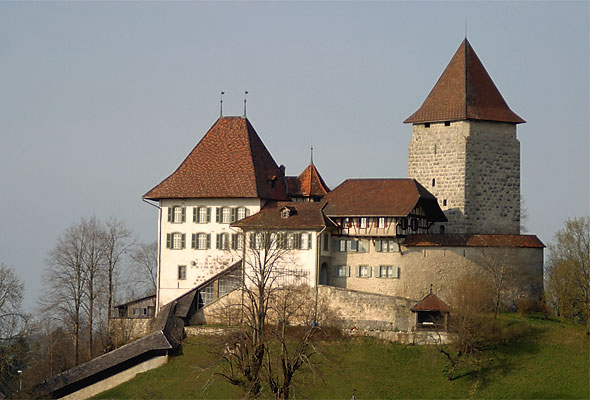
Wartenstein Castle
Wartenstein Castle stands as a compelling example of a high medieval hill castle located in the municipality of Lauperswil, Switzerland. Perched on a wooded hill above the village, the castle's ruins overlook the surrounding landscape, embodying centuries of regional history, feudal power struggles, and architectural evolution. Its origins trace back to the 13th century, a period marked by territorial consolidation and the rise of noble families asserting control through fortified residences.
The origins and early history of Wartenstein Castle
The castle was constructed on a narrow ridge carved into three terraces, a strategic location chosen for its natural defensive advantages. The earliest known resident was the knight Swaro von Wartenstein, documented in 1228, indicating the castle's establishment by the early 13th century. This aligns with the broader pattern of castle-building in the high medieval period across the Swiss plateau, where fortifications served both military and administrative functions.
Initially, the area was part of the Freiherrschaft of Signau and controlled by the lords of Ruoderswilare until the 12th century. By the 13th century, Wartenstein Castle replaced an earlier castle southwest of Rüderswil, marking a shift in regional power centers. Ownership passed through notable families, including the Schweinsberg family, who held significant influence and also owned Attinghausen Castle in Uri. The castle's connection to Werner von Attinghausen, an important figure in the early Swiss Confederacy, highlights its role within the broader political landscape of medieval Switzerland.
Architectural features and layout
The castle's design reflects typical medieval military architecture adapted to the local topography. The main castle was situated on the southern terrace and included a tower, courtyard, and a great hall. The northern terrace possibly contained a bailey, although its existence remains uncertain due to limited archaeological evidence. The castle well, located on the eastern slope, was essential for sustaining inhabitants during sieges.
Constructed primarily of stone, the castle's walls were robust, designed to withstand assaults. The main tower likely served as both a residence and a last line of defense, with living quarters on the upper floors featuring window niches and smoke vents indicative of fireplaces. The castle's layout on hand-carved terraces demonstrates advanced medieval engineering to maximize defensive capabilities while accommodating residential needs.
Historical events and decline
Wartenstein Castle witnessed significant historical events, including its capture and destruction during the Burgdorferkrieg in 1383 by Bernese troops. This conflict was part of the territorial disputes that shaped the power dynamics in the region. After the castle was burned, it passed through various hands, including Ulrich von Balmoos and later Wilhelm Hug von Sulz, who constructed a manor house in the valley, signaling a shift from fortified hilltop residences to more comfortable valley estates.
The castle's decline was gradual, exacerbated by changing military technology and political structures. By the 15th century, the castle was largely in ruins, and the surrounding Herrschaft was dissolved, integrating Lauperswil into the Vogtei of Trachselwald. Local legends, such as the tale of the last lord and his daughter perishing during their escape, add a layer of cultural mystique to the site.
In the 20th century, efforts were made to excavate and stabilize the remaining walls, preserving the ruins as a cultural heritage site. Today, visitors can access the castle via a steep trail from Blindenbach, experiencing firsthand the dramatic setting and remnants of a once formidable medieval fortress.
Wartenstein Castle in the context of Swiss medieval fortifications
Wartenstein exemplifies the strategic use of natural terrain in medieval Swiss castle construction. Its location on a narrow ridge with terraces allowed defenders to control key routes and maintain oversight of the surrounding valleys. The castle's history reflects the complex feudal relationships and territorial conflicts characteristic of the Swiss plateau during the Middle Ages.
The castle's architectural evolution, from its initial construction through phases of destruction and partial rebuilding, mirrors broader trends in castle design, including the transition from simple fortifications to more complex structures with baileys, zwingers, and improved defensive features.
Visiting Wartenstein Castle today
Today, Wartenstein Castle remains a site of historical interest and natural beauty. The ruins, though heavily weathered, retain enough structural elements to convey the castle's original form and function. The site offers a glimpse into medieval life, feudal power, and the architectural ingenuity of the period.
Visitors should prepare for a moderately challenging hike along a marked trail beginning in Blindenbach, which takes approximately 20 minutes to reach the ruins. The wooded hilltop location provides scenic views of the surrounding countryside and an evocative atmosphere for exploring the remains of this high medieval hill castle.
Frequently asked questions (FAQ)
- How do I get to Wartenstein Castle?
- Wartenstein Castle is accessible via a steep, marked trail starting from the hamlet of Blindenbach near Lauperswil. The hike takes about 20 minutes and offers scenic views of the surrounding area.
- What is the historical significance of Wartenstein Castle?
- Wartenstein Castle played a key role in regional power dynamics during the high medieval period. It was associated with notable noble families and witnessed significant conflicts such as the Burgdorferkrieg in 1383.
- Is Wartenstein Castle suitable for families with children?
- The castle ruins are located on a steep hill and involve a moderately challenging hike. While older children may enjoy the adventure, families should exercise caution and supervise younger children closely.
- When is the best time to visit Wartenstein Castle?
- The best time to visit is during late spring to early autumn when the weather is favorable for hiking and the trails are clear. Winter visits are less recommended due to slippery conditions.
- Are there guided tours available at Wartenstein Castle?
- Currently, there are no regular guided tours at Wartenstein Castle, but informational signage at the site provides historical context. Visitors can explore the ruins independently.
Information
Sources & official resources
Verify the information above using these authoritative references.
Loading map...
Visitor reviews
No reviews yet. Been here? Write the first review and help other travelers!
Write the first reviewVisited this castle? Share your experience
Your review helps other travelers and adds first-hand knowledge to our encyclopedia.