Wartburg Castle
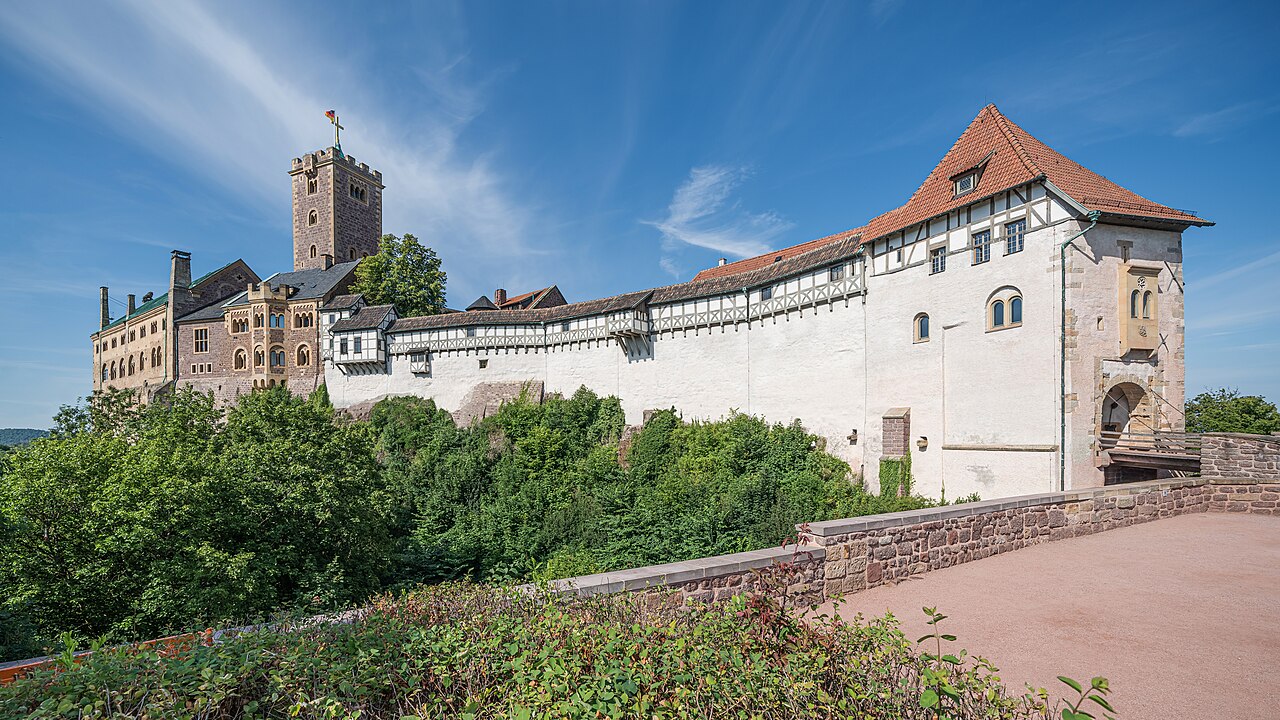
Wartburg Castle, perched on a steep rocky ridge overlooking the town of Eisenach in Thuringia, Germany, is one of the most remarkable and best-preserved medieval fortresses in Europe. Founded around 1067 by the Thuringian count Ludwig der Springer, this hill castle has played a pivotal role in German history, culture, and architecture for nearly a millennium.
The castle's name likely derives from the German word “Warte,” meaning watch or guard, reflecting its original purpose as a strategic lookout fortress. Situated approximately 220 meters above Eisenach at an elevation of about 411 meters above sea level, the Wartburg commands sweeping views of the surrounding landscape, which was essential for its defensive role during the High Medieval period.
Architectural evolution and medieval significance
The Wartburg's initial construction in the late 11th century established it as a formidable fortification. Its earliest surviving structure, the Palas (residential hall), was built between 1156 and 1162 under the reign of Landgrave Ludwig II. This building is historically significant as the oldest princely residential hall of its kind in the German-speaking world, showcasing early Romanesque architectural influences reminiscent of Roman palace designs.
The castle complex originally comprised four main sections, but today only the outer bailey (Vorburg) and the main castle (Hauptburg) remain. The outer bailey features a drawbridge and gatehouse, which were added during the castle's transformation into a princely residence. Surrounding it are late medieval structures such as the Ritterhaus and Vogtei. The ring wall dates partially to the 12th century and was modified in the 15th century with timber-framed overhangs known as the Margaretengang and Elisabethgang.
The main castle contains both medieval and 19th-century historicist elements. The Palas houses notable rooms including the Rittersaal (Knight’s Hall), the Speisezimmer (dining room), and the Elisabeth-Kemenate, which was redecorated with neobyzantine glass mosaics by August Oetken between 1902 and 1906, illustrating scenes from the life of Saint Elisabeth of Hungary.
The second floor features the Wartburg chapel and the Sängersaal (Singers’ Hall), adorned with 19th-century frescoes by Moritz von Schwind depicting the legendary Sängerkrieg, a medieval contest of minnesänger poets. The Elisabethgalerie frescoes were restored between 2015 and 2017. The third floor contains a 40-meter-long Festsaal (festival hall), added after the castle became a Ludowing residence.
The Südturm (South Tower), dating from the 13th century and rebuilt after a fire in 1318, is the only original medieval tower still standing in the main castle. The Bergfried (main tower) was reconstructed in the 19th century on the foundations of the original medieval tower, using local red Rotliegend sandstone and Seeberg sandstone.
The castle grounds include the Burggarten (castle garden), located below the Gadem building, which served variously as a magazine, armory, and kitchen. The Gadem was rebuilt in the late 19th century, preserving its vaulted cellar.
Historical and cultural importance
Throughout its history, Wartburg Castle has been a center of political power, culture, and religious significance. From 1172 to 1211, it served as a princely court under Landgrave Hermann I, who patronized the arts and supported renowned minnesänger poets such as Walther von der Vogelweide and Wolfram von Eschenbach. The castle is famously linked to the Sängerkrieg, a legendary contest of singers immortalized in German folklore.
Saint Elisabeth of Hungary lived at Wartburg from 1211 until 1227. She was renowned for her charitable works and was canonized just five years after her death in 1231. Her life and legacy remain integral to the castle's identity, celebrated through dedicated architectural features and artworks.
The castle's most internationally significant chapter occurred between May 1521 and March 1522, when Martin Luther was hidden there under the alias Junker Jörg (Knight George) following his excommunication from the Catholic Church. During his enforced stay, Luther translated the New Testament from Ancient Greek into German in just eleven weeks. This translation was not the first German Bible but became the most influential, contributing to the standardization of the German language and fueling the Protestant Reformation.
After the extinction of the Ludowing dynasty in 1247, the castle passed to the Wettin family, who maintained and expanded it. A devastating fire in 1317 or 1318 caused significant damage, prompting substantial reconstruction, including the addition of a chapel to the Palas.
19th-century restoration and modern legacy
By the 19th century, Wartburg had fallen into disrepair. The castle was revitalized under the patronage of Grand Duke Carl Alexander of Saxe-Weimar-Eisenach, who commissioned a historicist restoration beginning in 1838. The lead architect, Hugo von Ritgen, dedicated much of his life to this project, which was only completed after his death in 1889. This restoration introduced many of the castle's current features, blending medieval remains with 19th-century Romanticism.
The castle became a symbol of German nationalism and unity, hosting the Wartburg Festival in 1817 and again in 1848, where students and intellectuals gathered to celebrate the Reformation's legacy and advocate for German unification.
During the Nazi era, the castle was appropriated for propaganda purposes, including the temporary replacement of the original tower cross with a swastika in 1938, which was restored after public protest. The castle sustained minor damage from American artillery in 1945 but was promptly repaired.
Post-World War II, under East German administration, extensive restoration took place from 1952 to 1954, focusing on returning parts of the Palas to their original Romanesque appearance. Modern infrastructure improvements have continued since German reunification, supported by federal cultural funds.
In 1999, Wartburg Castle was designated a UNESCO World Heritage Site, recognized for its outstanding medieval architecture and profound cultural significance. Today, it remains a major tourist attraction, hosting exhibitions, concerts, and commemorative events, including celebrations marking the 500th anniversary of the Reformation in 2017.
Castle grounds and visitor experience
The Wartburg is surrounded by a protected forest area known as the “Blue Line,” established in the 1930s to preserve the castle's natural and historical landscape. Visitors can explore the outer bailey with its historic gatehouse and late medieval buildings, as well as the main castle with its richly decorated interiors and significant historical rooms.
The Vogtei building houses the Lutherstube, where Martin Luther stayed and worked on his Bible translation. It also features the Nürnberger Erker, a Gothic oriel window transplanted from a patrician house in Nuremberg, and the Pirckheimer Stübchen, a late 15th-century cabinet room relocated to the castle in the 19th century.
The castle also includes a concert hall influenced by composer Franz Liszt, enhancing its cultural offerings. The Wartburg-Gasthof guesthouse, built between 1912 and 1914, provides accommodation for visitors.
Visitor information
Wartburg Castle is accessible to the public year-round, offering guided tours that delve into its rich history and architecture. Its location near Eisenach makes it a convenient destination for cultural tourism in Thuringia. Visitors can enjoy panoramic views, explore the historic interiors, and attend various cultural events hosted at the castle.
Architectural highlights
- Palas: The oldest surviving princely residential hall in Germany, featuring Romanesque architecture and historic interiors.
- Sängersaal: The singers’ hall decorated with frescoes depicting the legendary Sängerkrieg.
- Elisabeth-Kemenate: A chamber adorned with neobyzantine mosaics illustrating Saint Elisabeth’s life.
- Südturm: The surviving medieval tower guarding the southern slope.
- Bergfried: The main tower rebuilt in the 19th century on medieval foundations.
- Lutherstube: Martin Luther’s study during his refuge at the castle.
Frequently asked questions (FAQ)
- How do I get to Wartburg Castle?
- Wartburg Castle is located in Eisenach, Germany, and can be reached by car or public transportation. The nearest train station is Eisenach, from where you can take a bus or enjoy a scenic hike up to the castle. Parking is available on-site for those driving.
- What is the historical significance of Wartburg Castle?
- Wartburg Castle is a UNESCO World Heritage site, renowned for its role in German history, particularly during the Reformation. It was here that Martin Luther translated the New Testament into German, making it accessible to the public. The castle also served as a refuge for various historical figures, enhancing its cultural importance.
- When was Wartburg Castle built?
- Wartburg Castle was originally constructed in the 11th century, around 1067, making it one of the oldest castles in Germany. Over the centuries, it has undergone numerous renovations and expansions, reflecting various architectural styles. Today, it stands as a testament to medieval and Renaissance architecture.
- Can I visit Wartburg Castle year-round?
- Yes, Wartburg Castle is open to visitors year-round, but it's advisable to check specific opening hours as they may vary by season. During peak tourist season, usually from May to September, the castle tends to be more crowded. Visiting in the off-peak months can provide a more tranquil experience.
- Why is Wartburg Castle a popular tourist attraction?
- Wartburg Castle is popular due to its rich history, stunning architecture, and breathtaking views of the surrounding landscape. It offers guided tours that educate visitors about its historical significance and the lives of its past residents. Additionally, its connection to Martin Luther adds a spiritual dimension that attracts many visitors.
- Is it possible to access Wartburg Castle for people with disabilities?
- Wartburg Castle strives to be accessible to all visitors, including those with disabilities. There are designated parking spaces, and the main areas of the castle are accessible via ramps. However, some parts of the castle may still present challenges due to its historic structure.
- What are the ticket prices for Wartburg Castle?
- Ticket prices for Wartburg Castle vary depending on the type of tour and age group. As of the latest information, adult tickets are approximately €12, while reduced prices are available for students and seniors. Children under a certain age may enter for free, making it an affordable destination for families.
- What are the opening hours for Wartburg Castle?
- Wartburg Castle typically opens at 9:00 AM and closes at 6:00 PM during the summer months, with shorter hours in the winter. It's best to check the official website for the most current information and any special holiday hours. Guided tours are available throughout the day, enhancing the visitor experience.
- What nearby attractions can I visit while at Wartburg Castle?
- While visiting Wartburg Castle, you can also explore the charming town of Eisenach, which offers attractions like the Bach House and the Luther House. Additionally, the surrounding Thuringian Forest provides beautiful hiking trails and outdoor activities. This combination makes for a well-rounded visit to the area.
Information
Website
Visit websiteFeatured in
Articles on the Castlopedia blog that feature Wartburg Castle.
Sources & official resources
Verify the information above using these authoritative references.
Loading map...
Visitor reviews
No reviews yet. Been here? Write the first review and help other travelers!
Write the first reviewVisited this castle? Share your experience
Your review helps other travelers and adds first-hand knowledge to our encyclopedia.