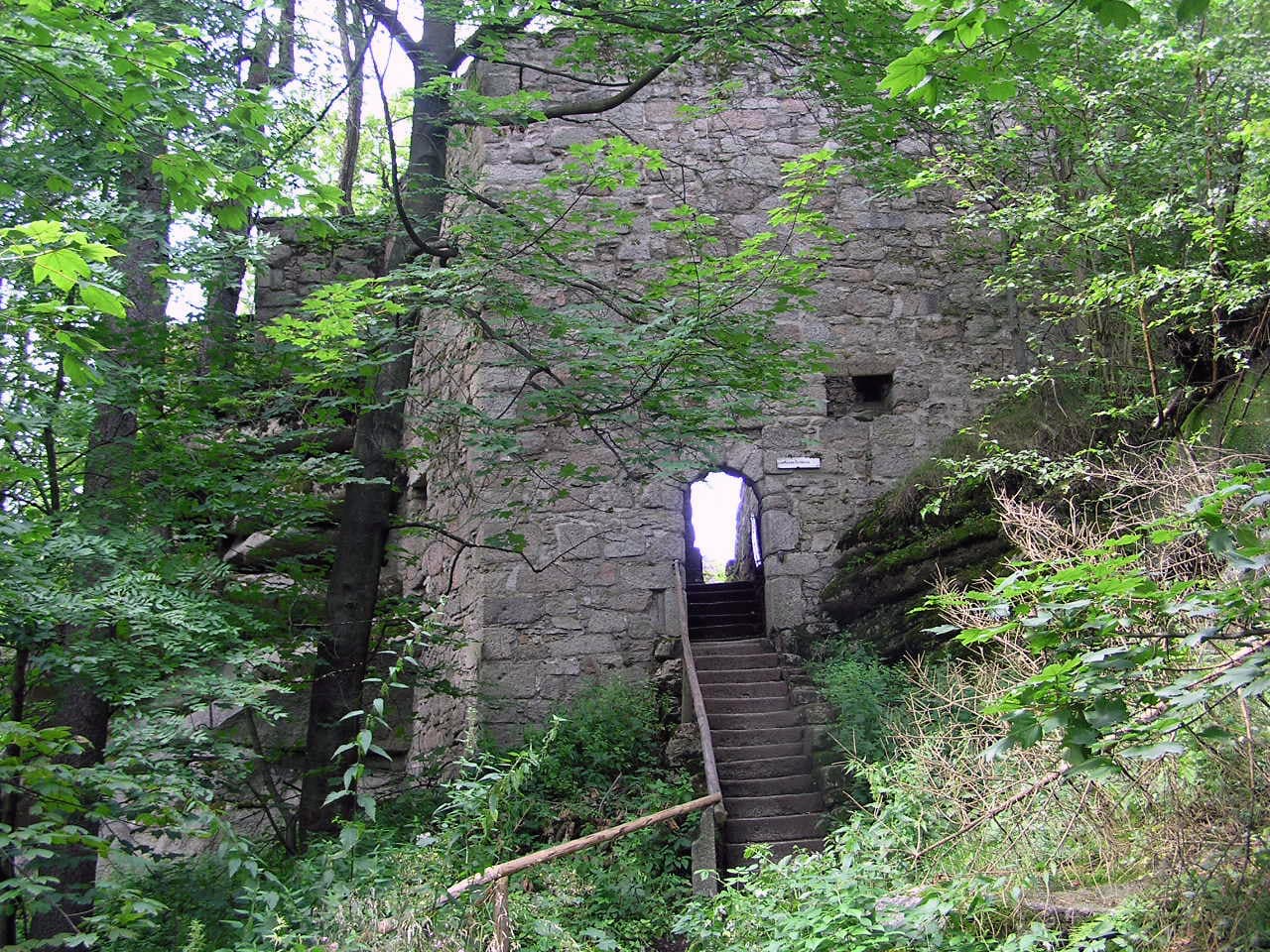
Waldsteinburg
Waldsteinburg castle, also known as the "Red Castle," stands as a striking ruin perched atop the Großer Waldstein summit in the Fichtel Mountains of Germany. This medieval hill castle was constructed by the knightly von Sparneck family in the 14th century, replacing the older Ostburg fortress which had become insufficient for defense. Its strategic location at nearly 880 meters above sea level provided commanding views over the surrounding forested terrain, a vital advantage in an era of frequent regional conflicts.
The castle is first documented in 1350 and was held as an imperial fief by the von Sparnecks, whose territory closely matched the former Münchberg district. Among the family, Rüdiger von Sparneck (active c. 1300–1360s) was a notable figure, appointed count palatine of Eger in 1336. Under his influence, the nearby town of Münchberg received rights modeled after those of Nuremberg in 1364, underscoring the family's regional importance and administrative power.
Architecture and layout
The castle's design capitalized on its natural rocky plateau, with a complex comprising an outer ward (Vorburg) and an inner ward (Hauptburg). The outer ward retained a portion of the original castle gate and was fortified on all sides, using natural rock formations and palisade fences to enhance defense. Within this area, a stone building served as a warehouse, supporting the castle's logistical needs.
The inner ward contained the main defensive and residential structures. Archaeological excavations have revealed foundations of a palace (Palas), a gatehouse, and a battlemented curtain wall featuring a centrally positioned large bartizan tower—a small fortified turret projecting from the wall. A square-shaped keep (Bergfried) anchored the defense. Access to this inner enclosure was secured by a drawbridge, an element confirmed by research despite its absence in contemporary depictions such as the 1523 woodcut by Hans Wandereisen. This image, while artistically impressive, exaggerated the castle's height and number of floors.
Historical significance and events
Waldsteinburg played a critical role in the turbulent politics of the region during the early 16th century. The von Sparneck family became embroiled in conflicts related to robber baron activity. Notably, the castle sheltered prisoners taken by Hans Thomas von Absberg, a notorious kidnapper of the time. In 1521, it was regarded as the most secure fortress in the Fichtel Mountains, used to detain imperial captives.
However, in early 1523, these prisoners escaped, prompting a punitive expedition by the Swabian League. On July 11, 1523, the castle was attacked and destroyed by fire and explosion. The von Sparneck family lost their holdings, which were confiscated by the Bohemian crown and later sold to Christoph Haller von Hallerstein. The von Sparneck lineage ended in 1744, marking the close of their regional influence.
Later use and cultural legacy
After nearly two centuries of neglect, the ruins of Waldsteinburg found renewed purpose during the War of Spanish Succession in the early 1700s. The gatehouse was reroofed with distinctive red tiles and repurposed as a watchtower and storage facility. This architectural adaptation gave rise to the castle's enduring nickname, the "Red Castle," first recorded by Johann Theodor Benjamin Helfrecht in 1795.
In modern times, the site has been subject to preservation efforts, including granite restoration work to stabilize the ruins. Since 1923, the castle has hosted the Waldsteinfestspiele, a historical festival revived in the 1990s by a local theatre group, celebrating the castle's rich cultural heritage and continuing its legacy as a symbol of regional history.
Defensive features and strategic setting
The castle's location atop a rocky plateau was deliberately chosen for its natural defensive advantages. The surrounding forest was cleared to provide clear sightlines, allowing early detection of approaching enemies. Contemporary records described Waldsteinburg as a "death pit," highlighting its formidable defensive reputation.
The architectural elements such as the battlemented curtain walls, bartizan tower, and square keep reflect typical medieval military design, optimized for surveillance and defense. The use of a drawbridge further enhanced security by controlling access to the inner ward.
Archaeological remains and preservation
Today, the ruins of Waldsteinburg provide valuable insights into medieval castle construction and regional history. While most standing structures have been lost, the foundations outline a complex and well-fortified summit castle. The site includes remnants of the outer and inner wards, the palas, gatehouse, curtain walls, bartizan tower, and the keep.
Recent conservation efforts have focused on preserving the granite masonry and stabilizing the ruins against further decay. Visitors can explore the site to appreciate its strategic location and architectural significance, connecting with the turbulent history of the von Sparneck family and the broader medieval landscape of the Fichtel Mountains.
Frequently asked questions (FAQ)
- When was Waldsteinburg castle built and by whom?
- Waldsteinburg castle was constructed in the 14th century by the knightly von Sparneck family as a replacement for the older Ostburg fortress.
- What led to the destruction of Waldsteinburg in 1523?
- The castle was destroyed by fire and explosion after the escape of prisoners in 1523, prompting a retaliatory attack by the Swabian League.
- Why is Waldsteinburg called the 'Red Castle'?
- The castle's gatehouse was reroofed with distinctive red tiles in the early 1700s, leading to its nickname 'Red Castle' first recorded in 1795.
- What defensive features did Waldsteinburg have?
- The castle featured battlemented curtain walls, a bartizan tower, a square keep, and a drawbridge, all designed to maximize defense on its rocky summit.
- Is Waldsteinburg castle accessible to visitors today?
- Yes, the ruins are accessible and have been preserved with restoration efforts; visitors can explore the foundations and enjoy the site's historical significance.
Photo gallery

Photo by No machine-readable author provided. Schubbay assumed (based on copyright claims).•CC BY-SA 3.0
Information
Loading map...
Visitor reviews
No reviews yet. Been here? Write the first review and help other travelers!
Write the first reviewVisited this castle? Share your experience
Your review helps other travelers and adds first-hand knowledge to our encyclopedia.



