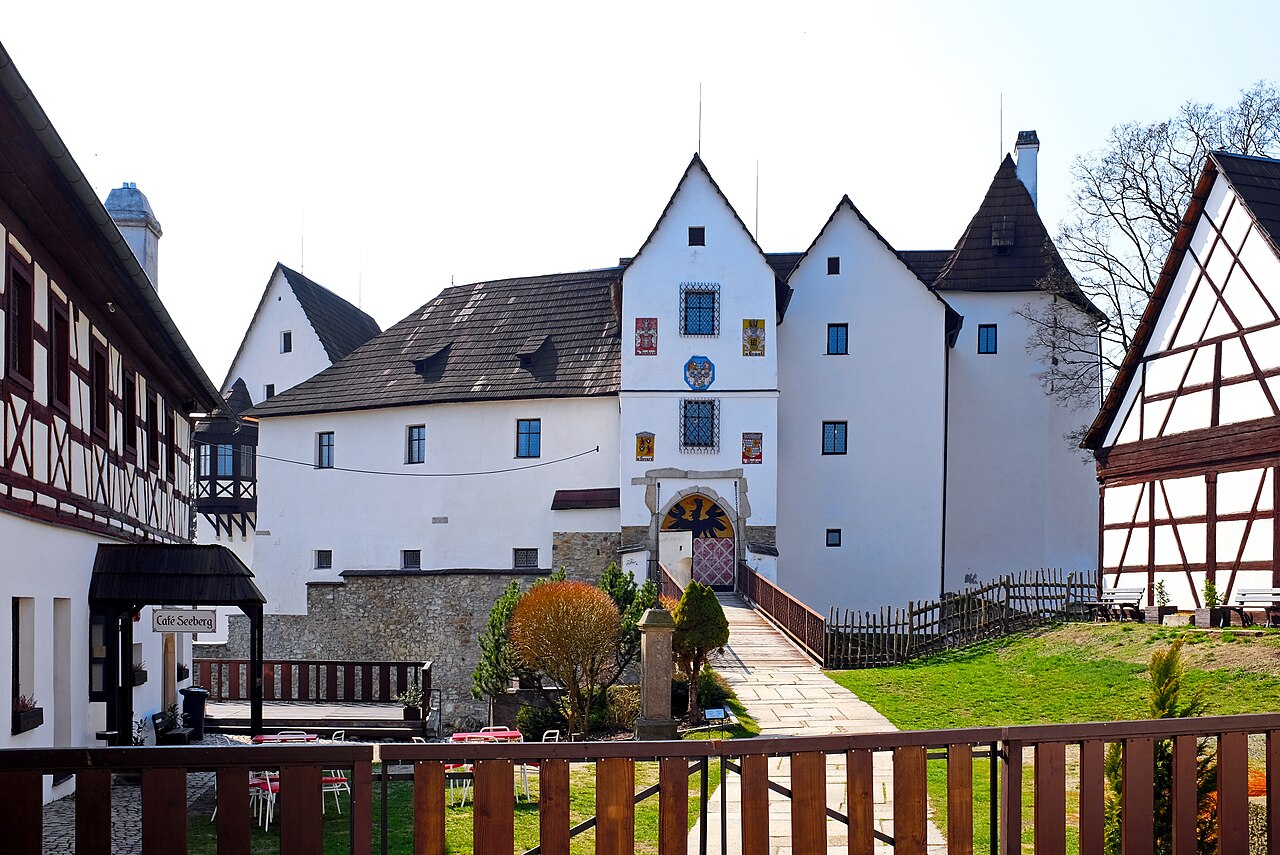
Thierstein Castle
Thierstein Castle stands as a remarkable example of a medieval hill castle strategically perched on a narrow basalt ridge approximately 615 meters above sea level in the municipality of Thierstein, Bavaria, Germany. Constructed in the early 14th century by Albrecht VI of Wildstein, this fortress played a significant role in the administration and defense of the surrounding region through the Late Medieval period.
The castle's origins are closely tied to the noble Nothafft family, who established it as the seat of their authority following Albrecht VI's appointment as imperial forest master by King Heinrich VII in 1310. This position gave the family jurisdiction over the imperial forests of the historical Egerland region, making Thierstein Castle a vital administrative center. However, the castle's ownership and strategic importance evolved considerably over the centuries, reflecting the turbulent political landscape of the region.
Historical ownership and political significance
Initially controlled by the Nothafft family, the castle's fortunes shifted when King Johann of Bohemia granted the office of forest master to the nearby city of Eger in 1340. This act sparked prolonged disputes between the Nothaffts and the city, eventually leading to the family's loss of the castle and adjacent market town by the late 14th century. Subsequently, ownership passed to Margrave Wilhelm I of Meissen and later, from 1415 onwards, to the Burgraves of Nuremberg, members of the powerful House of Hohenzollern.
The Hohenzollerns appointed bailiffs to manage the castle and its lands, maintaining its role as a defensive and administrative stronghold. During the Bavarian War of 1462, the castle's bailiff, Friedrich von Dobeneck, took the drastic measure of setting fire to the village beneath the castle to prevent enemy forces from using it as a fortified position. This event underscores the castle's military significance in regional conflicts.
Architectural features and defensive structures
Thierstein Castle was constructed as a hill castle utilizing the natural basalt ridge for defense, enhanced by man-made fortifications. A prominent feature is the cylindrical bergfried or keep, which rises approximately 24 meters and was positioned on the castle's most vulnerable side to serve as a lookout and last line of defense. This bergfried is one of the best-preserved elements of the castle and exemplifies typical Late Medieval military architecture.
The castle complex originally included an inner bailey surrounded by residential buildings and an outer bailey separated by a neck ditch, which functioned as a formidable defensive barrier. The outer curtain wall, which also served as a zwinger—a narrow enclosed killing ground between walls—was designed to hinder attackers and protect the inner sanctum. Although much of the curtain wall has been lost, surviving fragments reveal the layered defensive strategy employed by the builders.
Castle layout and strategic location
Positioned on a narrow ridge oriented northeast, the castle's natural topography was exploited to create a defensible site. The main access was protected by a neck ditch cutting off the castle from the landward side, making direct assault difficult. A second neck ditch once separated the outer bailey from the inner bailey but was filled in during the 19th century. The elevated position afforded commanding views over the Fichtel Mountains and the Egerland region, allowing early detection of approaching forces and control over important trade and military routes.
Military engagements and decline
Thierstein Castle's military history includes occupation by Bohemian troops in 1553 during the Second Margrave War, illustrating its strategic importance in regional power struggles. By the early 17th century, the castle's military relevance diminished, leading Margrave Georg Friedrich of Brandenburg to order its abandonment in 1603 in favor of a new administrative building outside the village of Thierstein. Despite this, the castle was maintained through necessary repairs during the Thirty Years' War to serve as a refuge and grain storage facility.
In 1703, amid the War of the Spanish Succession, the castle was briefly refortified, but its final destruction came in 1725 when a devastating fire consumed both the castle and the adjacent market town. This event marked the end of Thierstein Castle as a functional fortress.
Present condition and preservation
Today, Thierstein Castle exists as a ruin, with its most striking remnant being the towering bergfried. The remains of the residential buildings within the inner bailey still stand, with some walls reaching up to three stories in height, providing valuable insights into the castle's original scale and domestic arrangements. The curtain walls of the outer bailey survive only in fragments, but they hint at the castle's complex defensive design.
Access to the ruins is controlled, requiring a key, which helps preserve the delicate remains while allowing visitors to experience the site firsthand. The castle's location and ruins offer spectacular views of the surrounding landscape, connecting visitors with the region's rich medieval heritage.
Historical documentation and cultural significance
Numerous historical drawings and images dating from the early 17th to the late 18th century document the castle's gradual decay, providing invaluable visual records that aid modern understanding of its architecture and history. Thierstein Castle remains an important cultural monument, reflecting the complex feudal and military history of Bavaria and the broader Germanic territories during the Late Medieval and early modern periods.
Its architectural features, strategic location, and layered history make it a subject of interest for historians, archaeologists, and castle enthusiasts alike. The castle's story exemplifies the evolution of medieval fortifications in response to changing political and military needs and the eventual decline of such strongholds in the face of modern warfare and administrative reforms.
Frequently asked questions (FAQ)
- What is the historical significance of Thierstein Castle?
- Thierstein Castle dates back to the 13th century and played a crucial role in the region's defense during the Middle Ages. Its strategic location allowed it to oversee trade routes, making it an important stronghold for the local nobility.
- When was Thierstein Castle built?
- Thierstein Castle was constructed around the year 1250. It has undergone various renovations over the centuries, but much of its original medieval architecture has been preserved, offering visitors a glimpse into its storied past.
- Can I visit Thierstein Castle?
- Yes, Thierstein Castle is open to the public for visits. Guests can explore the castle grounds and its impressive architecture, making it a great spot for history enthusiasts and casual visitors alike.
- What are the opening hours for Thierstein Castle?
- Thierstein Castle typically opens from 10 AM to 6 PM during the tourist season, which runs from April to October. It's advisable to check the official website for any seasonal changes or special events that may affect visiting hours.
- Is it possible to tour the interior of Thierstein Castle?
- While the exterior and grounds are accessible to visitors, guided interior tours may be limited or available only on certain days. It's best to check in advance for any scheduled tours to ensure you can experience the castle's interiors.
- What is the best time to visit Thierstein Castle?
- The best time to visit Thierstein Castle is during the spring and summer months when the weather is pleasant and the gardens are in full bloom. Additionally, local festivals and events often take place during this time, enhancing your visit.
- Are there any nearby attractions to Thierstein Castle?
- Yes, visitors can explore nearby attractions such as the picturesque village of Thierstein and scenic trails for hiking. The surrounding area also offers charming cafes and shops, perfect for a relaxing day trip.
- How much are tickets to Thierstein Castle?
- Tickets to Thierstein Castle are generally affordable, with prices around €5 for adults and discounted rates for children and seniors. Special family packages may also be available, so be sure to inquire upon arrival.
- How do I get to Thierstein Castle?
- Thierstein Castle is easily accessible by car, with parking available nearby. For those using public transport, local buses connect Thierstein with larger cities, making it convenient for day visits.
Information
Website
Visit websiteSources & official resources
Verify the information above using these authoritative references.
Loading map...
Visitor reviews
No reviews yet. Been here? Write the first review and help other travelers!
Write the first reviewVisited this castle? Share your experience
Your review helps other travelers and adds first-hand knowledge to our encyclopedia.