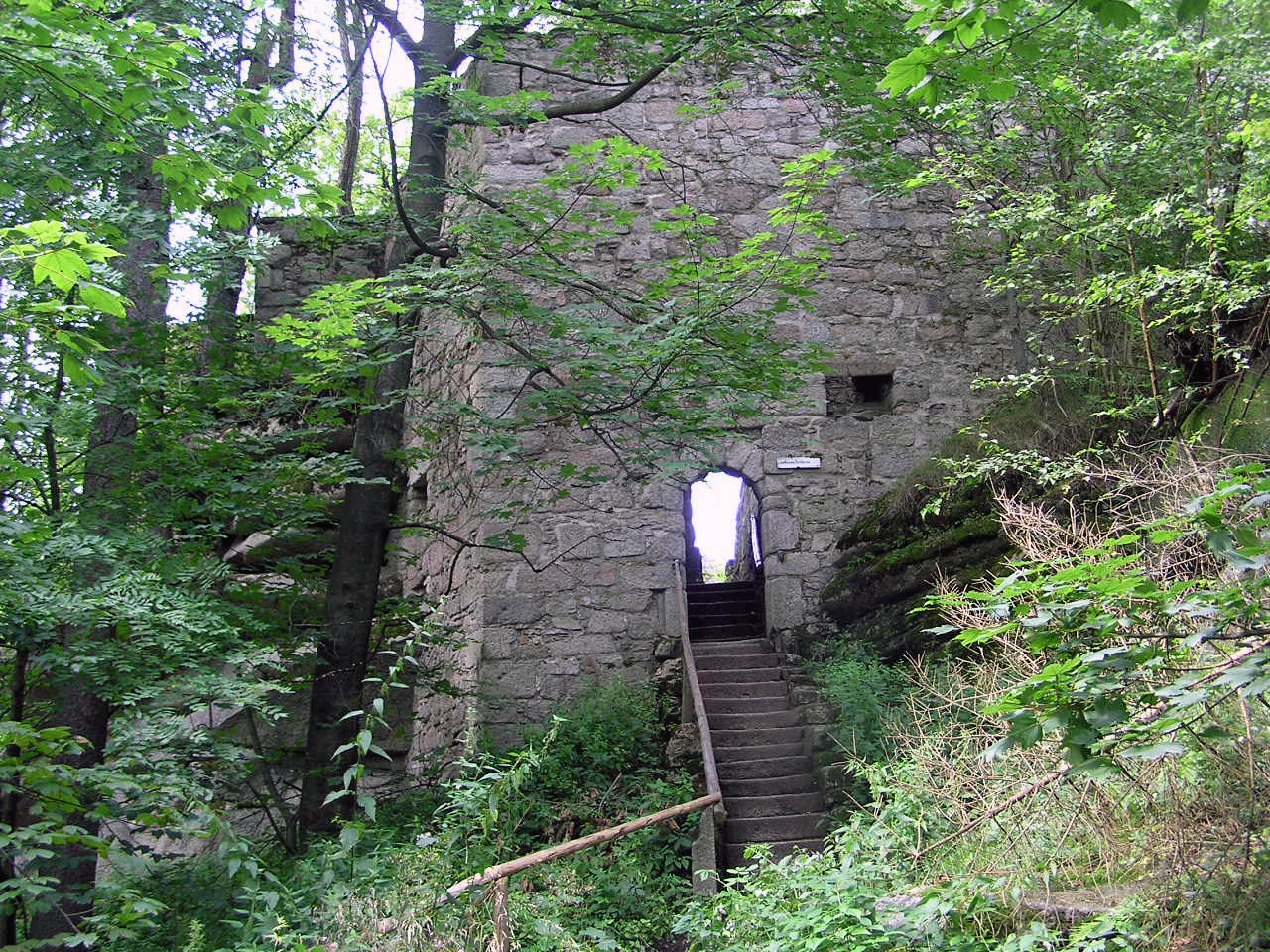
Epprechtstein Castle
Epprechtstein Castle stands as a historic medieval fortress perched on the summit of Epprechtstein mountain, a prominent granite peak reaching 782.1 meters in the Fichtel Mountains of Kirchenlamitz, Germany. This hill castle was strategically constructed during the High Middle Ages by German settlers to serve as a regional stronghold, overseeing the surrounding lands and controlling vital routes through the rugged landscape.
The earliest documented mention of the castle dates back to 1248, when Duke Otto II of Merania referenced a noble named Eberhardus de Eckebretsteine in a deed of gift, indicating the castle's established presence by the mid-13th century. Its ownership history reflects the complex feudal dynamics of the region, with the castle passing through hands of influential families such as the Sack family in 1308, who received it from King Henry VII. Joint ownership with the Wild family further underscores its importance as a feudal seat.
In 1337, Emperor Louis IV granted a portion of the castle to Henry of Plauen, who served as the Vogt, or protector, highlighting the castle’s administrative and military significance. However, the fortress's control shifted after a military siege in 1352, when forces led by the burgraves of Nuremberg, including Henry of Kotzau and his brothers, captured it. Subsequently, the burgraves purchased the castle and surrounding territories, incorporating them into the Sechsämterland district, with Epprechtstein Castle becoming the residence for local officials known as Amtmänner.
Architectural features and defensive structures
The castle was built on a long granite ledge with steep cliffs on either side, utilizing the natural topography for defense. The main surviving structure is the Wohnturm, or tower house, which served as the primary living quarters and administrative center. This tower was constructed directly on solid granite, emphasizing the castle's integration with its rocky environment.
By the late 15th century, the castle's tower was incorporated into the Wartordnung, a coordinated military watch and signaling system established in 1498 to enhance regional defense. This network of lookout points was crucial for early warning against invasions or raids.
Castle layout and materials
The fortress was primarily built from locally quarried granite, a durable material that has contributed to the survival of its remains despite centuries of exposure and conflict. The castle complex included defensive walls, gates, and living quarters, though today only fragmentary walls and foundations remain. No decorative stonework or inscriptions have been found, suggesting a focus on functionality over ornamentation.
Historical significance and ownership transitions
Epprechtstein Castle's history reflects the turbulent political landscape of medieval Bavaria. Its initial establishment by German settlers marked the expansion of feudal control in the region. The Sack family’s possession in the early 14th century and the involvement of the Wild family illustrate the castle’s role as a power center.
The 14th century saw significant shifts, with Emperor Louis IV’s grant to Henry of Plauen and the subsequent military capture by the burgraves of Nuremberg, who integrated the castle into the Sechsämterland administrative district. This transition marked the castle’s evolution from a feudal stronghold to an administrative hub.
However, the 16th century brought decline when troops under Henry of Plauen destroyed the fortress, leading to its abandonment. The castle fell into ruin, a fate common to many medieval fortifications rendered obsolete by changing military technology and political structures.
Modern rediscovery and preservation efforts
Interest in the ruins revived in the late 18th century through the work of historian Johann Theodor Benjamin Helfrecht and cartographer Johann Christoph Stierlein, who documented the site. The castle also inspired artist Georg Könitzer, whose lithographs captured the evocative ruins and the surrounding Fichtel Mountains landscape.
Today, the ruins are accessible to visitors, with a wooden viewing platform installed in 1982 atop the tower house, offering panoramic views of the Waldstein ridge, Großer Kornberg, and towns such as Schwarzenbach an der Saale, Oberkotzau, and Hof. The vantage point also extends southward across the inner Fichtel Mountains toward the Kösseine.
Near the ruins, a small service hut supports the Kirchenlamitz mountain rescue team, underscoring the site's ongoing role in the community. Despite the lack of extensive archaeological finds, the castle remains a valuable cultural and historical landmark, offering insight into medieval fortification strategies and regional governance.
Visiting epprechtstein castle today
Visitors to Epprechtstein Castle can explore the rugged ruins and enjoy the natural beauty of the surrounding landscape. The castle's elevated position provides a unique perspective on the Fichtel Mountains region, making it a popular destination for hikers and history enthusiasts alike.
The site’s preservation as a hill castle ruin allows for an authentic experience of medieval architecture integrated with natural defenses. While no formal museum exists on-site, informational signage helps contextualize the castle's history and significance.
Frequently asked questions (FAQ)
- When was Epprechtstein Castle originally built?
- Epprechtstein Castle was first recorded in 1248, indicating its construction during the High Middle Ages by German settlers.
- What type of castle is Epprechtstein?
- Epprechtstein Castle is classified as a hill castle, built on a granite summit to maximize natural defensive advantages.
- Can visitors access the tower at Epprechtstein Castle?
- Yes, visitors can climb a staircase inside the tower house to reach a wooden viewing platform installed in 1982, offering panoramic views of the Fichtel Mountains.
- What historical families were associated with Epprechtstein Castle?
- The castle was associated with the Sack family, the Wild family, Henry of Plauen, and the burgraves of Nuremberg during its history.
- Why did Epprechtstein Castle fall into ruin?
- The castle was destroyed by troops under Henry of Plauen in the 16th century and subsequently abandoned, leading to its ruinous state today.
- Is there any archaeological evidence found at the castle site?
- No significant archaeological artifacts such as tools or pottery have been documented, with the remains primarily consisting of walls and foundations.
Information
Website
Visit websiteSources & official resources
Verify the information above using these authoritative references.
Loading map...
Visitor reviews
No reviews yet. Been here? Write the first review and help other travelers!
Write the first reviewVisited this castle? Share your experience
Your review helps other travelers and adds first-hand knowledge to our encyclopedia.