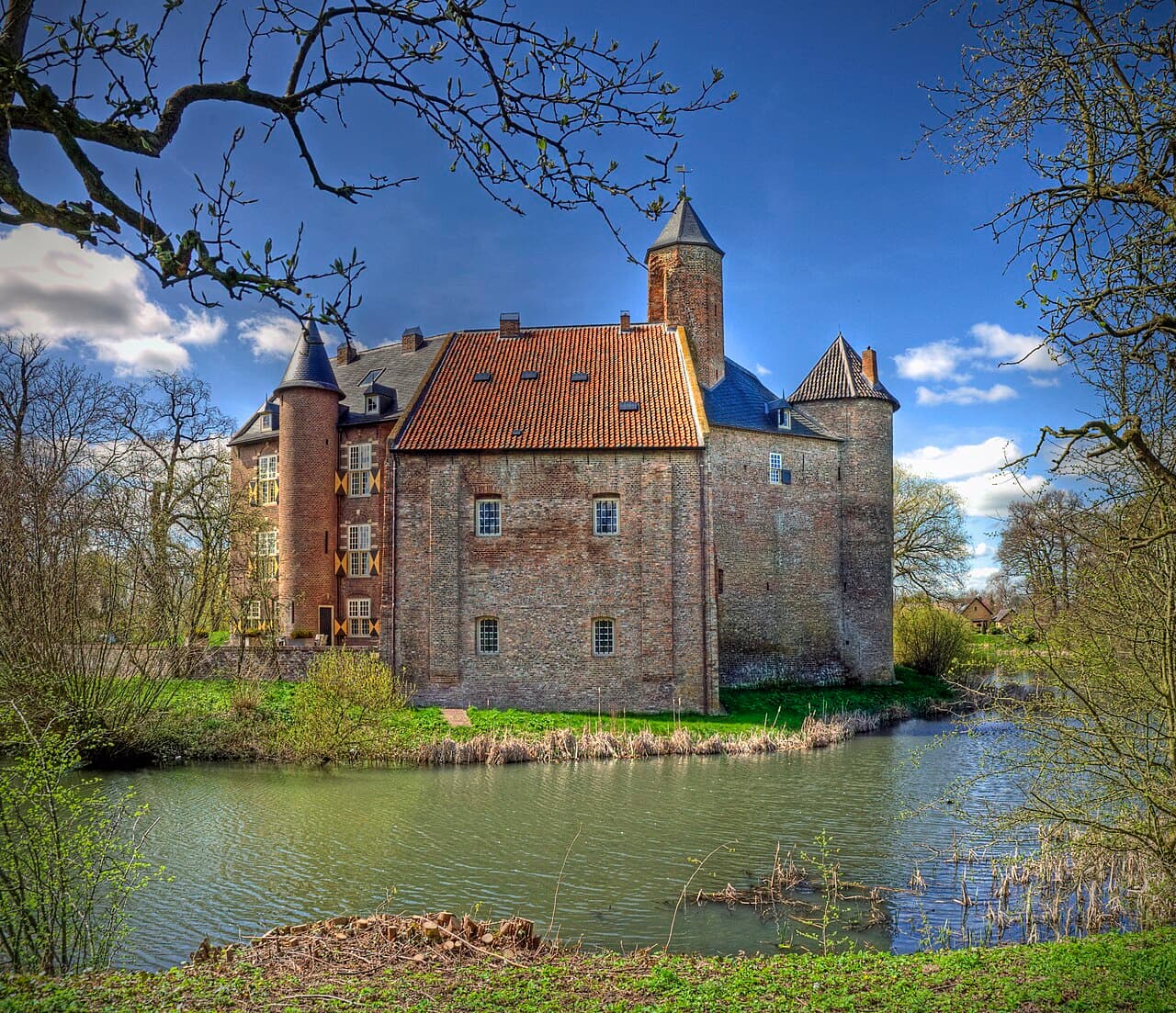
Waardenburg Castle
Waardenburg Castle, locally known as Kasteel Waardenburg, is a significant medieval fortress located near the village of Waardenburg in the province of Gelderland, the Netherlands. This hill castle dates back to the 13th century, with its origins firmly established around 1265. It stands as a remarkable example of medieval Dutch castle architecture, reflecting centuries of noble residence, military strife, and cultural folklore.
The castle's earliest incarnation was a wooden fortification constructed by Rudolf de Cock following a grant from Count Otto II of Guelders in 1265. This initial wooden structure, known as Hiern Castle after the hill it occupied, was soon replaced by a more durable stone tower by Rudolf's son by 1283. The castle evolved into a polygonal stone fortress with three connecting wings, a ring wall, moat, and multiple towers, including a prominent four-story donjon built in 1355 by Rudolf's grandson Johan. This donjon featured battlements and corner turrets typical of high medieval military architecture.
Architectural evolution and layout
The castle's original design centered on the imposing square donjon, surrounded by a circular curtain wall and an outer bailey. The bailey was protected by a broad water-filled moat, which in earlier centuries was directly adjacent to the river Waal. Over time, the castle expanded to include three wings connected to the central keep, forming a fortified residence suitable for noble families.
The castle's layout was significantly altered in the late 16th century during the Eighty Years' War. In 1574, forces led by Louis, Count of Nassau besieged the castle because its occupant, Catharina van Gelder, supported the Spanish side. The siege resulted in the destruction of the southern wing and the fortified bailey, which were never rebuilt. This left the castle with a distinctive horseshoe shape, with only the northern and eastern wings remaining intact.
Subsequent restoration efforts in the 17th century, particularly after the castle was acquired by Johan Vijgh in 1618, focused on making the northern wing habitable again. However, the southern wing remained demolished, permanently changing the castle's silhouette. In 1895, the eastern wing was enlarged and fitted with a small round stair tower, adding a late 19th-century architectural element that complemented the medieval core.
Historical significance and noble ownership
Waardenburg Castle's history is closely tied to several noble families who owned and inhabited it over centuries. After the de Cock family, ownership passed to the Van Broeckhuysens, Van Arkel, Van Aylva, and Van Pallandt families. These transitions often occurred through inheritance and marriage, reflecting the castle's role as a noble residence and regional power center.
The castle's strategic importance was underscored during the Eighty Years' War, when it became a focal point of conflict. The siege in 1574 by William of Orange's forces marked a turning point, as the castle's support for the Spanish crown led to its partial destruction. The damage from this conflict left Waardenburg Castle a ruin for several decades until restoration efforts began in the early 17th century.
In the 20th century, the castle changed hands multiple times, with the Van Pallandt family maintaining ownership until 1971. It was then leased to the heritage organization Het Geldersch Landschap / Vrienden der Geldersche Kasteelen for conservation. The castle was refurbished in 2011 and is currently used as an office by the Friends of the Castles of Gelderland foundation. Public access is restricted.
Faust legend and cultural heritage
Waardenburg Castle is steeped in local folklore, most famously associated with the legend of Doctor Faust. According to tradition, Faust, the scholar who made a pact with the devil for knowledge, resided in the castle. The legend recounts that after seven years, the devil came to claim Faust's soul, dragging him from the castle tower. The Faustkamer or Faust Chamber within the castle commemorates this tale, and purported bloodstains on the pavement are said to be remnants of this dark story.
While the historical Johann Georg Faust did exist and was imprisoned nearby at Batenburg Castle, the connection to Waardenburg Castle has become an enduring part of local cultural identity. This legend adds a layer of mystique to the castle's historical significance and attracts interest from folklore enthusiasts.
Preservation and current condition
Today, Waardenburg Castle is classified as a hill castle and is partially preserved. Approximately half of the original structure remains, including the northern and eastern wings and the central donjon, although the donjon is now one story shorter than originally built. The original roof has been replaced by a simple lean-to roof, altering its medieval silhouette but preserving the historic fabric.
The castle is separated from the river Waal by a dike, a change from earlier centuries when the river flowed directly alongside its walls. The moat and ring wall remain visible, maintaining the castle's defensive character. Restoration efforts in the mid-20th century and early 21st century have stabilized the ruins and adapted the castle for modern use while respecting its heritage.
Although the castle is not open to the public, its architectural and historical significance make it an important monument in the Gelderland region. The castle's layered history, from medieval fortress to noble residence and legendary site, reflects broader themes in Dutch and European castle development.
Frequently asked questions (FAQ)
- When was Waardenburg Castle originally built?
- Waardenburg Castle was originally built in 1265 as a wooden structure, with stone construction beginning around 1283.
- Can visitors tour Waardenburg Castle?
- Waardenburg Castle is currently used as an office and is not open to the public for tours or visits.
- What is the architectural style of Waardenburg Castle?
- Waardenburg Castle features high medieval architecture with a polygonal layout, a donjon, curtain walls, and defensive towers.
- What happened to Waardenburg Castle during the Eighty Years' War?
- In 1574, Waardenburg Castle was besieged and partially destroyed because its occupant supported the Spanish side; the southern wing and bailey were never rebuilt.
- What is the Faust legend associated with Waardenburg Castle?
- Local legend says Doctor Faust lived in the castle and was dragged from its tower by the devil after his pact ended; the Faust Chamber commemorates this tale.
Photo gallery

Information
Sources & official resources
Verify the information above using these authoritative references.
Loading map...
Visitor reviews
No reviews yet. Been here? Write the first review and help other travelers!
Write the first reviewVisited this castle? Share your experience
Your review helps other travelers and adds first-hand knowledge to our encyclopedia.



