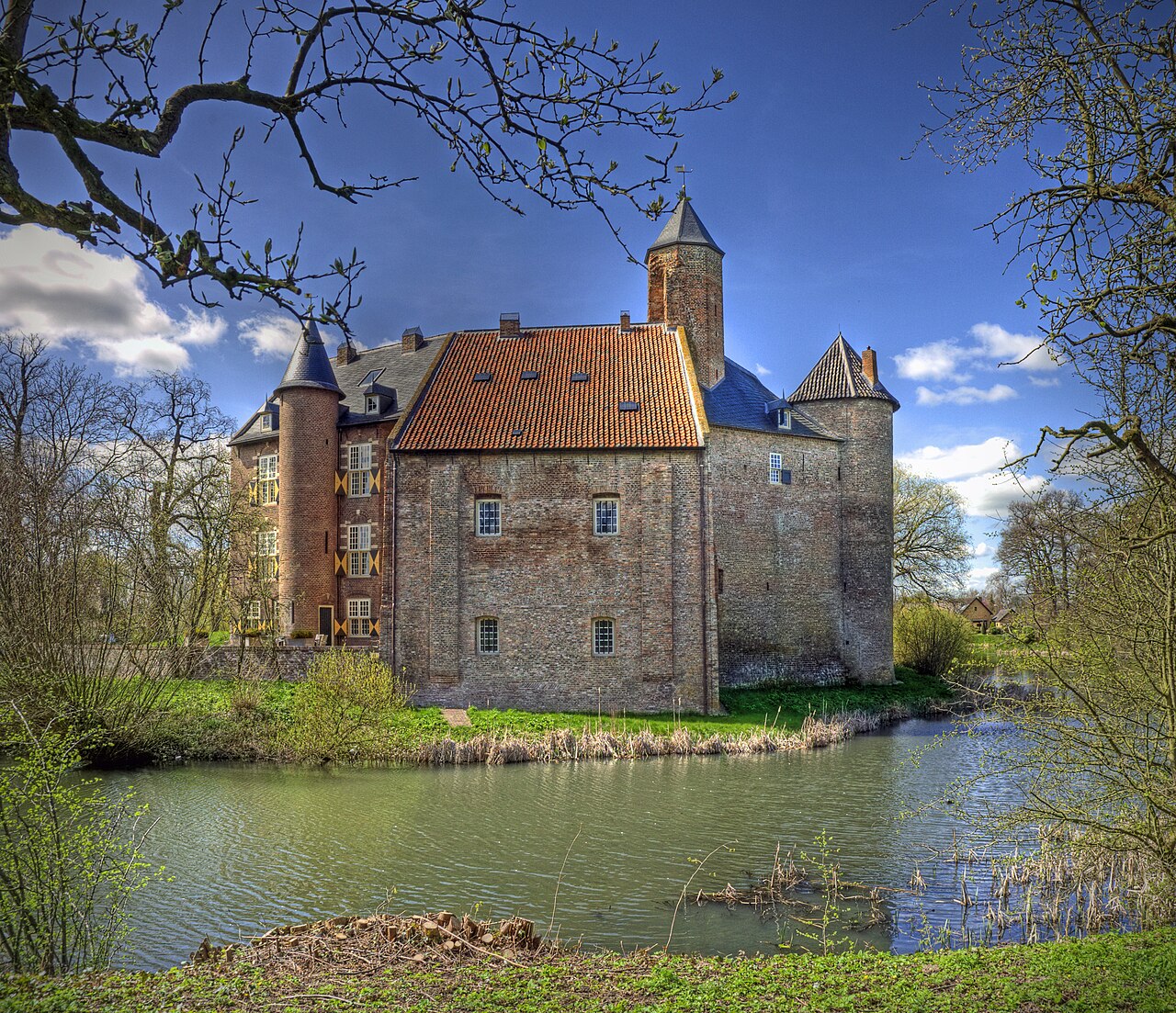
Fort New St. Andries
Fort New St. Andries, also known locally as Fort Sint Andries, is a historic military fortification located east of Rossum in the Gelderland province of the Netherlands. The fort occupies a strategic position near the confluence of the rivers Meuse and Waal, separated by a narrow stretch of land approximately 2.5 km wide. This location has been of military significance since the 16th century, during the turbulent period of the 80 Years' War (1568-1648).
Originally, several natural openings existed between the two rivers, making the area a crucial defensive point. In response to these strategic vulnerabilities, Prince Maurice of Orange commissioned the construction of Fort Voorne (also known as Fort Nassau) in the late 16th century. In 1599, the Spanish forces, aiming to control the region, built Fort St. Andries, likely named after Andreas of Austria, the vice governor-general of the Southern Netherlands. Alongside the fort, the Spanish dug the Channel of St. Andries to strengthen their defensive position. However, just a year later, in 1600, the Dutch forces captured Fort St. Andries, marking a significant shift in control of this strategic point.
Throughout the following centuries, the site experienced multiple destructions and reconstructions. Both Fort Voorne and Fort St. Andries were destroyed twice by French forces during various conflicts, leaving very little physical trace of these original fortifications today. The landscape, however, still bears subtle imprints of their former presence.
Construction of Fort New St. Andries in the 19th century
Between 1815 and 1816, the current Fort New St. Andries was constructed to replace the earlier fortifications. Designed by the notable major-engineer W. Valter, the fort was laid out in a regular pentagonal shape, a common design in the era reflecting advances in military architecture. At its center stood a distinctive circular bomb-proof tower, which originally housed 60 soldiers. This tower was a key defensive element, designed to withstand artillery bombardments.
In the period from 1856 to 1859, the original tower was replaced with a larger oval bomb-proof building featuring two stories. This new structure significantly increased the fort's capacity, accommodating up to 260 soldiers as well as storage for arms and gunpowder magazines. The fort's pentagonal layout included bastioned walls and defensive earthworks typical of 19th-century military engineering.
Modifications and military use in the 20th century
During the 1930s, changes to the surrounding waterways led to the closure of the old St. Andries channel adjacent to the fort. A new channel was excavated on the opposite side, altering the fort's immediate environment. In 1936, a concrete casemate was constructed within the fort to protect a bridge over the old channel, reflecting adaptations to modern warfare needs.
During World War II, Fort New St. Andries was occupied by German forces. Initially used by the Luftwaffe, it later served as a base for the German 712th Infantry Division. In April 1945, as Allied forces including the English Royal Marines and the Belgian 2nd Battalion of Fusiliers advanced, the Germans detonated explosives to destroy the fort, rendering it unusable.
Following the war, the fort was not restored to its former military function. Instead, in the 1950s, an air defense tower was built on the fort's highest point, serving until 1964. After this period, the fort was largely abandoned and gradually reclaimed by nature.
Restoration and current condition
In the early 21st century, around 2006, efforts were made to restore both the fort and the air defense tower. Today, Fort New St. Andries is freely accessible during daytime and offers visitors a unique opportunity to explore its ruins within a tranquil, green setting. The remains of the oval bomb-proof tower, the air defense tower, and the concrete casemate are all visible and can be climbed, providing panoramic views over the river Waal.
The fort presents a layered historical narrative visible in its architecture and landscape. Visitors can experience elements spanning from the Renaissance period through to 20th-century military adaptations. Despite its relative obscurity, the site is valued for its peaceful atmosphere and the sense of solitude it offers, making it a worthwhile destination for those interested in military history and fortification architecture.
Architectural features
The fort's pentagonal layout was designed to maximize defensive coverage, with bastions allowing overlapping fields of fire. The central bomb-proof tower, especially the later oval structure, was engineered to resist artillery fire and protect the garrison and ammunition stores. The addition of the concrete casemate in the 1930s illustrates the evolution of fortifications adapting to modern warfare technologies.
Historical significance
Fort New St. Andries occupies a site of strategic importance controlling river access between the Meuse and Waal. Its history reflects the shifting control of the Netherlands during the 80 Years' War and subsequent European conflicts. The fort's repeated destruction and rebuilding highlight its enduring military value over several centuries.
Visiting information
The fort is open to visitors during daylight hours without an entrance fee. The site is suitable for walking and climbing the remaining structures, offering educational insights into military architecture. Its location near Rossum makes it accessible for day trips, and the surrounding natural environment adds to the visitor experience.
Frequently asked questions (FAQ)
- When was Fort New St. Andries originally built and by whom?
- Fort New St. Andries was constructed between 1815 and 1816, designed by major-engineer W. Valter to replace earlier fortifications from the 16th century.
- What architectural style characterizes Fort New St. Andries?
- The fort features a mixed architectural style, combining elements of Renaissance military design with 19th-century pentagonal fort layouts and 20th-century concrete fortifications.
- Is Fort New St. Andries open to the public?
- Yes, the fort is freely accessible during daytime hours. Visitors can explore the ruins, climb the air defense tower, and enjoy views over the river Waal.
- What remains can visitors see at Fort New St. Andries?
- Visitors can see the ruins of the oval bomb-proof tower, the 20th-century air defense tower, and a concrete casemate built in the 1930s, all set within a green landscape.
- What role did Fort New St. Andries play during World War II?
- During World War II, the fort was occupied by German forces, including the Luftwaffe and the 712th Infantry Division. It was destroyed by the Germans in 1945 during an Allied attack.
Information
Opening hours
Daytime, freely accessible
Ticket prices
Free
Current owner
Municipality
Address
Kloosterdijk, Rossum, Netherlands
Loading map...
Visitor reviews
No reviews yet. Been here? Write the first review and help other travelers!
Write the first reviewVisited this castle? Share your experience
Your review helps other travelers and adds first-hand knowledge to our encyclopedia.