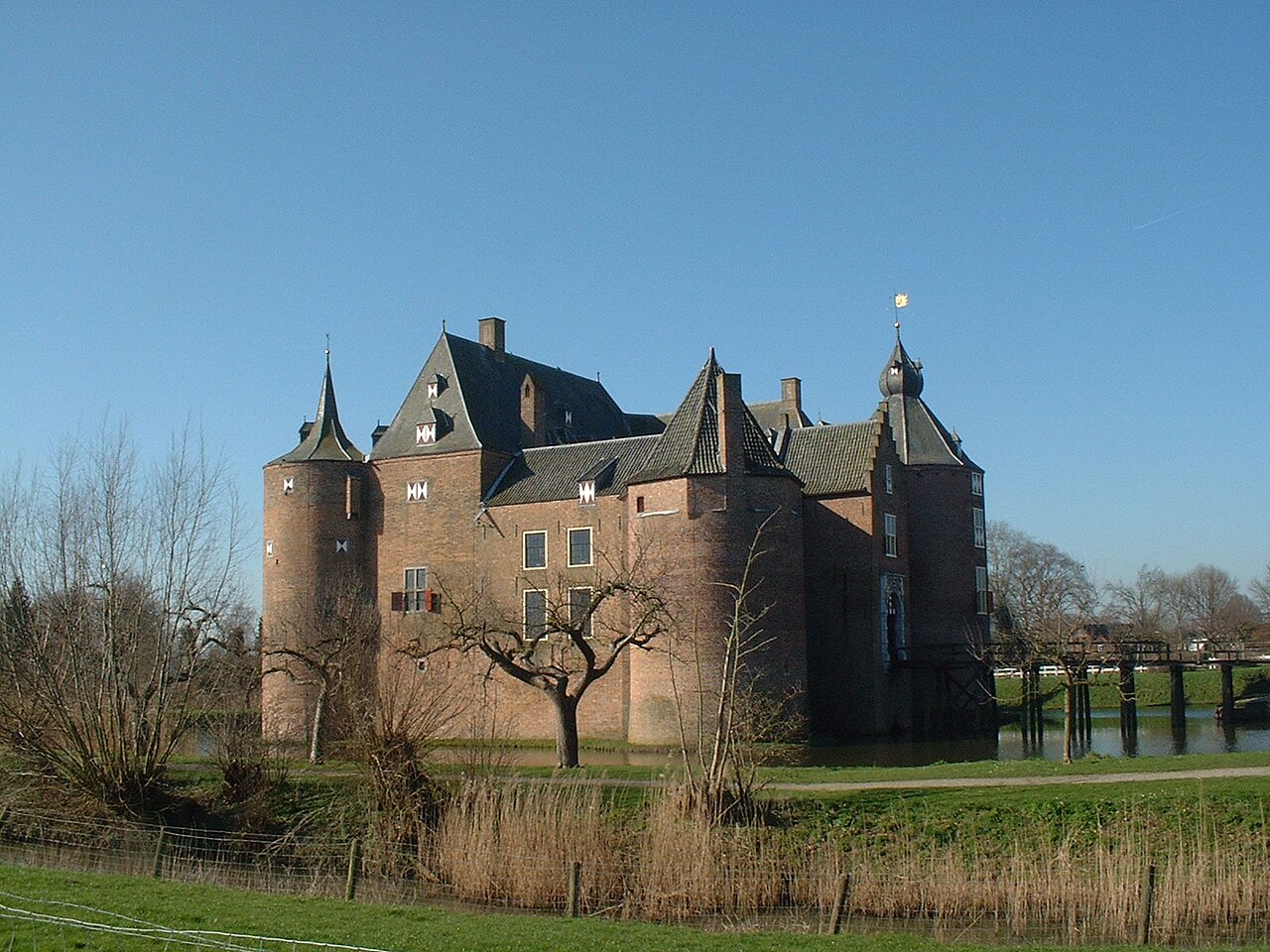
Goudenstein Castle

Goudenstein Castle in Haaften, Netherlands
Haaften, Gelderland, Netherlands
Late Medieval (14th–15th c.)
Ruins

Goudenstein Castle, locally known as Kasteel Goudenstein, is a historic medieval fortress located in the village of Haaften in the province of Gelderland, the Netherlands. Although today only a solitary tower remains, this castle holds significant historical importance as a late medieval stronghold with roots tracing back to the early 14th century.

The exact origins of Goudenstein Castle remain shrouded in mystery. Historical records mention a Rudolf van Haeften in 1281, who served as the keeper for the Count of Guelders. Whether Rudolf was the original owner of the domain of Haaften or the founder of the castle is unknown. Architectural analysis of the stone sizes suggests that the castle was likely constructed in the early 14th century, placing its origins firmly in the late medieval period.

Architectural features and original structure

At its zenith, Goudenstein Castle was a formidable fortress. By the early 17th century, specifically in 1609 when the Van Brederode family inherited the property, the castle reportedly consisted of four residential wings. Each wing was fortified with round towers positioned at the outer corners, a typical defensive design of medieval castles that allowed for better protection and surveillance.

The castle's layout likely included a central courtyard surrounded by these wings, creating a secure and self-contained residence suitable for nobility. The presence of round towers at the corners would have enhanced defense capabilities, allowing defenders to cover all approaches to the castle walls. Although no full plans survive, this configuration aligns with the architectural norms for castles built in the late medieval era in the region.

Historical context and ownership

From 1467 onwards, Goudenstein Castle became a fief under the jurisdiction of Guelders, a historic duchy in the Low Countries. This affiliation underscores the castle's strategic and political importance during the turbulent medieval period.

The castle's ownership transitioned to the Van Brederode family in 1609, a prominent noble lineage with significant influence in the region. The Van Brederode tenure marked the final phase of the castle's active use before its destruction.

Destruction and decline

The castle met its demise in 1672 during the Franco-Dutch War when French troops destroyed it. The destruction was part of a broader campaign that saw many Dutch fortifications targeted to weaken resistance.

Following the devastation, the remains of the castle were systematically demolished and repurposed as building materials. This practice was common in post-conflict periods when maintaining ruined fortifications was impractical, and the stone was valuable for other constructions.

By the 18th century, only a single tower remained standing, which was notable for still retaining its original spire. However, this spire disappeared by the end of the 19th century, further diminishing the castle's silhouette.

Preservation efforts and current status

In 1968, the solitary tower was consolidated to prevent further decay. During this restoration, a new spire was added, restoring part of the tower's original architectural character. Today, the tower is preserved under the care of the Friends of the Castles of Gelderland foundation, an organization dedicated to protecting regional heritage sites.

The tower is situated within a private backyard and is not accessible to the public. Despite limited access, the tower remains an important cultural landmark, representing the medieval history of Haaften and the broader Gelderland region.

Architectural significance and legacy

Goudenstein Castle exemplifies typical late medieval castle architecture in the Netherlands, characterized by its multi-wing layout and corner towers. Although only a fragment survives, the tower offers valuable insight into medieval defensive designs and noble residences in the region.

The castle's destruction and subsequent loss highlight the vulnerability of medieval fortifications during the 17th century's military conflicts. Its preservation as a tower ruin allows historians and visitors to connect with the region's feudal past and the shifting political landscape of the Low Countries.

Location and accessibility

The castle's remains are located at Dreef 6 in Haaften, Gelderland. While the tower itself is not open for public entry, its exterior can be viewed from nearby public areas, offering a glimpse into the medieval heritage embedded within the Dutch countryside.

Nearby historical context

Haaften and the surrounding Gelderland province are rich in medieval history, with many castles and fortifications that played roles in regional defense and governance. Goudenstein Castle contributes to this tapestry, reflecting the architectural and historical evolution of the area.

Frequently asked questions (FAQ)

How do I get to Goudenstein Castle?
Goudenstein Castle is located in Haaften, Netherlands, and is easily accessible by car or public transportation. If you are driving, take the A2 motorway and follow the signs to Haaften. For public transport, check local bus schedules for routes that connect to the nearest station.
What is the historical significance of Goudenstein Castle?
Goudenstein Castle dates back to the 14th century and has played a vital role in the region's history, serving as a noble residence and a strategic stronghold. Its well-preserved structure reflects the architectural styles of the time and offers insights into the feudal system of the Netherlands. The castle has witnessed numerous historical events that shaped the local landscape.
When was Goudenstein Castle built?
Goudenstein Castle was constructed in the 14th century, around 1350, making it one of the oldest castles in the region. Over the centuries, it has undergone various renovations, preserving its historical character while adapting to modern needs. The castle's long history adds to its charm and appeal for visitors.
Can I visit Goudenstein Castle?
Yes, Goudenstein Castle is open to visitors. Guided tours are available, allowing you to explore its rich history and stunning architecture. It is advisable to book your tickets in advance, especially during peak tourist seasons.
Why is Goudenstein Castle a popular tourist attraction?
Goudenstein Castle is popular due to its beautiful architecture, rich history, and picturesque surroundings. Visitors are drawn to its charming gardens and the opportunity to learn about the Netherlands' medieval past. Additionally, various events and exhibitions throughout the year make it an engaging destination for travelers.
Is it possible to host events at Goudenstein Castle?
Yes, Goudenstein Castle offers facilities for hosting private events, including weddings, corporate functions, and special celebrations. The unique setting of the castle provides a memorable backdrop for any occasion. It is recommended to contact the castle management for more details on availability and arrangements.
What are the opening hours for Goudenstein Castle?
Goudenstein Castle is typically open to visitors from Tuesday to Sunday, with specific opening hours varying by season. It is best to check the official website or contact the castle directly for the most current information on opening times and any holiday closures. Planning your visit accordingly will ensure an enjoyable experience.
What are the ticket prices for Goudenstein Castle?
Ticket prices for Goudenstein Castle vary depending on age, group size, and any special exhibitions. Generally, adult tickets are affordable, while discounts may be available for children and seniors. Be sure to check the official website for the latest pricing information and any available promotions.
What is the best time to visit Goudenstein Castle?
The best time to visit Goudenstein Castle is during the spring and summer months when the weather is pleasant, and the gardens are in full bloom. Additionally, many events and activities are scheduled during these seasons, enhancing the visitor experience. Fall offers beautiful foliage, while winter may have fewer visitors, providing a quieter atmosphere.
Are there any nearby attractions to visit while in Haaften?
Yes, there are several nearby attractions worth visiting, including the picturesque villages of Beesd and Geldermalsen, as well as the scenic countryside along the rivers. Local museums and parks also offer opportunities for exploration and leisure activities. A day trip to Haaften can easily be complemented by these nearby sites.

Information

Hill Castle

Address

Dreef 6

Loading map...

Visitor reviews

No reviews yet. Been here? Write the first review and help other travelers!

Write the first review

Visited this castle? Share your experience

Your review helps other travelers and adds first-hand knowledge to our encyclopedia.
Write a review

(5/5)

0/2000 characters

Your review will be visible after admin approval

Nearby castles

4.2 km
Waardenburg Castle — Netherlands castle

Waardenburg Castle

G.E.H. Tutein Noltheniuslaan 7, Netherlands

Waardenburg Castle, locally known as Kasteel Waardenburg, is a significant medieval fortress located near the village of Waardenburg in the province of Gelderland, the Netherlands. This hill castle dates back to the 13th century, with its origins firmly established around 1265. It stands as a remarkable example of medieval Dutch castle architecture, reflecting centuries of noble residence, military strife, and cultural folklore. The castle's earliest incarnation was a wooden fortification constructed by Rudolf de Cock following a grant from Count Otto II of Guelders in 1265. This initial wooden structure, known as Hiern Castle after the hill it occupied, was soon replaced by a more durable stone tower by Rudolf's son by 1283. The castle evolved into a polygonal stone fortress with three connecting wings, a ring wall, moat, and multiple towers, including a prominent four-story donjon built in 1355 by Rudolf's grandson Johan. This donjon featured battlements and corner turrets typical of high medieval military architecture. Architectural evolution and layout The castle's original design centered on the imposing square donjon, surrounded by a circular curtain wall and an outer bailey. The bailey was protected by a broad water-filled moat, which in earlier centuries was directly adjacent to the river Waal. Over time, the castle expanded to include three wings connected to the central keep, forming a fortified residence suitable for noble families. The castle's layout was significantly altered in the late 16th century during the Eighty Years' War. In 1574, forces led by Louis, Count of Nassau besieged the castle because its occupant, Catharina van Gelder, supported the Spanish side. The siege resulted in the destruction of the southern wing and the fortified bailey, which were never rebuilt. This left the castle with a distinctive horseshoe shape, with only the northern and eastern wings remaining intact. Subsequent restoration efforts in the 17th century, particularly after the castle was acquired by Johan Vijgh in 1618, focused on making the northern wing habitable again. However, the southern wing remained demolished, permanently changing the castle's silhouette. In 1895, the eastern wing was enlarged and fitted with a small round stair tower, adding a late 19th-century architectural element that complemented the medieval core. Historical significance and noble ownership Waardenburg Castle's history is closely tied to several noble families who owned and inhabited it over centuries. After the de Cock family, ownership passed to the Van Broeckhuysens, Van Arkel, Van Aylva, and Van Pallandt families. These transitions often occurred through inheritance and marriage, reflecting the castle's role as a noble residence and regional power center. The castle's strategic importance was underscored during the Eighty Years' War, when it became a focal point of conflict. The siege in 1574 by William of Orange's forces marked a turning point, as the castle's support for the Spanish crown led to its partial destruction. The damage from this conflict left Waardenburg Castle a ruin for several decades until restoration efforts began in the early 17th century. In the 20th century, the castle changed hands multiple times, with the Van Pallandt family maintaining ownership until 1971. It was then leased to the heritage organization Het Geldersch Landschap / Vrienden der Geldersche Kasteelen for conservation. The castle was refurbished in 2011 and is currently used as an office by the Friends of the Castles of Gelderland foundation. Public access is restricted. Faust legend and cultural heritage Waardenburg Castle is steeped in local folklore, most famously associated with the legend of Doctor Faust. According to tradition, Faust, the scholar who made a pact with the devil for knowledge, resided in the castle. The legend recounts that after seven years, the devil came to claim Faust's soul, dragging him from the castle tower. The Faustkamer or Faust Chamber within the castle commemorates this tale, and purported bloodstains on the pavement are said to be remnants of this dark story. While the historical Johann Georg Faust did exist and was imprisoned nearby at Batenburg Castle, the connection to Waardenburg Castle has become an enduring part of local cultural identity. This legend adds a layer of mystique to the castle's historical significance and attracts interest from folklore enthusiasts. Preservation and current condition Today, Waardenburg Castle is classified as a hill castle and is partially preserved. Approximately half of the original structure remains, including the northern and eastern wings and the central donjon, although the donjon is now one story shorter than originally built. The original roof has been replaced by a simple lean-to roof, altering its medieval silhouette but preserving the historic fabric. The castle is separated from the river Waal by a dike, a change from earlier centuries when the river flowed directly alongside its walls. The moat and ring wall remain visible, maintaining the castle's defensive character. Restoration efforts in the mid-20th century and early 21st century have stabilized the ruins and adapted the castle for modern use while respecting its heritage. Although the castle is not open to the public, its architectural and historical significance make it an important monument in the Gelderland region. The castle's layered history, from medieval fortress to noble residence and legendary site, reflects broader themes in Dutch and European castle development.

High Medieval (11th–13th c.)
Details
6.8 km

Aalst Castle

Aalst, Netherlands

Aalst Castle was a medieval fortress located in the village of Aalst in the province of Gelderland, Netherlands. Although no physical traces remain today, the castle's history spans over a millennium, with its first recorded mention dating back to 870 AD. It is believed to have been constructed around this time by Boudewijn II, Lord of Heusden, who also established other castles in the region, including those at Brakel and Poederoijen. Early origins and architectural features The original structure of Aalst Castle was likely a keep, a fortified tower that served as the main defensive and residential building. The walls of this keep were reported to be approximately 2 meters thick, indicating a strong defensive purpose typical of early medieval fortifications. The castle's layout, as suggested by historical depictions, was probably square or rectangular, surrounded by a wide moat that provided an additional layer of defense against attackers. Ownership and historical significance Throughout its history, Aalst Castle was owned by several noble families, most notably the Van Lynden family. The castle's strategic location in Gelderland, an area of considerable medieval activity, would have made it a significant local stronghold. However, detailed records of the castle's role in regional conflicts or political affairs remain scarce. Decline and disappearance By the 17th century, Aalst Castle was already described as a ruin, reflecting a period of decline that many medieval castles experienced due to changes in military technology and political structures. The last visible remnants of the castle were demolished in 1875, erasing almost all physical evidence of its existence. Today, the site where Aalst Castle once stood is occupied by a primary school, and no archaeological remains are visible on the surface. Historical depictions and legacy Historical drawings and depictions of Aalst Castle, though limited, show a fortified structure with a moat and a compact, possibly square plan. These images provide valuable insights into the castle's appearance and defensive features. However, the authorship of some of these drawings is uncertain, and they may have been based on earlier sketches or descriptions. Archaeological potential and research Despite the absence of above-ground remains, the site of Aalst Castle holds potential for archaeological investigation that could reveal more about its construction phases, layout, and the daily life of its inhabitants. Unfortunately, there is limited published research or excavation data available, and much of the castle's history remains to be uncovered.

Renaissance (15th–17th c.)
Details
7.1 km
Ammersoyen Castle — Netherlands castle

Ammersoyen Castle

Ammerzoden, Netherlands

Ammersoyen Castle, locally known as Kasteel Ammersoyen, is a remarkable example of a medieval water castle located near the village of Ammerzoden in the Gelderland province of the Netherlands. Constructed around 1350 by the Van Herlaer family, this castle stands as a testament to medieval defensive architecture and the turbulent history of the region. Its strategic location near the Meuse River and its characteristic square layout with four massive round corner towers make it a significant heritage site. Medieval origins and architectural design The castle was built along a branch of the River Maas (Meuse), which was later rerouted, leaving the castle surrounded by a moat fed by constructed canals. Ammersoyen Castle's design is notable for its rectangular, almost square layout comprising four wings that enclose a small central courtyard. Each corner is fortified with heavy round towers, a defensive feature that was common in medieval fortifications but executed here with particular symmetry and strength. This design is similar to other Dutch castles such as Helmond Castle, Muiden Castle, and the partially surviving Radboud Castle. The castle was constructed following a fixed plan rather than in stages, reflecting architectural influences popularized by Count Floris V of Holland. The entire complex was originally surrounded by a moat, with access controlled by a single drawbridge on the northern side leading to an artificial island, which served as a fortified outer bailey or forburg. A second drawbridge connected this island to the mainland, enhancing the castle's defensive capabilities. Historical significance and ownership The castle's history is marked by frequent changes in ownership and military conflicts. Initially built by Dirk van Herlaer, the castle was seized in 1386 by Duke William of Gelre during regional conflicts and granted to his illegitimate son, Willem van Wachtendonk, in 1405. It was sold in 1424 to Johan van Broekhuizen, Lord of Waardenburg, and later came into the possession of the Van Arkel family through marriage in 1496. The Van Arkels maintained ownership for nearly two centuries. The castle endured several sieges, notably in 1513 when it was damaged during a siege by Burgundian troops led by Count Henry III of Nassau-Dillenburg-Dietz, and again in 1574 when Spanish troops occupied it during the Eighty Years’ War. The castle escaped serious damage during these events, but in 1590, a devastating fire gutted the interior, killing the owner Joris van Arkel and leaving the castle in ruins. Reconstruction began only after the end of the Eighty Years’ War in 1648, lasting until 1667. Thomas Walraven van Arkel restored the exterior to its original medieval appearance, while modernizing the interiors for 17th-century living. In 1672, during the French invasion known as the "Year of Disaster," the castle was spared destruction by paying a ransom of 7,000 guilders to French troops, a financial burden that contributed to the Van Arkel family's decline. Following the death of the last Van Arkel lord in 1694, the castle passed through several owners from the Southern Netherlands, who rarely resided there. In the 19th century, Baron Arthur de Woëlmont acquired the castle and renovated its interiors in a neo-Gothic style. In 1873, the castle was sold to the Roman Catholic Church and converted into a convent for the Poor Clares. The moat was filled in, and a chapel was added to the western side, altering the castle's medieval landscape. Damage, restoration, and modern use The castle suffered heavy damage during World War II due to Allied shelling between 1944 and 1945. After the war, it served various functions, including as a factory and municipal office. In 1957, the Friends of Gelderland Castles Foundation purchased Ammersoyen and initiated a comprehensive restoration program that lasted until 1975. This restoration aimed to return the castle to its medieval appearance, uncovering original architectural features such as medieval staircases, arrow slits (embrasures), plastered fireplaces, and hidden chambers. The restoration also involved re-excavating the moat and reconstructing the drawbridges, reinstating the castle's historic water-surrounded setting. Archaeological excavations around the castle uncovered an extensive collection of artifacts, including ceramics, jewelry, clothing fragments, weapons, and children’s toys, representing five centuries of history. These items are now displayed in a permanent exhibition within the castle. Today, Ammersoyen Castle operates partly as a museum open to the public and partly as office space. The museum offers guided tours, cultural events, and exhibitions that highlight the castle's rich history and architectural significance. Architectural features and grounds The castle's primary building material is stone, which forms the thick defensive walls and robust towers. The Knight’s Hall is a notable interior space featuring a restored high ceiling and multiple fireplaces. The entrance pediment is adorned with decorative coats of arms from the Van Arkel and De la Kethulle families, symbolizing the castle's noble heritage. The castle grounds include a small French-style garden on the northern island, planted with heliotrope, lavender, daisies, pink begonias, mulberry, fig, and pear trees, alongside ornamental shrubs and flowers situated between the inner and outer moats. These gardens enhance the castle's aesthetic and historical ambiance. Archaeological importance and cultural heritage Archaeological investigations have revealed the castle's continuous occupation and adaptation over centuries. The moat's filled layers preserved artifacts from the 14th century onwards, providing invaluable insights into medieval and post-medieval life. The extensive artifact collection displayed at Ammersoyen Castle is among the largest in the Netherlands, offering a unique window into the daily lives of its inhabitants. The castle is a prime example of a medieval water castle that has survived through centuries of warfare, neglect, and restoration. Its preservation and public accessibility contribute significantly to the cultural heritage of Gelderland and the Netherlands as a whole.

Late Medieval (14th–15th c.)
Details