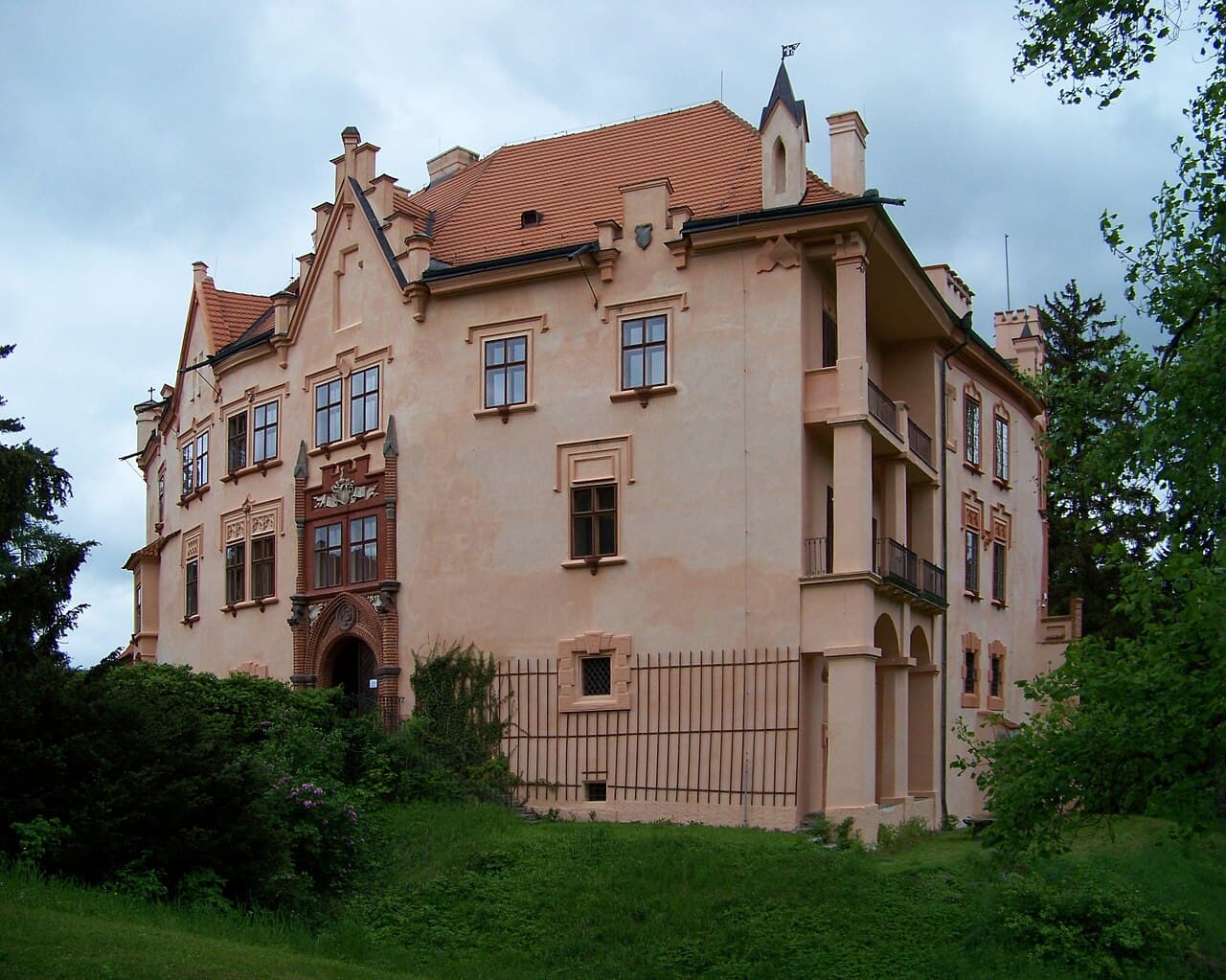
Vrchotovy Janovice Chateau
Vrchotovy Janovice Chateau stands as a remarkable example of a neo-Gothic hill castle in the Czech Republic, embodying centuries of architectural evolution and historical significance. Located in the municipality of Benešov, this castle's origins stretch back to the 15th century, with its core formed by a water fortress that has witnessed transformations through the Gothic, Renaissance, Baroque, Rococo, and finally 19th-century neo-Gothic styles. The castle’s layered history and architectural features make it a fascinating subject for historians and visitors alike.
The castle’s most defining characteristic today is its neo-Gothic appearance, achieved during a comprehensive reconstruction in the mid-19th century, particularly under the ownership of the Vratislav of Mitrovic family. However, its roots lie in a 15th-century water fortress originally constructed by the Lords of Janovice, designed for defense with moats and a strategic hilltop location. Over the centuries, the fortress expanded and softened into a noble residence, reflecting the changing needs and tastes of its owners.
Historical development and ownership
Medieval origins and early expansions
The earliest known structure on the site dates to around 1350, when a Gothic fortress was established by the Lords of Janovice. This fortress functioned primarily as a water castle, surrounded by moats that enhanced its defensive capabilities. In 1453, the property passed to Štěpán Vrchota of Vrchotice, whose family name the castle later adopted, marking a significant shift in ownership and identity.
During the 16th century, the fortress underwent expansions that incorporated Renaissance architectural elements. These changes reflected a trend across Europe where medieval fortifications were adapted into more comfortable and stately noble residences without losing their defensive character. The castle’s southern wing, built in this period, features the main entrance and exemplifies this blend of fortification and residential refinement.
Baroque and rococo transformations
From the 17th to 18th centuries, the castle was under the stewardship of the Vrtba family. They transformed the fortress into an elegant residence, embracing the Baroque and Rococo styles popular at the time. This period saw the addition of decorative flourishes and the establishment of a large English-style landscaped park surrounding the castle, complete with an artificial lake, terraces, and horticultural structures.
19th-century neo-gothic reconstruction
In 1807, the castle was sold to Count František Josef Vratislav of Mitrovic, whose family initiated a significant reconstruction around 1856. This renovation gave the castle its distinctive neo-Gothic style, characterized by decorative heraldry, pointed arches, and other medieval-inspired architectural details. The Vratislav coat of arms prominently adorns the main portal, symbolizing the family's influence and the Romantic-era fascination with medieval aesthetics.
20th-century cultural significance
The castle’s last private owner, Baroness Sidonie Nádherná von Borutín, was a notable cultural patron during the early 20th century. She transformed Vrchotovy Janovice into a vibrant salon for intellectuals and artists. Distinguished guests included writer Karel Čapek, politician Alice Masaryková, critic Karl Kraus, and poet Rainer Maria Rilke. The castle thus gained a reputation as a center for artistic and political exchange, enriching its cultural heritage.
During World War II, the castle was commandeered by the Nazi SS for military use, later occupied by Soviet and Czechoslovak forces. In 1949, it was nationalized and repurposed for industrial storage and archival functions, leading to a period of neglect. The National Museum took ownership in 1957, initiating restoration efforts and converting the castle into a public museum dedicated to 19th-century Czech society and the cultural figures associated with the site.
Architectural features and layout
Castle structure and defensive elements
The castle’s layout is an irregular triangular plan formed by three interconnected wings arranged around a closed courtyard. Access is granted through two gateways connected by arched stone bridges spanning the remnants of the original moat, a reminder of the castle’s defensive origins as a water fortress. The moat remains partially visible, offering insight into medieval defensive strategies.
The eastern wing is the oldest part of the castle, dating back to the 15th century. It includes the original tower located at its southern end, a vestige of the Gothic fortress that anchors the historic core. This wing retains masonry and structural elements typical of the Gothic period, such as pointed arches and robust stonework.
The southern wing, constructed in the 16th century, houses the main entrance and reflects Renaissance influences. It balances fortified features with more elegant residential spaces, illustrating the castle’s transformation from fortress to noble residence.
Ancillary buildings and parkland
South of the main castle complex lie former farm and administrative buildings, highlighting the estate’s role in regional land management and economy. These structures complement the castle’s residential and defensive functions, providing a comprehensive picture of a noble estate’s operations.
The castle is surrounded by an English-style landscaped park featuring an artificial lake at its center. The park dates largely from the 17th and 18th centuries and includes remnants of a greenhouse, terraces, and the gardener’s house. This park exemplifies the shift from purely defensive architecture to a leisure-oriented noble estate.
Within the park is a family cemetery with gravestones marking the resting places of the Nádherný family and memorials for their pets, adding a personal and intimate dimension to the estate’s history.
Cultural heritage and museum exhibitions
Today, Vrchotovy Janovice Chateau operates as a museum under the care of the National Museum. Its exhibitions focus on 19th-century Czech society and the lives of the castle’s notable cultural figures, including Baroness Sidonie Nádherná. A highlight is the 1906 portrait of Baroness Sidonie by Max Švabinský, painted in an expressive style influenced by Edvard Munch, which captures the artistic spirit associated with the castle.
The museum also showcases the tradition of Czech bell founding and the works of intellectuals who frequented the castle. Visitors gain a rich understanding of the castle’s architectural evolution alongside its role as a cultural hub, making it a unique destination for history and art enthusiasts.
Frequently asked questions (FAQ)
- How do I get to Vrchotovy Janovice Chateau?
- Vrchotovy Janovice Chateau is accessible by car and public transport. If you're traveling by train, the nearest station is in nearby Benešov, from where you can take a local bus or taxi to the chateau.
- What is the historical significance of Vrchotovy Janovice Chateau?
- Vrchotovy Janovice Chateau dates back to the late 16th century and reflects the Renaissance architectural style. It has been a residence for various noble families and played a significant role in the region's history.
- When was the chateau built?
- The construction of Vrchotovy Janovice Chateau began in 1580 and was completed in the early 1600s. Over the centuries, it has undergone several renovations, preserving its historical charm while adapting to modern needs.
- Can I take guided tours of the chateau?
- Yes, guided tours are available for visitors who wish to learn more about the history and architecture of Vrchotovy Janovice Chateau. Tours typically run several times a day and can be booked in advance.
- Why is the architecture of the chateau noteworthy?
- The architecture of Vrchotovy Janovice Chateau is noteworthy for its blend of Renaissance and Baroque styles, featuring elegant facades and beautifully decorated interiors. The design reflects the artistic trends of its time, making it a significant example of Czech heritage.
- Is it possible to host events at the chateau?
- Yes, Vrchotovy Janovice Chateau offers facilities for hosting various events, including weddings and corporate gatherings. The picturesque surroundings and historical ambiance provide a unique setting for special occasions.
- What are the opening hours for visitors?
- The chateau is open to visitors from April to October, typically from 10 AM to 6 PM. During the off-season, visiting hours may vary, so it’s recommended to check the official website for the most current information.
- What are the ticket prices for entry?
- Ticket prices for Vrchotovy Janovice Chateau are generally affordable, with discounts available for students, seniors, and groups. Children under a certain age may enter for free, making it an excellent choice for family outings.
- What is the best time to visit the chateau?
- The best time to visit Vrchotovy Janovice Chateau is during the spring and early autumn when the weather is pleasant, and the gardens are in full bloom. Additionally, visiting during weekdays can help you avoid larger crowds.
- Are there any nearby attractions to explore?
- Yes, there are several nearby attractions, including the beautiful landscapes of the Bohemian countryside and other historical sites like the town of Benešov and Konopiště Castle. These can complement your visit and offer more insight into the region's rich history.
Photo gallery

Information
Website
Visit websiteSources & official resources
Verify the information above using these authoritative references.
Loading map...
Visitor reviews
No reviews yet. Been here? Write the first review and help other travelers!
Write the first reviewVisited this castle? Share your experience
Your review helps other travelers and adds first-hand knowledge to our encyclopedia.



