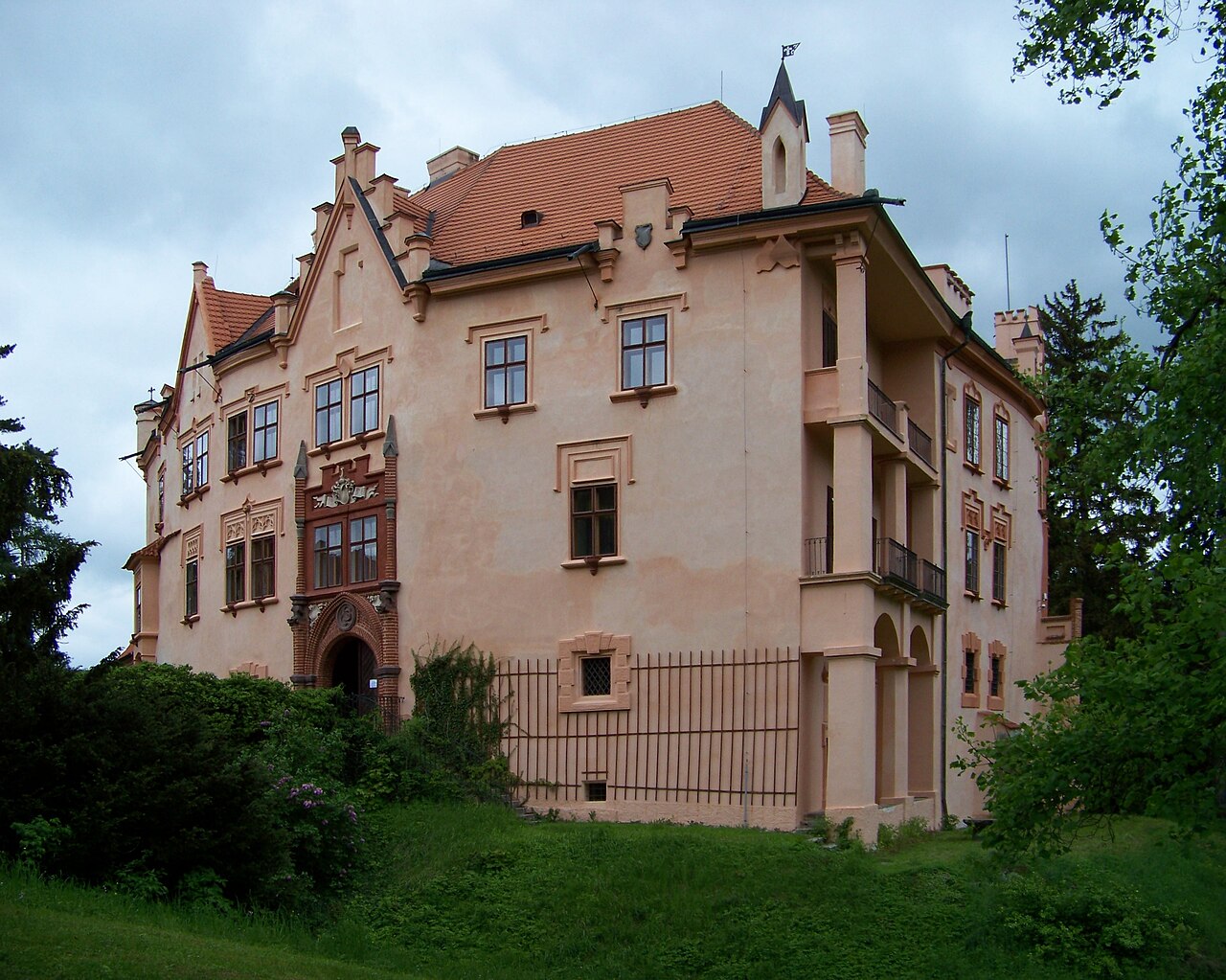
Kouty Castle
Kouty Castle stands as a testament to the medieval fortification strategies employed by the Bohemian nobility during the 14th century. Situated in the village of Kouty within the municipality of Smilkov-Heřmaničky, Czechia, this hill castle was strategically constructed on an island surrounded by a pond, creating a natural moat that enhanced its defensive capabilities. The castle's compact footprint, measuring approximately 20 by 30 meters, reflects the typical scale of a small medieval water fortress designed to serve as both a residence and a stronghold.
Historical background and ownership
The earliest documented mention of Kouty Castle dates back to 1366, firmly placing its origins in the high medieval period. The castle was initially built and controlled by the Bohemian nobility, with the Vejhák family, notably Jarohněv Vejhák of Křečovice, becoming prominent owners by the late 14th century. The Vejhák family maintained possession of the castle throughout the 15th and into the 16th centuries, using it as a family seat and a local power base within the region.
After 1606, Kouty Castle was absorbed into the larger Smilkov estate, marking a significant shift in its function and status. This integration led to the castle's gradual abandonment, as it ceased to be maintained either as a defensive fortress or as a noble residence. Over the following centuries, the lack of upkeep resulted in the castle's deterioration and eventual ruin. The physical remnants of the fortress were largely demolished in 1813, erasing much of the above-ground structure. Despite this, the site retained cultural and historical importance, leading to its designation as a protected cultural monument in 1965.
Architectural features and layout
Kouty Castle exemplifies the characteristics of a medieval water castle, where natural water bodies were integrated into the defensive system. The castle's island location within a pond served as a natural moat, a common medieval defensive feature that hindered direct assault and siege efforts. The fortified area was enclosed by walls forming a courtyard, which was typical for castles of this size and function.
Residential and entrance structures
The surviving ruins include parts of two main buildings that originally enclosed the courtyard. One significant fragment is a section of the residential building's courtyard wall, which still showcases window and door openings on both the ground and first floors. These openings provide valuable insight into the castle's interior organization, indicating multi-level habitation spaces and the use of natural light and ventilation.
Another preserved element is the corner of the east-facing entrance building, notable for its extension into the water-filled moat. The entrance's ground floor features a barrel vault, an architectural technique where the ceiling forms a continuous semi-cylindrical arch. This vaulting method not only enhanced structural strength but also offered fire resistance, reflecting advanced medieval construction practices.
Archaeological findings and below-ground structures
Modern archaeological investigations, including geophysical surveys, have revealed additional walls and structural remains beneath the current ground level. These subterranean features suggest that the castle's original footprint and complexity might have been greater than the visible ruins indicate. However, the precise dating and function of these below-ground structures remain undetermined, awaiting further research and excavation.
Post-medieval transformations and site legacy
South of the main castle island, where service and economic buildings likely stood, a Baroque-period farmyard now occupies the area. This later development illustrates the site's transition from a medieval defensive residence to an agricultural hub, reflecting broader socio-economic changes in the region following the castle's decline.
The demolition of the castle's ruins in 1813 marked the end of its physical presence, yet the site's designation as a cultural monument in 1965 underscores its enduring historical and cultural significance. Today, Kouty Castle's remains offer valuable insights into medieval fortification techniques, noble residential architecture, and the adaptive reuse of historical sites over centuries.
Significance in Czech medieval heritage
Kouty Castle holds an important place in the medieval heritage of Czechia. Its strategic location, architectural features, and historical ownership narrative contribute to our understanding of regional power dynamics and defensive architecture during the high and late medieval periods. As a hill castle with a water moat, it exemplifies the integration of natural landscape features into castle design, a hallmark of medieval military architecture.
Preservation efforts and archaeological studies continue to shed light on the castle's historical context, making it a valuable site for historians, archaeologists, and visitors interested in the evolution of medieval fortresses in Central Europe.
Frequently asked questions (FAQ)
- When was Kouty Castle built and who were its original owners?
- Kouty Castle was built in the 14th century by the medieval Bohemian nobility, with the Vejhák family becoming prominent owners by the late 14th century.
- What remains of Kouty Castle can visitors see today?
- Visitors can see ruins including parts of two main buildings enclosing the courtyard, window and door openings, and a vaulted entrance corner extending into the moat.
- Why was Kouty Castle abandoned and eventually demolished?
- After its incorporation into the Smilkov estate post-1606, Kouty Castle was no longer maintained, leading to deterioration and demolition of the ruins in 1813.
- What defensive features did Kouty Castle have?
- Kouty Castle was a water fortress built on an island within a pond, using the water as a natural moat to enhance its defenses.
- Is Kouty Castle protected as a cultural monument?
- Yes, the site was officially recognized and placed under protection as a cultural monument in 1965, preserving its historical significance despite the loss of most structures.
Information
Website
Visit websiteSources & official resources
Verify the information above using these authoritative references.
Loading map...
Visitor reviews
No reviews yet. Been here? Write the first review and help other travelers!
Write the first reviewVisited this castle? Share your experience
Your review helps other travelers and adds first-hand knowledge to our encyclopedia.