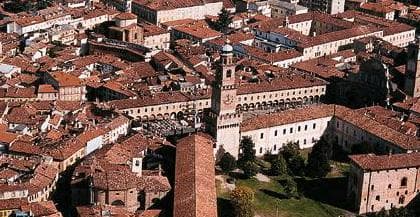
Visconti-Sforza Castle
The Visconti-Sforza Castle in Vigevano, Lombardy, stands as a monumental example of medieval and Renaissance architecture, reflecting centuries of political power and artistic patronage. Originally a fortified settlement known as Vicogebuin, the site evolved from wooden defenses to a brick fortress by the 10th century. The castle's transformation into a ducal residence began under Luchino Visconti in 1337, who initiated the conversion of the existing fortifications into a family residence. Successive rulers, including Gian Galeazzo Visconti, the first Duke of Milan, and later the Sforza dynasty, notably Ludovico il Moro and his grandson Gian Galeazzo Sforza, expanded and refined the complex throughout the 14th and 15th centuries.
Historical evolution and political significance
The castle's origins trace back to a square enclosure with a moat, serving as a refuge and shelter for livestock during sieges. By the early 14th century, under the Visconti family, it became a fortified ducal residence with battlemented walls and corner towers. In 1341, Luchino Visconti built the adjacent Rocca Vecchia, linking it to the castle with the Strada Coperta, a covered fortified road allowing secure passage between the two structures.
Following the Visconti, the Sforza family took control in 1449 after a siege involving Bartolomeo Colleoni and Francesco I Sforza. The Sforzas repaired war damages and transformed the castle into a Renaissance ducal palace. Under Galeazzo Maria Sforza, the maschio was enhanced with new stables, houses within the moat, and covered bridges connecting buildings. Ludovico il Moro, born in Vigevano, completed the castle's Renaissance transformation, commissioning architect Donato Bramante to design elegant porticoes, gardens, and frescoes, elevating the castle’s status as a courtly residence.
Architectural features and layout
The maschio and ducal palace
The castle's centerpiece is the maschio, a massive U-shaped main body forming the ducal palace. It encloses a central courtyard and includes two wings facing inward. The eastern extension housed a hanging garden surrounded by two porticoed buildings designed by Bramante, of which only the southern portico, the Loggia delle Dame, survives today. The maschio underwent multiple expansions and 19th-century Tudor-style reconstructions after parts collapsed.
Falconry and stables
Integral to the castle's function were the falconry building (Falconiera) and the stables (Scuderie). The Falconiera, connected to the maschio by an elevated loggia, exemplifies the blend of utility and elegance. The stables, including the Scuderia di Ludovico, feature double colonnades and vaulted ceilings, with traces of Bramante-attributed frescoes, reflecting the importance of equestrian culture to the ducal court.
Brilliant Bramante tower
The imposing Bramante Tower, modeled after the Milan Castle’s tower designed by Filarete, was completed in 1491. Rising approximately 75 meters above the piazza and 57 meters above the courtyard, it is the tallest structure in Vigevano. The tower comprises three stacked levels crowned with Ghibelline battlements, a clock section, and an octagonal belvedere housing a large 17th-century bell known as "il campanone," which still chimes every fifteen minutes despite being intentionally cracked to reduce its volume.
Urban context and related structures
The castle is part of a broader urban transformation in Vigevano during the 14th and 15th centuries, including the construction of the Piazza Ducale, the Rocca Vecchia, and the Palazzo Sanseverino (or Rocca Nuova). The Strada Coperta connects the castle with the Rocca Vecchia, facilitating communication and defense. The adjacent piazza and civic buildings enhanced Vigevano’s prestige as a ducal seat.
Later history and military use
After the Sforza dynasty ended with the death of Francesco II Sforza in 1535, the castle's prominence declined under Spanish rule. It was adapted for military use from the 18th century onward by Austrian and later Italian forces. Significant 19th-century modifications included filling the western moat, demolishing parts of the maschio’s walls, and constructing a neo-Gothic entrance atrium. Military adaptations also introduced indoor riding halls and repurposed kitchens and ovens as officers’ facilities.
Restoration and current use
The castle ceased military functions in 1968 and was abandoned until restoration began in 1980. Today, it houses the National Archaeological Museum of Lomellina in the third stable, opened in 1998 and expanded in 2018, and the International Shoe Museum Pietro Bertolini in rooms above the second stable since 2009. Portions of the castle, including restored rooms and exhibition spaces in the stables, are open to the public, while much of the complex remains unused.
Architectural and cultural significance
The Visconti-Sforza Castle exemplifies the evolution from medieval fortress to Renaissance ducal palace, showcasing the work of prominent figures like Donato Bramante and the influence of the Visconti and Sforza families. Its combination of defensive structures, residential quarters, service buildings, and elegant gardens reflects the multifaceted nature of aristocratic life in Lombardy during the late Middle Ages and Renaissance. The castle’s towering Bramante Tower remains a defining symbol of Vigevano’s historical identity.
Frequently asked questions (FAQ)
- What are the opening hours of Visconti-Sforza Castle?
- Visconti-Sforza Castle is typically open to visitors from 9:00 AM to 7:00 PM, Tuesday through Sunday. It is closed on Mondays and certain public holidays, so it's always a good idea to check their official website for any seasonal changes or special events.
- How do I get to Visconti-Sforza Castle?
- The castle is conveniently located in Vigevano, Italy, which is accessible by train from major cities like Milan. Once you arrive at Vigevano train station, it's just a short walk to the castle, making it easy to include in your travel itinerary.
- What is the historical significance of Visconti-Sforza Castle?
- Visconti-Sforza Castle dates back to the 14th century and is a symbol of the power held by the Visconti and Sforza families in the region. It was an important military and cultural center during the Renaissance, showcasing the architectural advancements of the time.
- Can I take guided tours of the castle?
- Yes, guided tours of Visconti-Sforza Castle are available and highly recommended for a deeper understanding of its history and architecture. These tours often include access to areas that may not be open to the general public, enhancing your visit experience.
- Is the castle accessible for visitors with disabilities?
- Visconti-Sforza Castle strives to be accessible to all visitors, including those with disabilities. There are ramps and designated pathways to facilitate access, but it is advisable to contact the castle in advance to confirm specific accessibility options.
- When is the best time to visit Visconti-Sforza Castle?
- The best time to visit is during the spring and early fall when the weather is pleasant, and there are fewer tourists. Visiting during these seasons allows you to appreciate the castle's beautiful gardens and surrounding landscapes.
- What are the ticket prices for visiting the castle?
- Ticket prices for Visconti-Sforza Castle typically range from €5 to €10 depending on the type of tour and access level. Discounts may be available for students, seniors, and groups, so be sure to inquire when purchasing your tickets.
- Are there any nearby attractions to visit after the castle?
- Yes, after exploring Visconti-Sforza Castle, you can visit the nearby Piazza Ducale, known for its stunning architecture and vibrant atmosphere. Additionally, the Museum of the Castle offers further insights into the history of Vigevano and is just a short walk away.
Photo gallery

Information
Website
Visit websiteSources & official resources
Verify the information above using these authoritative references.
Loading map...
Visitor reviews
No reviews yet. Been here? Write the first review and help other travelers!
Write the first reviewVisited this castle? Share your experience
Your review helps other travelers and adds first-hand knowledge to our encyclopedia.


