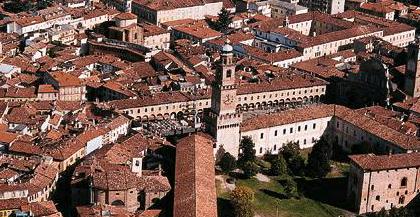
Abbiategrasso Castle
Abbiategrasso Castle is a significant medieval fortress located in Abbiategrasso, Italy, strategically positioned along the Naviglio Grande canal. Constructed primarily to protect this crucial waterway leading to Milan, the castle played a vital role in the defense and administration of the region during the High Medieval period. Its origins trace back to the late 13th century, built on the site of an earlier fortification known as Castro Margazario, near a Benedictine monastery, reflecting the common medieval practice of situating castles close to religious institutions for mutual protection and influence.
Early construction and visconti expansions
The initial structure of Abbiategrasso Castle was established at the end of the 13th century, embodying the typical characteristics of a hill castle designed for both defense and control of the surrounding territory. The castle underwent significant enlargement under the rule of Azzone Visconti (1329-1339), who reinforced its fortifications to strengthen the Visconti family's hold on the region. Further expansions were made by Gian Galeazzo Visconti (1378-1402), the first Duke of Milan, who enhanced the castle's defensive capabilities and residential comfort, reflecting the transition of such fortresses from purely military installations to noble residences.
Architectural features
The castle originally featured massive stone walls, towers, and a moat fed by the Naviglio Grande, which served both defensive and symbolic purposes. Its layout included a central courtyard surrounded by residential and service buildings, typical of Visconti castles. The castle's position on the canal allowed for easy access by water, a strategic advantage for transportation and supply during sieges or conflicts.
Renaissance transformation and ducal residence
In the 15th century, under Duke Filippo Maria Visconti, the castle lost much of its military function and was transformed into a favored country residence. The duke undertook restoration and embellishment works in 1438, adapting the castle to the tastes and needs of a Renaissance noble court. This period saw the introduction of more refined architectural elements, including decorative windows and enhanced living quarters, signaling a shift from fortress to palace.
Notable residents and cultural significance
The castle was a preferred residence for the dukes and duchesses of Milan, including Agnese del Maino, the mistress of Duke Filippo Maria and mother of Bianca Maria Visconti. Bianca Maria's descendants, the Sforza family, also valued Abbiategrasso Castle as a symbol of their Visconti heritage, using it to reinforce their legitimacy and status. The castle's role as a ducal mansion highlights its importance not only as a military structure but also as a center of political and social life in Renaissance Milan.
Military role during the italian wars and later changes
Following the Visconti-Sforza period, the castle resumed a more defensive role during the turbulent years of the Italian Wars (1494-1559). Its fortifications were maintained and adapted to the evolving military technologies of the time. However, in 1658, significant alterations occurred when three of the castle's towers were demolished and the remaining tower was truncated, reflecting changes in military strategy and the reduced importance of medieval castles in warfare.
19th-century modifications and preservation efforts
In 1862, the castle was sold to the municipality of Abbiategrasso. Subsequent urban development led to the removal of the surrounding ramparts to accommodate a new train station, a common fate for many medieval fortifications in expanding modern towns. Despite these changes, restoration efforts were undertaken to preserve the castle's remaining structures, ensuring its survival as a historical monument and cultural landmark.
Architectural style and current condition
Abbiategrasso Castle is primarily an example of High Medieval architecture with subsequent Renaissance modifications. Its style reflects the transition from a military fortress to a noble residence, combining robust defensive features with more elegant and comfortable living spaces. Today, the castle is considered partially preserved, retaining key elements of its original structure, including portions of its walls and towers, which offer valuable insights into medieval and Renaissance castle design in northern Italy.
Visiting abbiategrasso castle
The castle is accessible to visitors interested in exploring its historical and architectural significance. Its location near Milan makes it an attractive destination for those interested in medieval history, the Visconti and Sforza dynasties, and the evolution of castle architecture. Visitors can appreciate the castle's strategic position along the Naviglio Grande and its blend of defensive and residential features.
Frequently asked questions
- When was Abbiategrasso Castle built? The castle was constructed in the late 13th century, around the end of the 1200s, on the site of an earlier fortification.
- Who expanded the castle during the Visconti era? Significant expansions were made by Azzone Visconti and Gian Galeazzo Visconti in the 14th century.
- What is the architectural style of the castle? The castle features High Medieval architecture with Renaissance modifications.
- Can visitors tour the castle? Yes, the castle is open to visitors and offers insights into medieval and Renaissance history.
- Why was the castle important during the Italian Wars? It resumed a defensive role during the Italian Wars, adapting to the military needs of the period.
- What happened to the castle's towers? Three towers were demolished in 1658, and the fourth was truncated.
- How did the castle's function change over time? Originally a fortress, it became a ducal residence in the 15th century and later returned to a military role during the Italian Wars.
- Is the castle well preserved? The castle is partially preserved, with some original walls and towers remaining.
Frequently asked questions (FAQ)
- How do I get to Abbiategrasso Castle?
- Abbiategrasso Castle is easily accessible by public transport, with regular trains connecting from Milan. If you prefer to drive, there is parking available nearby, making it a convenient visit for those traveling by car.
- What is the historical significance of Abbiategrasso Castle?
- Built in the 14th century, Abbiategrasso Castle played a crucial role in the defense of the region during various conflicts. Its rich history includes serving as a residence for nobility and a strategic military fortress.
- When was Abbiategrasso Castle constructed?
- The construction of Abbiategrasso Castle began in the year 1382 and was completed in 1400. It was commissioned by the Visconti family, who were influential in the development of Milan and its surroundings.
- Can I take guided tours of the castle?
- Yes, guided tours are available and provide an in-depth look at the castle's history, architecture, and artworks. These tours are highly recommended for visitors who want to gain a deeper understanding of the site.
- Why is the architecture of Abbiategrasso Castle unique?
- The architecture of Abbiategrasso Castle showcases a blend of Gothic and Renaissance styles, which is characteristic of many castles built during that era. Its impressive towers and fortified walls reflect the military purpose it served while also embodying the elegance of noble residences.
- Is it possible to visit Abbiategrasso Castle year-round?
- Yes, Abbiategrasso Castle is open to visitors throughout the year, although specific opening hours may vary by season. It's advisable to check the official website for the most current information regarding accessibility and special events.
- What are the ticket prices for visiting the castle?
- Ticket prices for Abbiategrasso Castle are generally affordable, with discounts available for students and seniors. Children under a certain age can often enter for free, making it a great family-friendly destination.
- When is the best time to visit Abbiategrasso Castle?
- The best time to visit Abbiategrasso Castle is during the spring and fall when the weather is mild and the gardens are in bloom. Additionally, visiting during weekdays can help you avoid larger crowds, allowing for a more enjoyable experience.
- What nearby attractions can I explore after visiting the castle?
- After visiting Abbiategrasso Castle, you can explore the charming town of Abbiategrasso, which features beautiful parks and local restaurants. Nearby, the Naviglio Grande canal offers scenic walks and boat tours, enhancing your visit to the area.
Information
Loading map...
Visitor reviews
No reviews yet. Been here? Write the first review and help other travelers!
Write the first reviewVisited this castle? Share your experience
Your review helps other travelers and adds first-hand knowledge to our encyclopedia.