Visconteo Castle
Visconteo Castle, also known as Castello Visconteo, stands prominently in the city of Locarno, Switzerland, as a testament to the region's rich medieval heritage and strategic importance. This late medieval fortress has a complex history intertwined with the power struggles of the Visconti Dukes of Milan and the shifting political landscape of the Alpine foothills. Today, the castle functions as an archaeological museum, showcasing Locarnese artefacts spanning from the late Bronze Age through the High Middle Ages, thus bridging the ancient past with the medieval era.
The castle's origins trace back to a site of royal and noble significance dating to the 9th and 10th centuries, with the earliest surviving architectural elements dating from the late 12th or early 13th century. Over the centuries, Visconteo Castle evolved from a fortified noble residence to a powerful administrative center under the Visconti family, who ruled from the castle between 1513 and 1798. Its strategic location near Lake Maggiore and the Alpine passes made it a key military and political stronghold.
Early history and medieval origins
Historical records indicate that a royal palace existed in Locarno as early as 866, and by the 10th century, a noble family had established a castle on the site. The surviving parts of the castle, including sections of the ring wall, a residential tract, and the foundation of a tower, date from the late 12th or 13th century. In 1164, Emperor Frederick Barbarossa granted Locarno the right to hold a market and first mentioned the Capitanei di Locarno, a group of noble families who administered the town and its church (the Pieve). These Capitanei enjoyed imperial immediacy but often found themselves in conflict with imperial authority.
By around 1240, Locarno had become a stronghold of the Guelph faction, supporters of the pope against the emperor. This factionalism likely led to the construction or expansion of the castle as a defensive bulwark. However, in 1260, the castle was attacked and destroyed by the pro-emperor Ghibellines. Following this destruction, Simon di Orelli, the most powerful Capitanei member, switched allegiance to the Ghibellines, bringing Locarno under imperial influence until his death in 1290. The castle was rebuilt after the 1260 destruction, marking a significant phase in its development.
Visconti rule and architectural transformation
During the 14th century, the powerful Visconti family of Milan expanded aggressively into the Alpine valleys. In 1342, Lucchino and Giovanni Visconti besieged and captured Visconteo Castle from both land and lake approaches. Many members of the Capitanei were captured but later released after acknowledging Visconti overlordship. The Visconti appointed a podestà to govern Locarno, who became the sole resident of the castle, while some of the older buildings fell into disrepair.
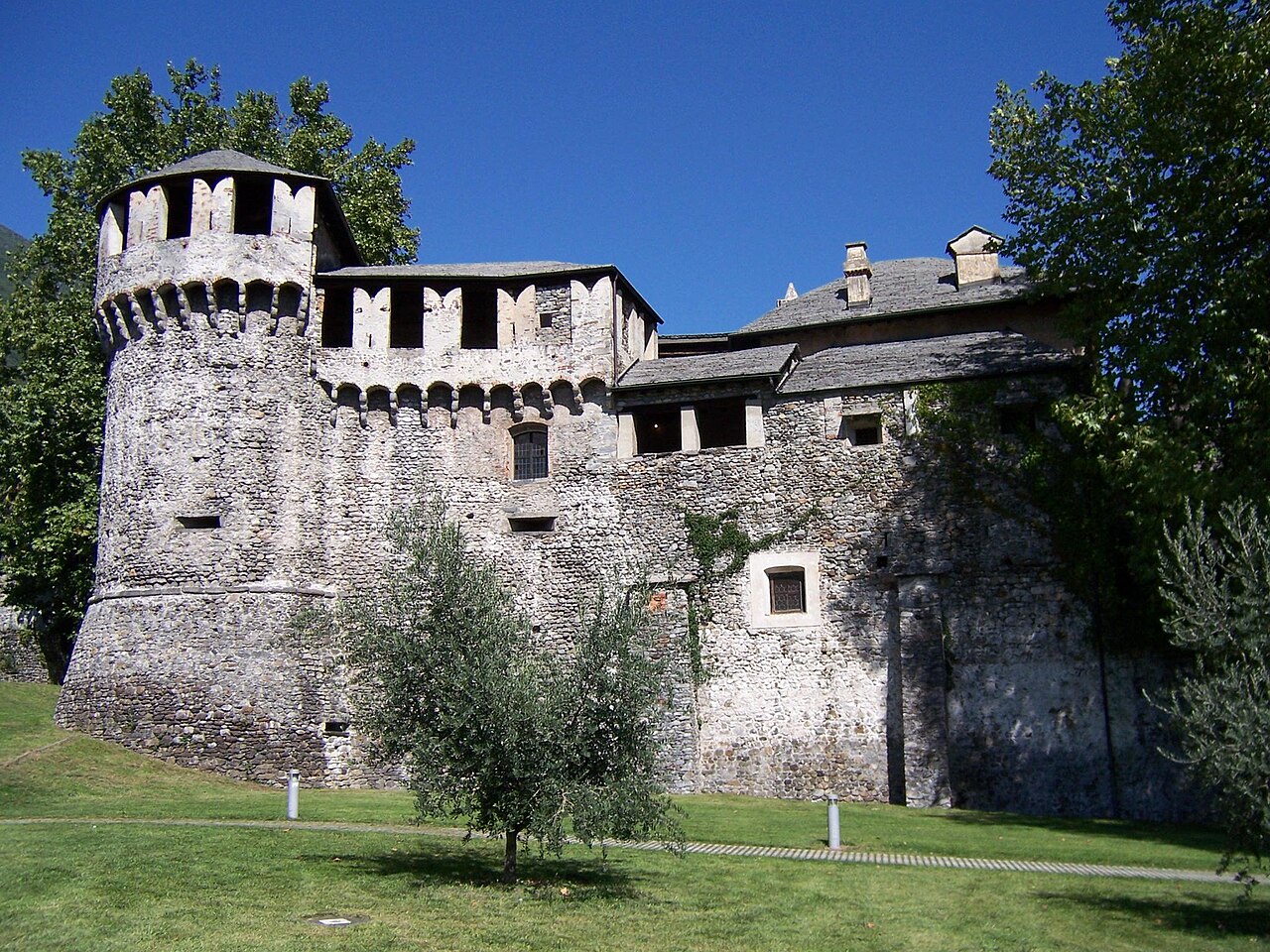
Under Visconti rule, the castle's fortifications were strengthened with new defensive walls. In 1439, the Visconti appointed Franchino Rusca as podestà, who undertook extensive renovations and expansions. The castle was transformed into an ornate late medieval administrative center, featuring a palazzo with large halls, chimneys, and an arcade opening onto the courtyard. The castle was surrounded by a ring wall with machicolations and half-round towers topped with distinctive swallow-tail merlons. Portions of the Rusca castle wall remain visible today on the southwest side of the complex.
The dual residency and internal divisions
By the late 15th century, concerns arose that the Rusca family might side with the Old Swiss Confederacy against Milan. To counter this, the Duke of Milan appointed a castellan to manage the castle, who resided in the old main tower known as the Rocca. Meanwhile, the Rusca family continued to live in the palazzo. The castellans frequently requested funds for repairs and reinforcements, highlighting the castle's ongoing strategic importance and the challenges of maintaining such a complex fortress.
Conflicts and changes in control
In 1495, Louis XII of France offered Locarno to the Swiss Confederacy in exchange for military support against Milan. He later invaded Lombardy and captured Locarno and its castle but delayed transferring control to the Swiss. In 1503, the Swiss Confederation invaded and took Locarno, but the Treaty of Arona returned the town to France while granting Bellinzona's fortifications to the Swiss.
In 1507, the castle was expanded with the addition of the Rivellino, a triangular bastion on the north side. Historian Marino Viganò has suggested that this bastion was designed by Leonardo da Vinci, although no direct documentary evidence survives to confirm this. The castle withstood a siege by the Swiss during the War of the League of Cambrai in 1512 but was not captured due to a lack of artillery.
Following the Swiss victory at the Battle of Novara in 1513, the castle came under Swiss control, formalized by the 1516 peace treaty which granted the Swiss permanent control over much of Ticino, including Locarno. The Swiss appointed a landvogt to administer the castle and town. However, the cost of maintaining the extensive fortifications was high, leading to the demolition of much of the complex in 1531, leaving primarily the palazzo intact. By 1535, harbor fortifications near the castle were also removed.
Later use and preservation
Despite the reductions, the castle remained the seat of the Swiss vogt until the 1798 French invasion and the establishment of the Helvetic Republic. After the Republic's collapse, the 1803 Act of Mediation created the Canton of Ticino, transferring the castle to cantonal authority. It served as a cantonal administration building until 1921, when ownership passed to the town of Locarno.
The town undertook repairs and transformed the castle into the Museo civico e archeologico, an archaeological museum that preserves and exhibits the region's rich heritage. The museum's collections span from the late Bronze Age to the High Middle Ages, highlighting the historical continuity of human settlement and culture in the Locarno area.
Architectural features and significance
Visconteo Castle exemplifies the evolution of a medieval fortress adapting to changing political and military needs over several centuries. Its architectural features include the remnants of the original ring wall, the palazzo with its ornate halls and chimneys, the Rocca tower, and the Rivellino bastion. The castle's defensive walls with machicolations and swallow-tail merlons reflect the late medieval military architecture typical of northern Italy and the Alpine region.
The possible involvement of Leonardo da Vinci in the design of the Rivellino adds a layer of cultural and historical intrigue, linking the castle to Renaissance innovations in fortification design. The castle's transformation from a noble residence to an administrative center and finally to a museum underscores its enduring importance to Locarno's cultural landscape.
Visiting visconteo castle today
Today, Visconteo Castle is a restored heritage site open to the public as a museum. Visitors can explore its well-preserved architectural elements and enjoy exhibitions that trace the region's history from prehistoric times through the medieval period. The castle's location offers scenic views of Lake Maggiore and the surrounding Alpine foothills, making it a popular destination for tourists interested in history, architecture, and archaeology.
The museum provides educational opportunities to learn about the Capitanei di Locarno, the Visconti family's rule, and the castle's role in regional conflicts. Its rich collections and preserved structures offer a comprehensive glimpse into the political, military, and cultural developments of this part of Switzerland.
Frequently asked questions (FAQ)
- How do I get to Visconteo Castle?
- Visconteo Castle is located in Locarno, Switzerland, and is easily accessible by public transportation. You can take a train to Locarno station and then walk to the castle, which is about a 15-minute stroll from the station.
- What is the historical significance of Visconteo Castle?
- Visconteo Castle, built in the 15th century, played a crucial role in the defense of Locarno and the surrounding area. It is a remarkable example of military architecture from the late Middle Ages, reflecting the strategic importance of the region during that time.
- When was Visconteo Castle constructed?
- Construction of Visconteo Castle began in 1478 and was completed in 1487. Its establishment marked a significant development in the fortifications of Locarno, designed to protect against invasions and to assert power in the region.
- Can I visit Visconteo Castle year-round?
- Yes, Visconteo Castle is open to visitors throughout the year, although specific areas may have seasonal restrictions. It's recommended to check the official website for any updates on accessibility and maintenance schedules before planning your visit.
- Why is Visconteo Castle an architectural landmark?
- Visconteo Castle is renowned for its impressive defensive structures, including massive walls and towers that showcase the military design of the 15th century. Its unique blend of Gothic and Renaissance elements makes it a significant architectural landmark in Switzerland.
- Is it possible to take guided tours of the castle?
- Yes, guided tours are available at Visconteo Castle, offering visitors a deeper insight into its history and architecture. These tours are typically conducted in multiple languages, making it accessible for a diverse audience.
- What are the opening hours for Visconteo Castle?
- Visconteo Castle generally opens to the public from 10 AM to 6 PM, with extended hours during the summer months. However, it's advisable to verify the current hours on the official website before your visit, as they may vary seasonally.
- What are the ticket prices for visiting Visconteo Castle?
- Ticket prices for Visconteo Castle are quite reasonable, with discounts available for students and seniors. Children under a certain age may enter for free, making it an affordable outing for families.
- What nearby attractions can I visit while in Locarno?
- While visiting Locarno, you can explore the beautiful Lake Maggiore, visit the famous Sanctuary of Madonna del Sasso, or enjoy the scenic Verzasca Valley. Each of these attractions is easily accessible and offers unique experiences in the stunning Swiss landscape.
Information
Sources & official resources
Verify the information above using these authoritative references.
Loading map...
Visitor reviews
No reviews yet. Been here? Write the first review and help other travelers!
Write the first reviewVisited this castle? Share your experience
Your review helps other travelers and adds first-hand knowledge to our encyclopedia.