Visconteo Castle, Locarno
Visconteo Castle in Locarno, Switzerland, stands as a remarkable example of medieval military architecture combined with Renaissance residential elegance. Its origins trace back to at least 866 AD, when Emperor Ludwig II granted the royal court of Locarno to his wife Engelberga. Although the earliest surviving parts of the castle date from the late 12th or early 13th century, the site itself has a much longer history of occupation, reflecting its strategic importance overlooking the upper Verbano region.
Early history and medieval origins
The castle initially served as the residence of the Capitanei di Locarno, a noble family loyal to the emperor. This early phase established the castle as a fortified noble seat, strategically positioned on a hill to oversee the surrounding territory and the medieval harbor below. In 1260, the castle suffered destruction during the violent conflicts between the Ghibellines and Guelphs, two rival political factions that shaped much of northern Italy's medieval history. The castle was swiftly rebuilt, maintaining its role as a fortified center of power.
Visconti rule and architectural expansion
In 1342, the castle came under the control of the powerful Visconti family of Milan, who were influential rulers in northern Italy. The Visconti reinforced the castle's defenses by constructing massive walls and enhancing its fortifications to control the region effectively. Their occupation lasted until 1439, during which time the castle became a key military and administrative stronghold.
Following the Visconti era, the castle was administered by the Rusca family, who expanded and renovated it into a princely residence. The Rusca introduced ornate halls and improved defensive features, blending military functionality with residential comfort. By the late 15th century, concerns about governance led to the appointment of a castellan to oversee the castle's security and management.
Renaissance modifications and military significance
The castle faced further turmoil during the French occupation in 1499. Between 1499 and 1512, the castle's defenses were bolstered with the addition of the Rivellino bastion, a triangular fortification on the northeast corner. Some historians speculate that Leonardo da Vinci may have influenced its design, although this remains debated. The castle briefly changed hands, falling under Swiss control in 1513 and definitively becoming Swiss territory in 1516 after the Treaty of Eternal Peace.
Despite its strategic importance, financial constraints led to the demolition of much of the castle's fortifications between 1531 and 1532. This left primarily the residential palazzo and parts of the defensive walls intact. The harbor fortifications were abandoned by 1535, marking a shift in the castle's military role.
Post-medieval use and restoration efforts
After the collapse of the Helvetic Republic in 1803, Visconteo Castle transitioned from a military fortress to a cantonal administrative building and later housed private residences. In 1921, the city of Locarno purchased the castle and initiated a comprehensive restoration led by architect Edoardo Berta. This restoration carefully blended the castle's medieval and Renaissance architectural elements, converting it into the Museo civico e archeologico, a civic and archaeological museum.
The museum's collections are notable for their extensive Roman glassware and artifacts from the Roman and Bronze Ages, reflecting the site's long history of human occupation. Exhibits also cover the 1925 Locarno Peace Conference and the impact of the Reformation on the city, adding layers of cultural and historical significance.
Further restoration work was undertaken in 1990 by architects Giorgio and Michele Tognola, ensuring the preservation of the castle's structural integrity and historical character. The Rivellino bastion remains privately owned as of 2010, preserving this unique architectural feature.
Architectural features and surviving structures
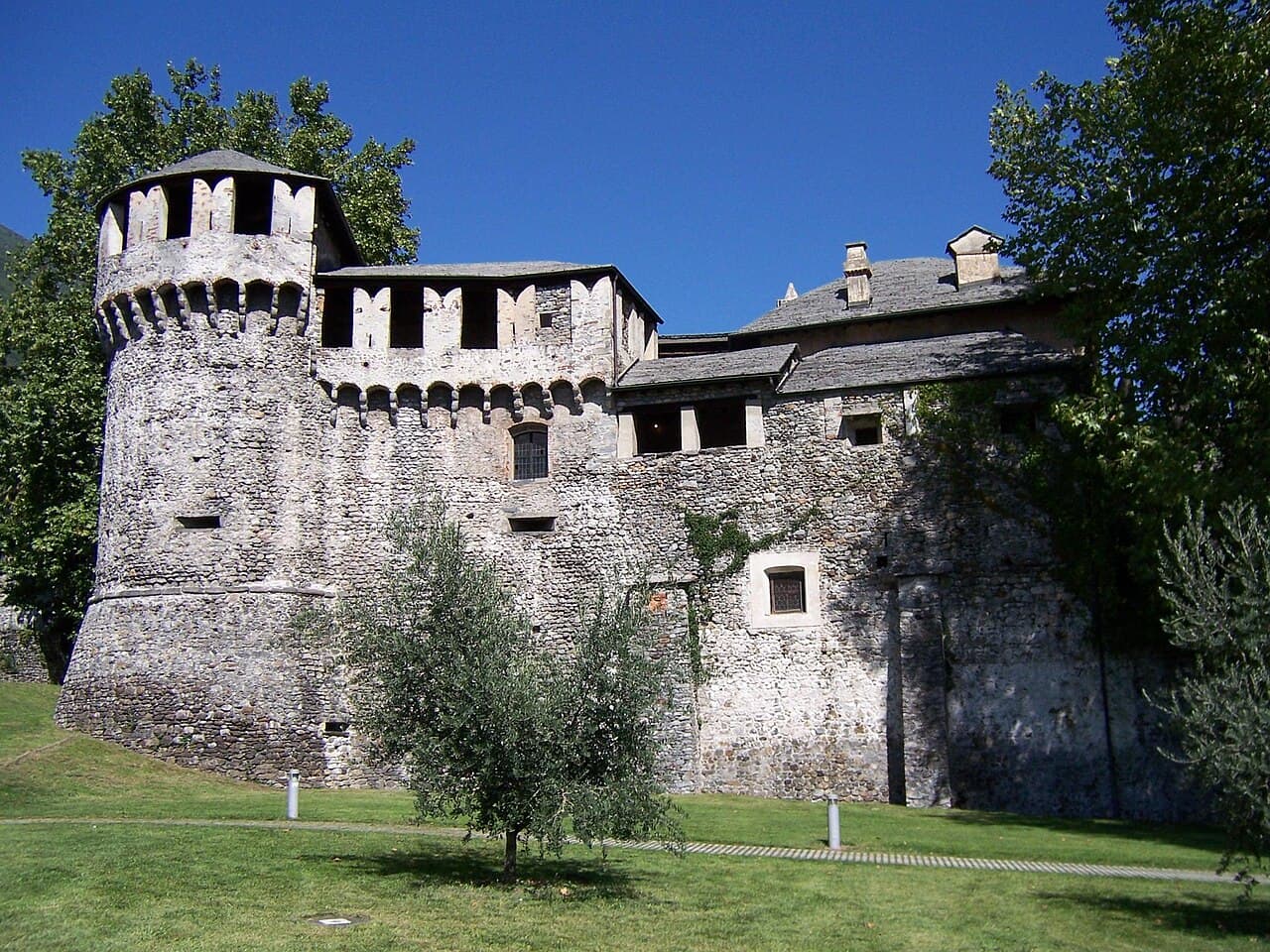
Today, only about one-fifth of the original Visconteo Castle complex survives. The current appearance largely reflects the 20th-century restorations, which preserved key medieval and Renaissance elements. The castle's layout includes defensive walls, residential palazzi, towers, and a central courtyard.
On the south side, remnants of the Visconti-era defensive walls remain, featuring a battlemented walkway, a round tower at the southwest corner, swallowtail-shaped crenellations, machicolations, and arrow slits. A preserved section of the castle moat lies before these defenses, illustrating the castle's medieval military design.
The courtyard is bordered by two Renaissance-style palazzi on the west and south sides, attributed to the Rusca family. One palazzo was likely built by Franchino Rusca, and the other expanded by Giovanni Rusca, both serving as residential wings. To the east, the courtyard is enclosed by the substantial base of a tower that once supported the late 16th-century Casorella residence. Remains of a defensive walkway survive on the hillside side, adding to the castle's layered defensive system.
The castle opens eastward toward the former medieval harbor, now covered by a modern road. Beneath this road, foundation walls of harbor buildings from the 13th to 15th centuries remain visible in a pedestrian underpass, providing insight into the castle's maritime connections.
The castle's construction primarily employs medieval stone masonry, with decorative features such as swallowtail crenellations and machicolations exemplifying late medieval military architecture. During the 20th-century restorations, interior frescoes and medieval stucco work were uncovered and partially reconstructed, enhancing the castle's historical ambiance.
The rivellino bastion
The Rivellino bastion is a distinctive triangular fortification constructed between 1499 and 1512 on the castle's northeast corner. Its innovative design reflects Renaissance military architecture and possibly the influence of Leonardo da Vinci, although this attribution remains speculative. The bastion remains privately owned, standing as a testament to the castle's evolving defensive strategies during the early modern period.
Cultural significance and museum collections
As the Museo civico e archeologico, Visconteo Castle serves as a cultural hub preserving the region's rich archaeological heritage. Its collections include significant Roman glass artifacts and items from the Bronze Age, highlighting the long continuum of human activity in the Locarno area. The museum also educates visitors about the castle's role in regional history, including its military, political, and social transformations.
Exhibits on the 1925 Locarno Peace Conference emphasize the castle's place in 20th-century diplomatic history, while displays on the Reformation illustrate the profound religious and cultural shifts that affected the city and its inhabitants.
Visitor experience and accessibility
Visitors to Visconteo Castle can explore the preserved courtyard, defensive walls, and towers, gaining insight into medieval and Renaissance castle architecture. The museum offers a comprehensive narrative of the site's history through its exhibits and restored interiors. While the Rivellino bastion is not open to the public due to private ownership, the castle grounds and museum provide ample opportunities for education and appreciation of the region's heritage.
Photo gallery

Information
Website
Visit websiteSources & official resources
Verify the information above using these authoritative references.
Loading map...
Visitor reviews
No reviews yet. Been here? Write the first review and help other travelers!
Write the first reviewVisited this castle? Share your experience
Your review helps other travelers and adds first-hand knowledge to our encyclopedia.