Montebello Castle
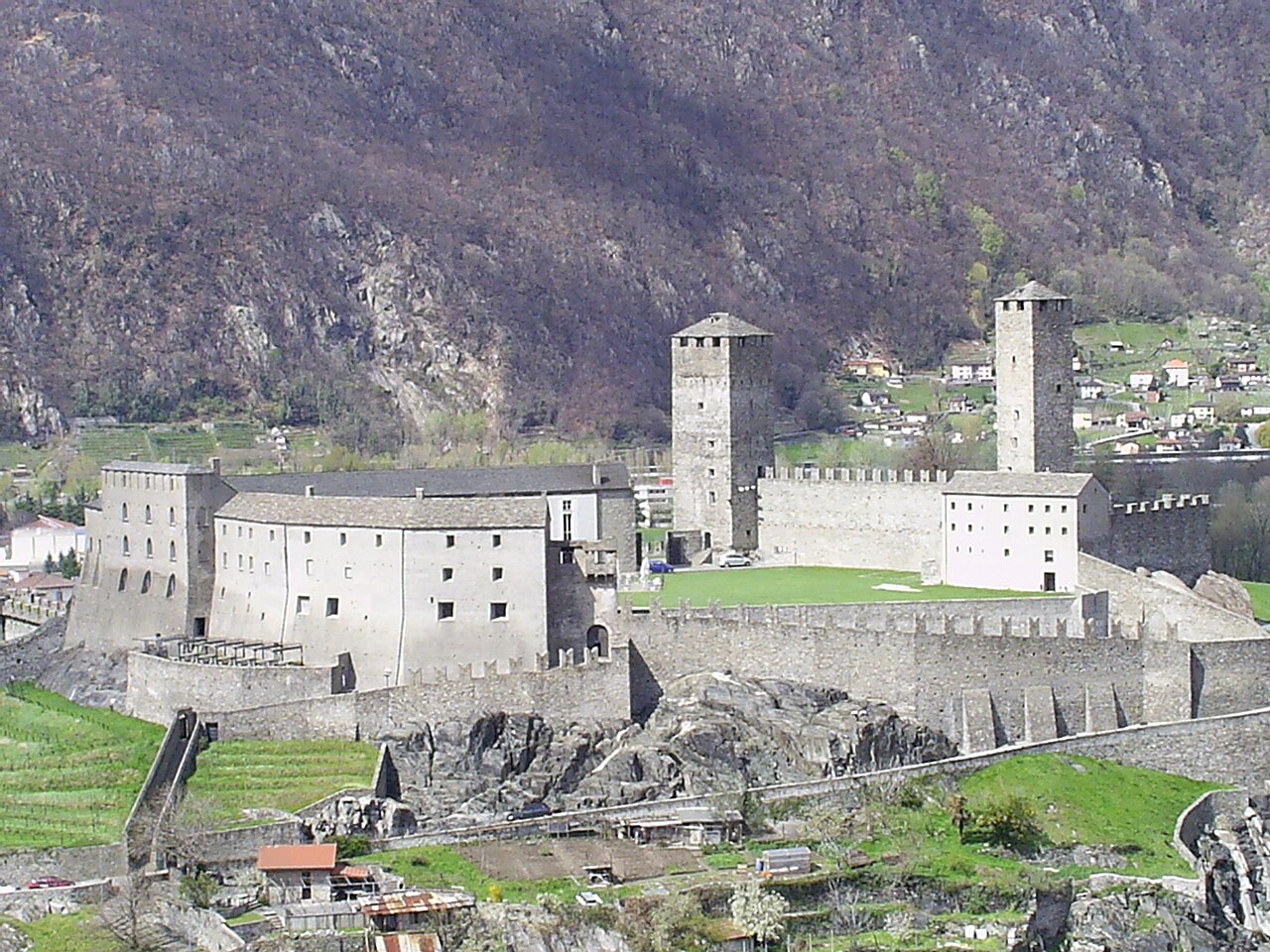
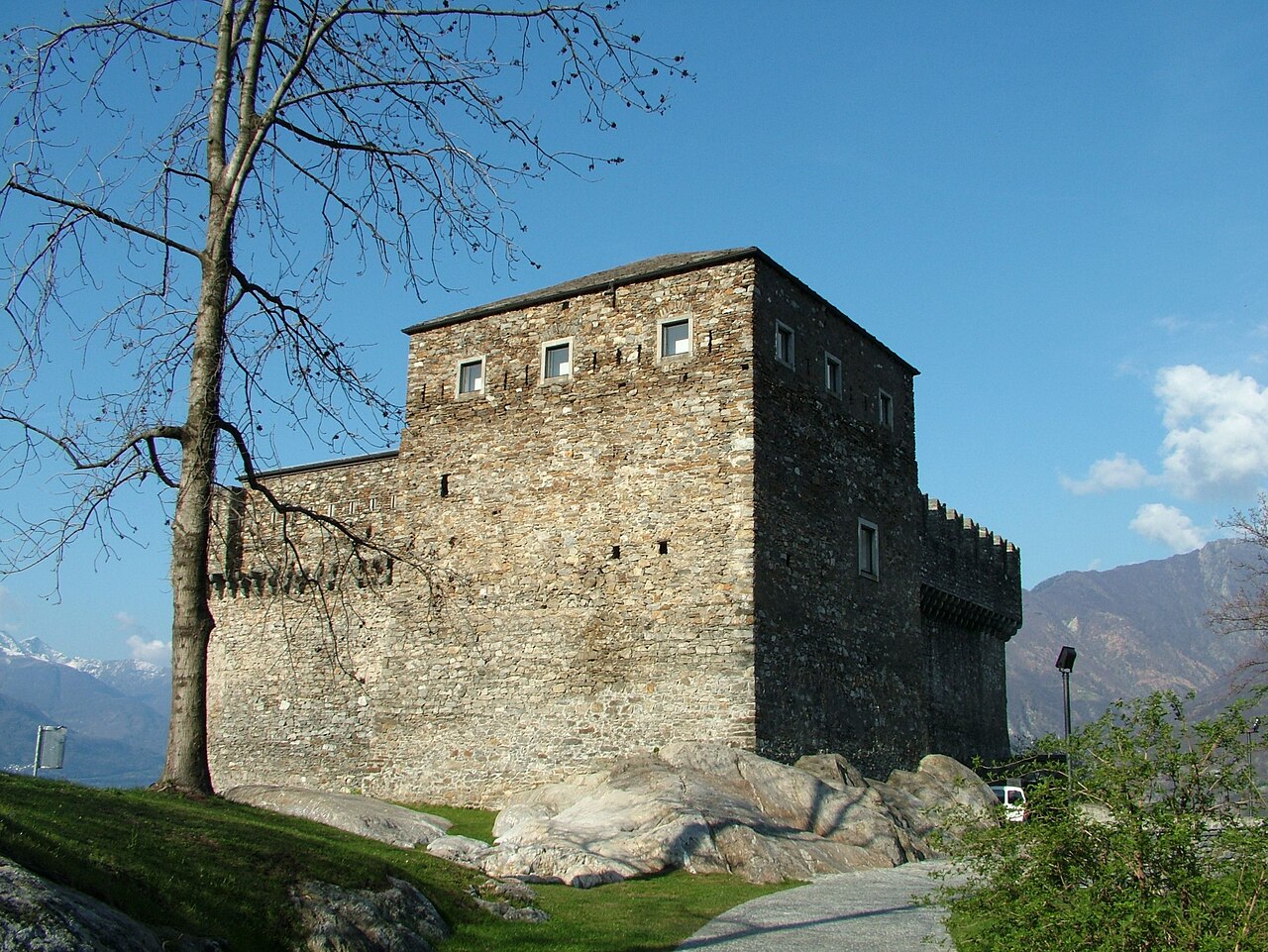
Montebello Castle stands as a prominent late medieval hill castle in the historic town of Bellinzona, located in the Canton Ticino of Switzerland. This fortress is one of three key castles that form the celebrated defensive complex of Bellinzona, alongside Castelgrande and Sasso Corbaro. Together with the extensive connecting walls, these fortifications have been recognized as a UNESCO World Heritage Site since 2000, underscoring their cultural and historical significance. Montebello Castle today serves as the home to the Archaeology and History Section of Bellinzona's Municipal Museum, preserving and showcasing the region's rich past.
Early origins and strategic importance
The origins of Montebello Castle trace back to the late 13th century, when it was constructed by the pro-Imperial Rusca family. This family built the initial fortification on a commanding rocky ridge overlooking the oldest part of Bellinzona, a location strategically chosen to control access routes through the Ticino valley to the Alpine passes. The castle's elevated position allowed it to serve as a key defensive stronghold amid the turbulent political struggles involving the Holy Roman Empire, the Visconti of Milan, and local noble factions.
The earliest documented mention of Montebello Castle dates to 1313, although the fortress likely existed slightly earlier. At that time, the castle consisted primarily of an irregular rectangular keep with a trapezoidal shape, surrounded by two courtyards and a small number of houses. The keep featured a high, sturdy outer wall enclosing living quarters and utility buildings along the interior, with the original entrance located high on the western wall, accessible only by an external staircase — a typical defensive design of the period.
Architectural evolution through the 14th and 15th centuries
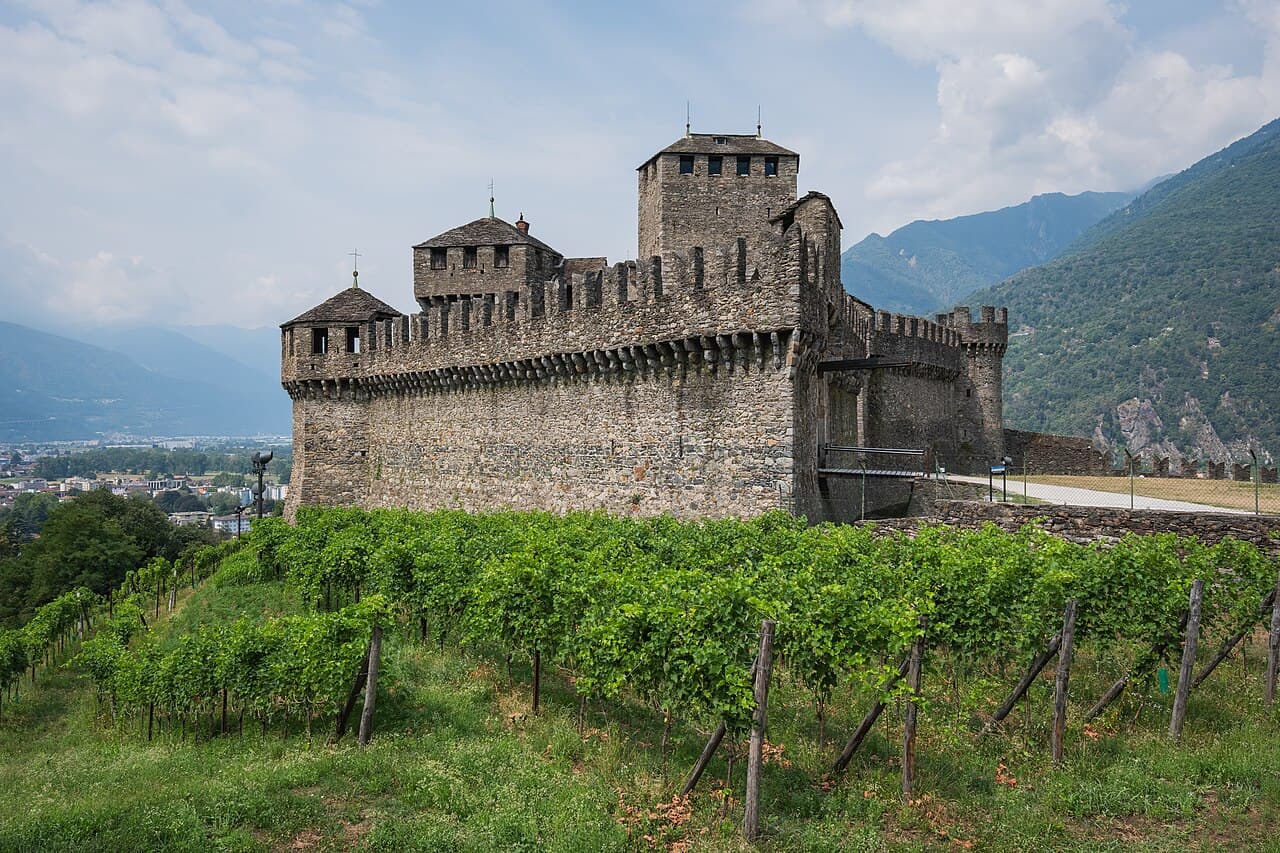
Throughout the 14th century, Montebello Castle underwent significant fortification enhancements. The castle was equipped with Ghibelline battlements, recognizable by their swallowtail crenellations, which were characteristic of pro-Imperial fortresses. This period also saw the construction of a projecting gatehouse guarding the main entrance, along with the addition of curtain walls that enclosed the castle's courtyards.
Between 1462 and 1490, during the period of Milanese rule, the castle experienced its most extensive expansion. This phase introduced a new outer defensive perimeter featuring round and polygonal towers with embrasures facing inward to protect the walls and defenders. A second moat was excavated, accompanied by a lunette — a detached, crescent-shaped fortification — and a wall walk equipped with trapdoors for dropping projectiles on attackers. These additions greatly enhanced the castle's ability to withstand artillery and siege warfare, reflecting the evolving military technology of the late medieval period.
The expanded fortifications included a parapet and a distinctive pentagon-shaped tower marking the beginning of the outer walls, which extended around the south, northwest, and the section separating the castle from the adjacent village. The complex's rhomboid layout clearly displays the three major construction phases: the original keep, the 14th-century walls, and the 15th-century outer defenses.
Features and defensive elements
Montebello Castle's defensive architecture is notable for its integration of multiple layers of protection. The innermost keep is surrounded by the 14th-century curtain walls, which in turn are enclosed by the 15th-century fortifications. The original entrance, positioned high on the western side of the keep, was designed to be accessed via an external staircase, making direct assault difficult.
The 14th-century gateway is fortified with a projecting gatehouse, while modern reconstructions illustrate the presence of inner and outer drawbridges, which originally spanned the moats. The 15th-century walls, located approximately 715 meters from the original structure, are complemented by a deep moat on the eastern side and feature a rounded arch on the southeast. An arrowhead-shaped barbican was added east of the moat, defended by another moat and machicolated battlements on the northern side. The southern gate was enhanced with a murder-hole, allowing defenders to attack enemies attempting to breach the entrance.
Later additions and restorations
In the 17th century, a small chapel dedicated to Saint Michael was constructed against the southern wall of the castle. This chapel is one of the few structures built during the period when Bellinzona was under the control of the three Swiss cantons. The chapel was renovated in 1934 by architect Giuseppe Weith, preserving its historical and architectural integrity.
The castle fell into disrepair during the 19th century but underwent significant restoration starting in the early 20th century. Between 1902 and 1910, a commission led by Eugen Probst consolidated the structure, completing the original tower and stabilizing the walls. In 1974, a modern steel structure was added, suspended within the castle to accommodate the museum spaces, blending contemporary architectural elements with the medieval fabric.
Cultural significance and current use
Montebello Castle remains a vital cultural landmark in Bellinzona. It not only exemplifies late medieval military architecture but also reflects the region's complex political history, marked by shifting allegiances and territorial conflicts. The castle's preservation and integration into the Municipal Museum allow visitors to explore artifacts ranging from the Bronze Age through the medieval period, including sculptures, arms, and architectural fragments.
The castle's vaulted cellars continue to serve practical purposes, notably as storage for regional cured meats, maintaining a tangible link between historical tradition and present-day local culture. Montebello Castle's layered construction, defensive innovations, and ongoing role as a museum make it an essential destination for those interested in medieval fortifications and Swiss heritage.
Frequently asked questions (FAQ)
- How do I visit Montebello Castle in Bellinzona?
- Montebello Castle is open to visitors as part of the Municipal Museum of Bellinzona. Check the museum's official website for current opening hours and ticket prices to plan your visit.
- What is the historical significance of Montebello Castle?
- Montebello Castle is a key part of Bellinzona's medieval fortifications, built in the late 13th century by the Rusca family and expanded under Milanese rule in the 15th century. It played a vital role in controlling Alpine trade routes.
- Can I see original medieval architecture at Montebello Castle?
- Yes, Montebello Castle preserves its original keep, 14th-century walls with Ghibelline battlements, and 15th-century expansions including moats, towers, and a barbican. Some reconstructions illustrate original features like drawbridges.
- Is Montebello Castle accessible for people with mobility issues?
- Due to its medieval hilltop location and historic structure, accessibility may be limited. Visitors with mobility concerns should contact the museum in advance for specific information on access and assistance.
- When is the best time to visit Montebello Castle?
- The castle is best visited during the warmer months from spring to early autumn when the weather is favorable for exploring the outdoor fortifications and surrounding walls.
Photo gallery

Information
Sources & official resources
Verify the information above using these authoritative references.
Loading map...
Visitor reviews
No reviews yet. Been here? Write the first review and help other travelers!
Write the first reviewVisited this castle? Share your experience
Your review helps other travelers and adds first-hand knowledge to our encyclopedia.