Vindobala
Vindobala is a Roman fort located in the hamlet of Rudchester in Northumberland, England, within the United Kingdom of Great Britain and Northern Ireland. The name Vindobala derives from Brytonnic Celtic roots, combining "windo-" meaning "fair" or "white" and "bala" meaning "place" or "situation," suggesting a "fair place" or "white location." This fort is historically significant as the fourth fort westward along the famous Hadrian's Wall, a monumental Roman frontier defense system constructed in the early 2nd century AD to mark the northern boundary of the Roman Empire in Britain.
Vindobala is situated approximately 11 kilometres (6.8 miles) west of the Roman fort of Condercum (modern Benwell) and about 7.5 miles east of Halton Chesters fort. Its strategic location along Hadrian's Wall placed it as a key military installation for controlling movement and defending the empire's frontier against northern tribes.
Historical context and significance
Constructed during the High Medieval period of Roman Britain, Vindobala was part of a chain of forts and milecastles designed to secure the frontier line established by Emperor Hadrian around AD 122. The fort was garrisoned by Roman troops tasked with monitoring and controlling access across the wall, as well as conducting patrols in the surrounding region.
While Hadrian's Wall stretched approximately 73 miles (117 km) across northern England, Vindobala's position contributed to the overall defensive network that included signal towers, barracks, and fortified gates. The fort's presence helped maintain Roman authority in the area and facilitated communication between other forts along the wall.
Architectural features and layout
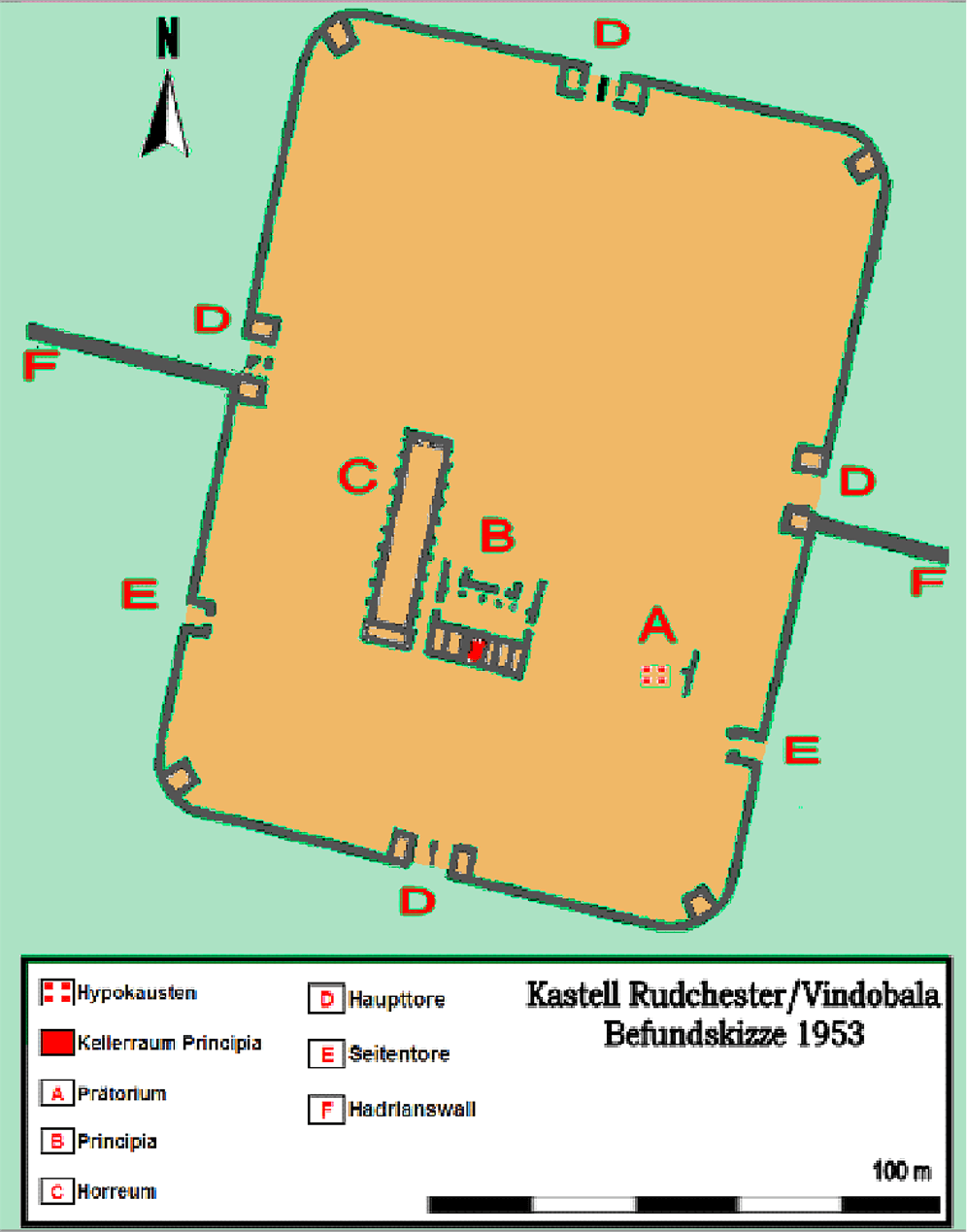
Vindobala was constructed as a typical Roman fort, featuring a rectangular plan enclosed by defensive walls and ditches. The fort's walls were built with stone and incorporated towers at intervals for enhanced defense and observation. The layout included barracks for soldiers, a headquarters building (principia), granaries, workshops, and a commandant's residence.
The fort was bisected by the modern B6318 Military Road, which follows the line of Hadrian's Wall at this location. This road has impacted the preservation of the site but also provides access for visitors interested in exploring the remains and understanding the Roman military architecture.
Defensive structures
The fort's walls were reinforced with towers and gates that controlled entry and exit points. Defensive ditches surrounded the fort, adding an additional obstacle to potential attackers. These features exemplify Roman military engineering designed for both defense and control of the frontier region.
Internal buildings
Within Vindobala, the principia served as the administrative center, while the barracks housed the garrison troops. Granaries stored food supplies essential for sustaining the soldiers during campaigns or sieges. Workshops supported repairs and manufacturing of equipment.
Current condition and archaeological significance
Today, Vindobala exists primarily as archaeological ruins with partial remains visible at the site. The fort's location along the B6318 Military Road means that much of the original structure has been disturbed or lost, but archaeological investigations have uncovered foundations and artifacts that shed light on Roman military life.
Vindobala is an important site for understanding Roman frontier defense systems and the daily operations of a Roman fort along Hadrian's Wall. It offers valuable insight into Roman engineering, military strategy, and the interaction between the empire and northern tribes.
Visiting Vindobala
The site is accessible to visitors interested in Roman history and archaeology. While the remains are limited, the location along the Military Road provides convenient access. Visitors can explore the surrounding landscape, which retains traces of the wall and fortifications, and appreciate the scale and ambition of Roman frontier defenses.
Nearby attractions
Vindobala is part of the broader Hadrian's Wall World Heritage Site, which includes multiple forts, milecastles, and museums dedicated to Roman Britain. Nearby forts such as Condercum and Halton Chesters offer additional context and more extensive ruins for visitors.
Accessibility and visitor information
There are no formal visitor facilities at Vindobala, and the remains are primarily visible as earthworks and stone foundations. Visitors should prepare for outdoor exploration and check local resources for guided tours or information centers along Hadrian's Wall.
Frequently asked questions (FAQ)
- What is Vindobala and where is it located?
- Vindobala is a Roman fort situated in Rudchester, Northumberland, England, along Hadrian's Wall.
- When was Vindobala built?
- Vindobala was constructed in the 2nd century AD as part of the Roman frontier defenses on Hadrian's Wall.
- What remains can be seen at Vindobala today?
- Today, Vindobala exists mainly as archaeological ruins with visible foundations and earthworks, though much has been disturbed by the B6318 Military Road.
- Is Vindobala accessible to visitors?
- Yes, Vindobala is accessible to the public, but there are no formal visitor facilities. Visitors should be prepared for outdoor exploration.
- What other Roman sites are near Vindobala?
- Nearby Roman forts include Condercum (Benwell) to the east and Halton Chesters to the west, both part of the Hadrian's Wall World Heritage Site.

Information
Loading map...
Visitor reviews
No reviews yet. Been here? Write the first review and help other travelers!
Write the first reviewVisited this castle? Share your experience
Your review helps other travelers and adds first-hand knowledge to our encyclopedia.