
Vincennes Castle
Vincennes Castle, located in the eastern suburb of Paris, France, stands as a monumental testament to medieval and early modern French royal power. This massive fortress originated in the 12th century and evolved through centuries of construction, serving variously as a royal residence, military stronghold, prison, and arsenal. Today, it is one of the most significant preserved medieval castles in Europe, renowned for its imposing 52-meter-high donjon, the tallest medieval fortified structure on the continent.
Early origins and royal connections
The site of Vincennes Castle began as a hunting lodge built around 1150 for King Louis VII amidst the dense forest of Vincennes. This modest beginning laid the groundwork for a complex that would grow into a major royal fortress. By the 13th century, under Philip Augustus and Louis IX, the lodge was replaced by a more substantial manor house. Notably, Louis IX, also known as Saint Louis, is said to have departed from Vincennes on the crusade during which he died, underscoring the site's early royal significance.
Vincennes was not only a military site but also a place of royal life and ceremony. Philippe III and Philippe IV were each married at Vincennes in the late 13th century, and three 14th-century kings—Louis X, Philippe V, and Charles IV—died within its walls, marking it as a key royal residence during the medieval period.
14th-century transformation and architectural grandeur
The castle underwent its most significant transformation in the 14th century, when it was extensively enlarged to replace the earlier manor. Construction began around 1336 under Philip VI of France, who commissioned the imposing donjon, a massive rectangular keep standing 52 meters tall. This keep remains one of the tallest and best-preserved medieval fortified towers in Europe and was a pioneering example of early use of reinforced masonry.
The castle's grand rectangular curtain walls, enclosing a perimeter over one kilometer long (approximately 330 by 175 meters), were completed by the Valois dynasty around 1410. The enceinte featured six towers and three gates, each originally standing 13 meters high, surrounded by a deep, stone-lined moat that enhanced its defensive capabilities. The donjon was designed not only for defense but also as a royal residence, housing the personal library and study of Charles V.
The chapel and religious significance
Vincennes also held religious importance. The castle temporarily housed the relics of the Crown of Thorns while the famous Sainte-Chapelle in Paris was being prepared to receive them. A dedicated chapel was built within Vincennes, likely by Peter of Montereau, who may have also designed the Sainte-Chapelle. This chapel remains a significant architectural and spiritual feature of the castle complex.
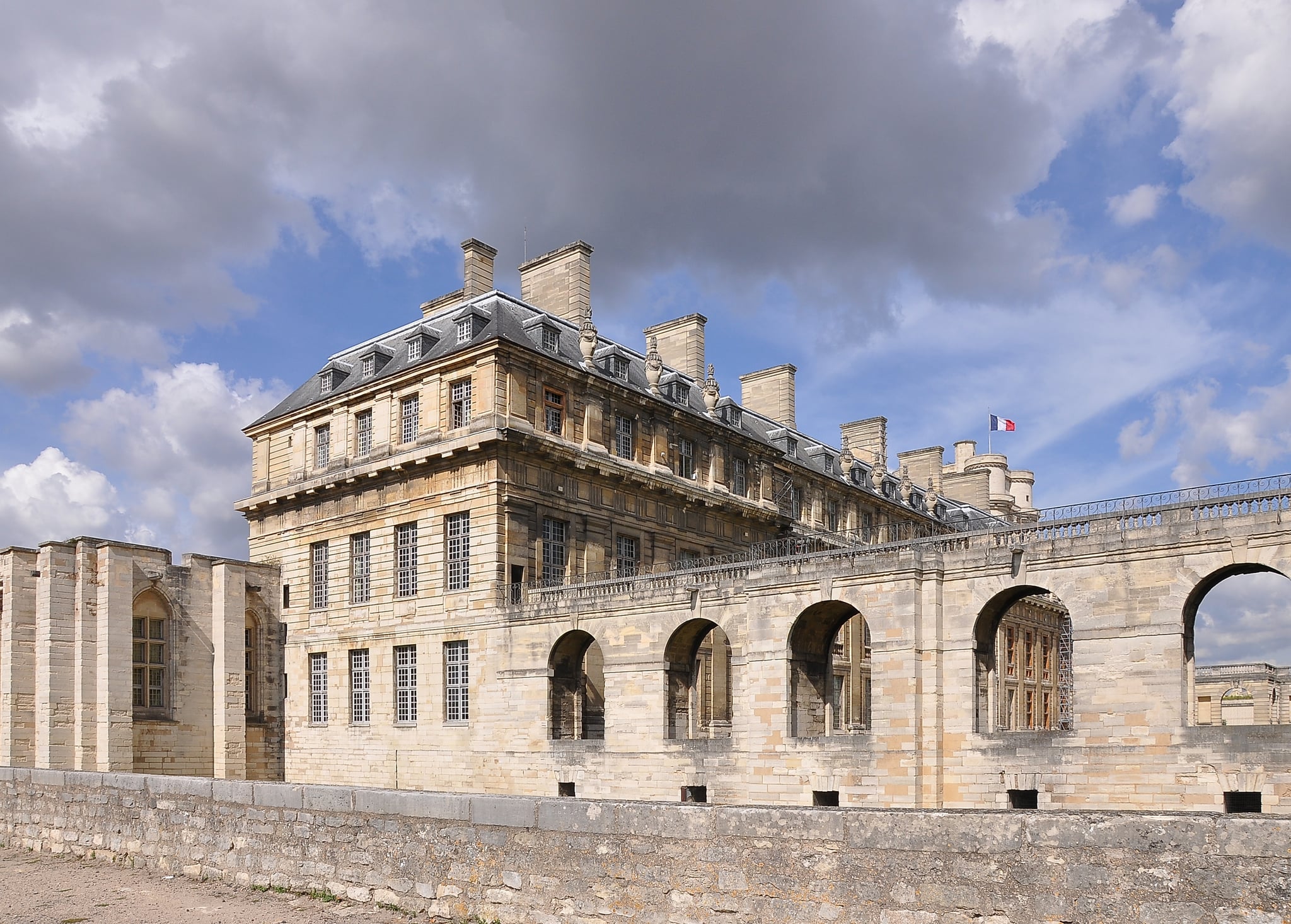
Photo by Moonik • CC BY-SA 3.0
Notable historical events and figures
Throughout its history, Vincennes Castle played host to numerous pivotal events. During the Wars of Religion in the 16th century, Henri IV was imprisoned there in 1574, and Charles IX died at Vincennes the following month. The castle also served as a prison for notable figures such as the marquis de Sade, Diderot, and Mirabeau.
In the 17th century, the architect Louis Le Vau constructed two elegant wings—the Pavillon du Roi and the Pavillon de la Reine—reflecting the early style of Louis XIV. These buildings were intended for the Queen Mother and Cardinal Mazarin but were never fully completed due to the shift of royal focus to Versailles.
The castle also witnessed dramatic moments during the Napoleonic era, including the execution of the duc d'Enghien in 1804 in its moat. Later, during the Napoleonic Wars, General Daumesnil, who famously declared he would surrender Vincennes only when he got his leg back, defended the fortress against coalition forces in 1814.
Military use and decline
After the 18th century, Vincennes Castle's military importance shifted. It was used as an arsenal and a state prison, housing various political prisoners. The castle narrowly escaped destruction during the French Revolution, when a mob attempted to demolish it in 1791 but was stopped by the marquis de Lafayette.
In the 19th century, the castle grounds were transformed into an English landscape park, and restoration work was undertaken by Viollet-le-Duc on the keep and chapel under the direction of Napoleon III. The surrounding Bois de Vincennes was gifted to Paris as a public park, enhancing the site's cultural significance.
Modern era and preservation
During World War II, Vincennes served as the military headquarters for General Maurice Gamelin during the defense against the German invasion in 1940. The castle also witnessed tragic events during the liberation of Paris in 1944, when members of the French Resistance were executed in its eastern moat by the Waffen-SS.
Today, Vincennes Castle is restored and maintained as a historic monument and museum. It houses the Defence Historical Service, preserving France's military heritage. Visitors can explore the impressive donjon, the extensive curtain walls, the chapel, and the elegant 17th-century pavilions, experiencing a rich tapestry of French history and architecture spanning the medieval to modern periods.
Architectural features and layout
The castle's layout is a rectangular enclosure measuring approximately 330 by 175 meters, surrounded by a deep, stone-lined moat. The keep and its enceinte occupy the western side, separated from the rest of the fortress by the moat. The donjon is a marvel of medieval military architecture, notable for its height and early use of reinforced masonry techniques.
The curtain walls originally featured six towers, though most were reduced to wall height during 19th-century demolitions, with the exception of the Tour du Village on the north side. The southern end of the castle is dominated by the two wings designed by Louis Le Vau, the Pavillon du Roi and Pavillon de la Reine, which face each other across a formal parterre.
Defensive elements
The castle's fortifications include three main gates, each approximately 13 meters tall, and a deep moat providing formidable defense. The walls and towers were designed to withstand siege warfare typical of the Late Medieval period, incorporating thick stone construction and strategic placements for archers and artillery.
Residential and ceremonial spaces
Within the walls, the donjon served as the royal residence and included private chambers, a library, and a chapel. The 17th-century additions by Louis Le Vau introduced more refined residential spaces reflecting the evolving tastes of the French court, blending functionality with early Baroque elegance.
Frequently asked questions (FAQ)
- What are the visiting hours for Vincennes Castle?
- Vincennes Castle is typically open to visitors daily from 10:00 AM to 6:00 PM, but it is recommended to check official sources for seasonal variations and special closures.
- Is Vincennes Castle accessible for visitors with mobility impairments?
- The castle grounds and some parts of the donjon are accessible to visitors with mobility impairments, but due to the historic nature of the buildings, some areas may have limited access.
- Can I visit the donjon of Vincennes Castle?
- Yes, the donjon is open to the public and offers a unique opportunity to explore one of the tallest medieval fortified towers in Europe, featuring exhibitions on the castle's history and military heritage.
- What is the historical significance of Vincennes Castle?
- Vincennes Castle played a crucial role as a royal residence, fortress, and prison throughout French history, witnessing key events from the medieval period through World War II.
- Are there guided tours available at Vincennes Castle?
- Guided tours are available and provide in-depth information about the castle's architecture, history, and notable events, enhancing the visitor experience.
Photo gallery

Information
Website
Visit websiteSources & official resources
Verify the information above using these authoritative references.
Loading map...
Visitor reviews
No reviews yet. Been here? Write the first review and help other travelers!
Write the first reviewVisited this castle? Share your experience
Your review helps other travelers and adds first-hand knowledge to our encyclopedia.