Vimperk Castle
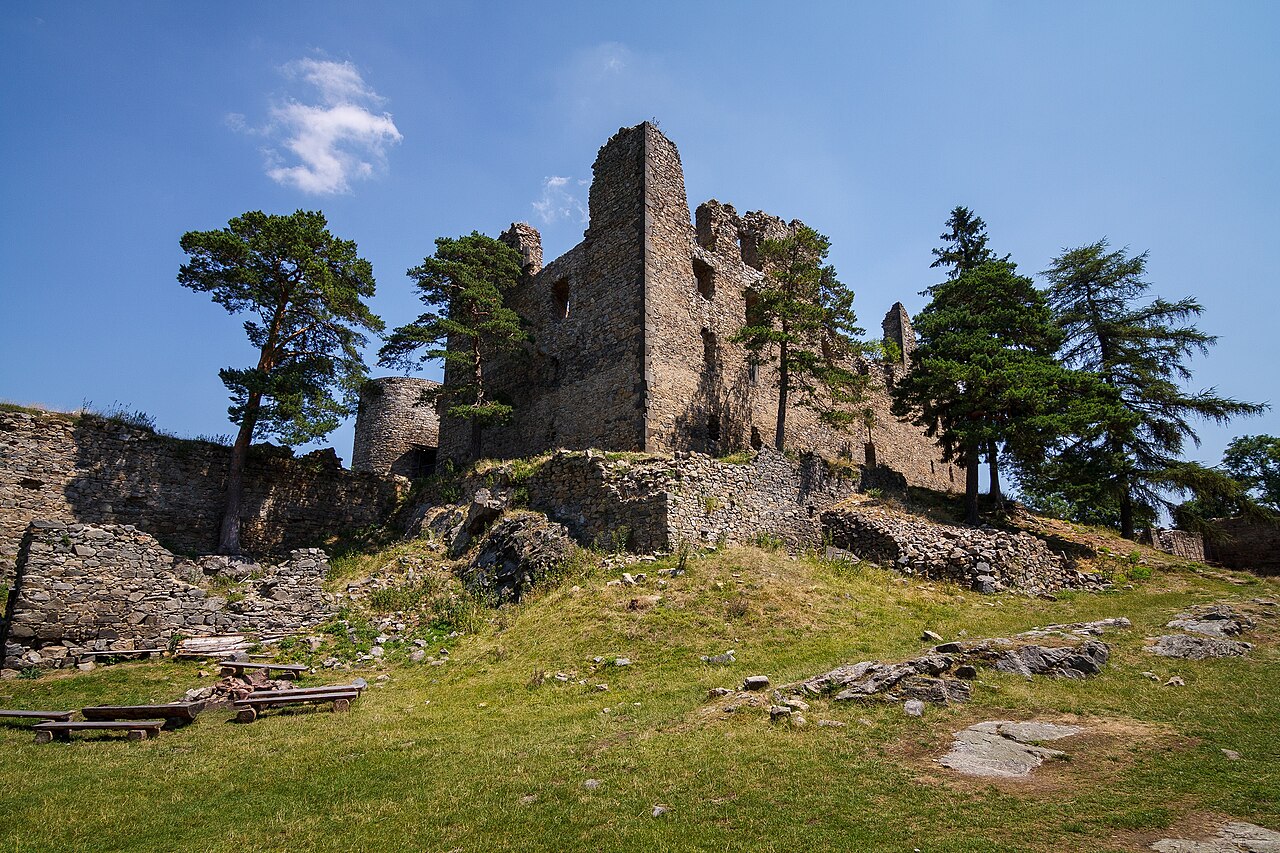
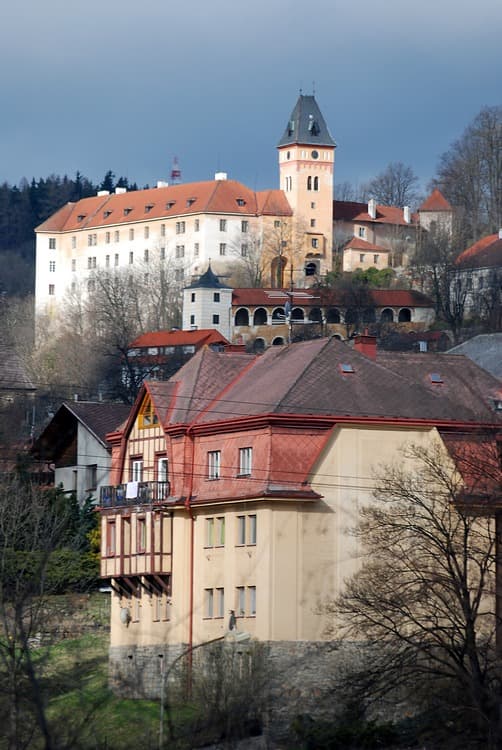
Vimperk Castle, located in the town of Vimperk in the Czech Republic, is a prominent hill castle with origins dating back to the mid-13th century. Founded around 1250, it was most likely established under the reign of King Ottokar II of Bohemia or by his burgrave Purkart of Janovice. The castle was strategically positioned on a rocky outcrop overlooking the confluence of the Křesanovský brook and the Volyňka river, guarding the vital medieval trade route known as the Golden Trail, which connected Bohemia with the Danube region and further into Bavaria.
The castle’s initial purpose was military and administrative, serving as a defensive stronghold to protect the land border and the important commercial route from Passau to Bohemia. Throughout the High Medieval period, Vimperk Castle evolved from a simple fortress into a complex fortified residence, adapting to changing military technologies and political circumstances.
Medieval origins and gothic architecture
The original layout of Vimperk Castle was typical of Gothic hill castles of the 13th century, featuring an oval-shaped ground plan surrounded by a deep moat and an earthen rampart on the northern approach. The core castle was trapezoidal, with two main palace wings enclosing the inner courtyard. The Vlček Tower, a 13-meter-high structure dating from the late 13th century, remains a significant surviving element of this period. Its vaulted ground floor and barrel vaulting above demonstrate early Gothic architectural techniques.
During the 14th and early 15th centuries, the castle was expanded and fortified extensively. Defensive walls were strengthened, and additional round and square towers were added to improve protection. By the early 15th century, the castle complex included two towers and several palaces, all enclosed within developed defensive walls. The upper castle was further fortified with a round bergfried tower around 1400, serving as a lookout and last refuge in case of siege.
Defensive enhancements and haselburg bastion
In response to the growing threat of artillery and unstable political situations during the 15th century, the castle and the adjoining town were merged into a single fortified unit for more effective defense. To protect the vulnerable south-east side, the Haselburg bastion was constructed on a nearby hill. This artillery fortress features a massive round battery tower, approximately 14 meters in diameter, with vaulted chambers and thick curtain walls up to eight meters wide. It is one of the best-preserved artillery bastions in the Czech Republic, illustrating the transition from medieval to early modern military architecture.
Renaissance and baroque transformations
Ownership of Vimperk Castle passed to the powerful House of Rosenberg in the mid-16th century, marking a shift from purely military functions to more residential and administrative uses. Under their stewardship, the castle underwent significant Renaissance-style renovations, including the addition of palatial wings and decorative elements. The gate of the upper castle bears the date 1622, reflecting this period of transformation.
The castle changed hands several times in the 17th and 18th centuries, coming under the control of the Eggenberg family in 1630 and later the Schwarzenberg family in 1719. The Schwarzenbergs introduced Baroque architectural features and partially rebuilt the castle accordingly. The Chapel of St. Joseph, originally part of the palace complex, was modified in 1757 to reflect Baroque stylistic influences.
Fire and 19th-century restoration
On 20 July 1857, a lightning strike caused a devastating fire that severely damaged the upper castle buildings. By this time, the castle was no longer a noble residence but served as a forest administration headquarters. The subsequent 19th-century restoration incorporated Neo-Renaissance elements, preserving medieval and Renaissance features such as vaulted chambers, towers, and fortifications while adapting the complex for administrative functions.
20th-century uses and modern preservation
During the First Czechoslovak Republic (1918–1938), the castle was rented to the Czechoslovak Army as barracks. After World War II, the property was nationalized under the Lex Schwarzenberg law and transferred to the Czechoslovak state. It became the administrative center for South Bohemian forest management and housed various offices.
From 1961, part of the castle was adapted to accommodate a municipal museum, showcasing local history and the castle’s heritage. However, during the Communist era, maintenance was neglected, leading to deterioration of the structures. In 2010, Vimperk Castle was declared a national cultural heritage site, prompting extensive restoration efforts managed by the National Heritage Institute starting in 2015. Archaeological investigations began in 2019 to better understand and preserve the site’s historical layers.
Architectural features and castle complex
The castle complex includes three main courtyards and a forecourt to the north. The inner castle features two main palace wings along the courtyard, with the northwest wing partially preserved. The Vlček Tower and the round bergfried tower are key medieval defensive structures. The castle’s roofs are predominantly gabled with wooden dormers, covered with cement tiles.
The Haselburg bastion stands north of the castle on a strategic hill, featuring a round battery tower with vaulted basement and thick curtain walls designed for artillery defense. The bastion includes firing slits for cannons, artillery chambers, a moat, and a drawbridge at the gate.
Two chapels exist within the castle grounds: the Chapel of St. Joseph, accessible from the second courtyard and reflecting Baroque modifications, and the smaller Chapel of the Evangelists dating to 1611, attached externally near the northern moat.
Cultural significance and public access
Recognized as a national cultural monument of the Czech Republic since 2010, Vimperk Castle is an important example of medieval, Renaissance, and Baroque architecture in South Bohemia. Its well-preserved defensive structures, especially the artillery bastion, provide insight into the evolution of military architecture from the late Middle Ages through the early modern period.
Today, the castle is open to the public, offering visitors a chance to explore its historic courtyards, towers, chapels, and museum exhibits. Restoration and archaeological projects continue to enhance understanding and preservation of this significant heritage site.
Frequently asked questions (FAQ)
- How do I get to Vimperk Castle?
- Vimperk Castle is located in the town of Vimperk in South Bohemia, Czech Republic. It is accessible by car and public transport, with the castle situated near the town center.
- What are the opening hours of Vimperk Castle?
- The castle is generally open to visitors from spring to autumn, with typical opening hours from 9:00 to 17:00 daily. It is advisable to check the official website for seasonal variations and special events.
- What architectural styles are represented at Vimperk Castle?
- Vimperk Castle showcases a blend of Gothic, Renaissance, Baroque, and Neo-Renaissance architectural styles, reflecting its long history and various phases of construction and restoration.
- Is Vimperk Castle suitable for family visits?
- Yes, Vimperk Castle offers a family-friendly environment with accessible courtyards, historical exhibitions, and guided tours that engage visitors of all ages.
- Can I visit the Haselburg bastion?
- Yes, the Haselburg bastion is part of the castle complex and is accessible to visitors. It is one of the best-preserved artillery fortifications in the Czech Republic and provides insight into medieval and early modern military defenses.
Photo gallery

Information
Website
Visit websiteSources & official resources
Verify the information above using these authoritative references.
Loading map...
Visitor reviews
No reviews yet. Been here? Write the first review and help other travelers!
Write the first reviewVisited this castle? Share your experience
Your review helps other travelers and adds first-hand knowledge to our encyclopedia.