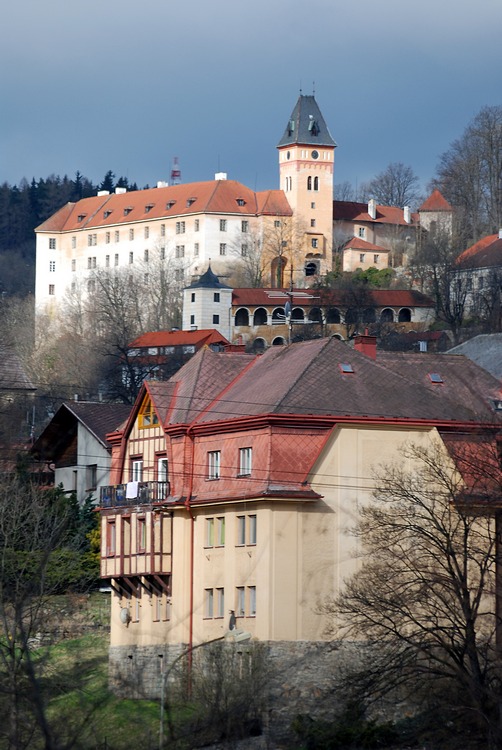
Hus Castle
Hus castle is a significant medieval fortress located in the municipality of Včelná-Prachatice in the modern-day Czech Republic. Constructed in the mid-14th century by Bohemian nobility, it was strategically positioned to oversee and protect important trade routes and surrounding settlements in the region. The castle's historical purpose was closely tied to controlling the Golden Trail, a vital medieval trade route connecting the towns of Volary and Prachatice, which facilitated commerce between Bohemia and Bavaria.
Founding and early history
The origins of Hus castle date back to 1341, when King John of Luxembourg granted permission to the four Janovice brothers—Jenšík, Vavřinec, Herbort, and Pešek—to establish a fortified site. This initiative aimed to safeguard newly formed villages around Záblatí and to maintain control over the strategically important Golden Trail. By 1359, Emperor Charles IV formally confirmed the ownership of Hus along with the nearby villages of Husinec and Křišťanovice, thereby consolidating the castle's role within the regional governance and defense network.
The castle was built as a hill castle atop a narrow rocky ridge on the southern slope of Panský vrch, approximately 730 meters above sea level. Its natural defenses were enhanced by the surrounding Blanice river, which encircled the site on three sides, creating a formidable barrier against attackers. This location was carefully chosen to maximize defensive advantages and to oversee the important trade route.
Ownership and political significance
After the male line of the Janovice family ended in 1363, the castle reverted to direct royal ownership. Around 1390, King Wenceslaus IV granted Hus as a pledge to his favored noble, Zikmund Huler, who maintained control until his execution in 1405. Subsequently, Wenceslaus appointed Mikuláš of Pístný as hereditary burgrave, who adopted the castle’s name and became a prominent military leader aligned with the Hussite movement, a religious reform movement inspired by Jan Hus. Mikuláš’s alignment with the Hussites led to his banishment from Prague in 1419, and he died in 1420 following a fatal accident.
During the turbulent Hussite Wars, ownership of Hus castle changed hands multiple times. It was held by Jan Smil of Křemže until his imprisonment in 1439, after which the castle was seized by Habart Lopata of Hrádek, described as a robber knight. The castle's final chapter occurred in 1441 when a coalition led by Přibík of Klenová, Petr Zmrzlík of Svojšín, and Jan Sedlecký of Prachatice besieged and captured Hus. Following its conquest, the castle was deliberately burned and destroyed, never to be rebuilt, leading to its gradual decay into ruins.
Architectural layout and defensive features
The castle's layout consisted of two main parts: the inner castle (or core) situated on the highest point above a protective ditch, and the outer bailey, a lower courtyard area extending toward the river. Access to the complex was from the north, with the road running along the southwestern edge of the inner castle before entering the outer bailey.
The outer bailey still retains substantial sections of its defensive walls, including a long building along the southwestern stretch likely used for administrative or residential purposes. To the east, a fortified wall extended directly to the riverbank, allowing controlled access to the vital water supply from the Blanice river, an essential feature during sieges.
The inner castle's precise arrangement is difficult to interpret due to collapsed stone walls that have filled much of the space, creating a "closed castle" effect where ruins appear interconnected and obscured. However, it is believed that multiple individual structures existed within this core area, including living quarters, defensive towers, and storage facilities. Two defensive ditches and various wall remnants survive on the forested slopes surrounding the castle, though they are overgrown, they remain discernible to visitors.
Historical role and cultural significance
Hus castle played a crucial role in guarding the Golden Trail and controlling access in the event of Bavarian invasions. The monarch retained special rights to pass freely through the fortress, underscoring its strategic importance within the kingdom of Bohemia. The castle was first documented in written sources under the Czech name "Huscz" in 1361.
Since 1963, the ruins of Hus castle have been protected as a cultural monument, highlighting their historical and architectural significance. Today, the ruins stand as fragmentary remains nestled in the woods along a marked hiking path between Libínské Sedlo and Volary. They provide valuable insight into medieval fortification techniques adapted to difficult terrain and testify to the castle's historical status as a frontier stronghold guarding key routes in Bohemia.
Visiting hus castle today
Visitors to Hus castle can explore the ruins situated on a rocky ridge surrounded by forest. The site offers a glimpse into medieval military architecture and the strategic importance of hill castles in controlling trade and defense routes. While the castle is largely in ruins, the remaining walls, ditches, and layout allow visitors to appreciate the original defensive design. The natural setting along the Blanice river adds to the site's scenic and historical appeal.
The castle is accessible via hiking trails that connect to nearby towns and natural landmarks, making it a popular destination for those interested in history, architecture, and outdoor activities. Interpretive signage and cultural heritage protections help preserve the site for future generations.
Frequently asked questions (FAQ)
- How do I get to Hus castle?
- Hus castle is accessible via marked hiking trails in the South Bohemia region, near the town of Včelná-Prachatice. Visitors can follow paths between Libínské Sedlo and Volary to reach the ruins nestled in the forest.
- What is the historical significance of Hus castle?
- Hus castle played a key role in guarding the Golden Trail trade route and served as a strategic defensive site during the Hussite Wars. It was a royal fortress with important military and administrative functions in medieval Bohemia.
- Can I explore the ruins of Hus castle?
- Yes, visitors can explore the ruins, including remnants of defensive walls, ditches, and the layout of the inner and outer castle. The site offers insight into medieval fortification techniques adapted to hilltop terrain.
- When was Hus castle built?
- Hus castle was constructed in 1341 after King John of Luxembourg granted permission to the Janovice brothers to establish the fortress to protect trade routes and nearby villages.
- Is there an entrance fee to visit Hus castle?
- There is no entrance fee to visit Hus castle as it is an open ruin accessible to the public year-round.
Information
Website
Visit websiteSources & official resources
Verify the information above using these authoritative references.
Loading map...
Visitor reviews
No reviews yet. Been here? Write the first review and help other travelers!
Write the first reviewVisited this castle? Share your experience
Your review helps other travelers and adds first-hand knowledge to our encyclopedia.