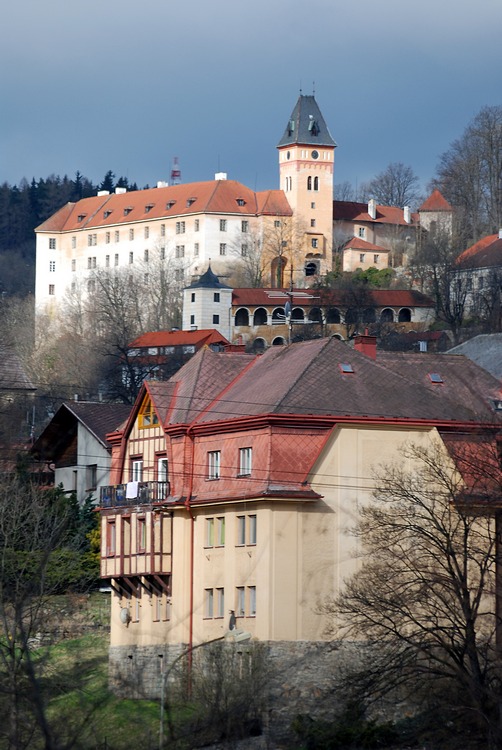
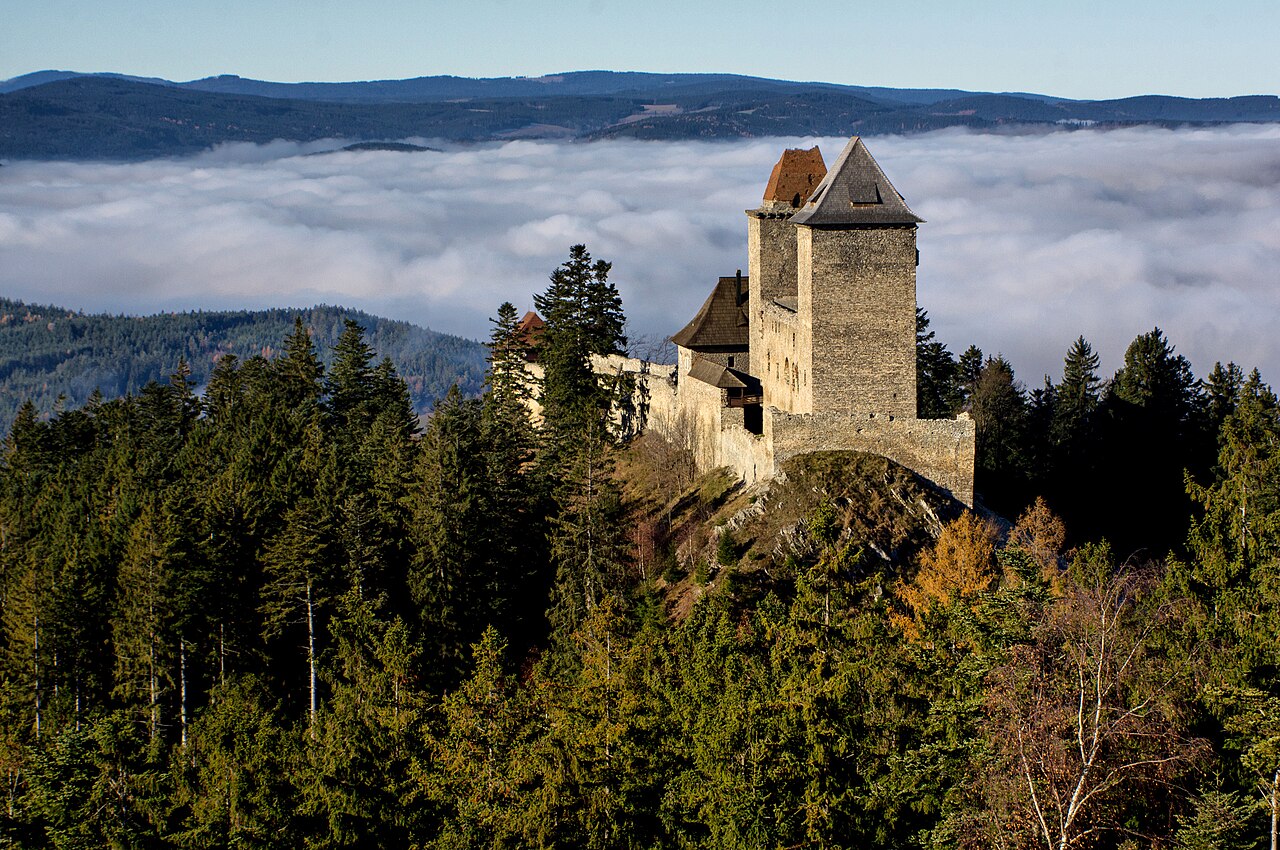
Kunžvart Castle
Kunžvart Castle stands as a remarkable example of a medieval hill castle strategically positioned atop a granite ridge near the town of Strážný in the Bohemian Forest region of Czechia. Its origins trace back to the early 14th century, a period marked by the consolidation of royal power under John of Luxembourg, King of Bohemia. The castle was primarily constructed to oversee and protect the vital Golden Trail (Zlatá stezka), a medieval trade route linking the Bohemian town of Vimperk with Passau in Bavaria. This trade corridor was crucial for the transport of salt and other valuable goods, making Kunžvart a key military and economic asset.
Historical background and significance
Archaeological evidence indicates human activity in the area surrounding Kunžvart Castle since the Hallstatt period around the 6th century BCE, with ceramic fragments and horseshoes from the 13th century confirming early medieval use. The first documented mention of the castle dates to 1359, during the reign of Emperor Charles IV, who confirmed that the estate of Vimperk—including Kunžvart (then known as Kungenslen)—belonged to the noble family of Pešek of Janovice and his brother's heirs.
During the reign of King Wenceslaus IV, Kunžvart's role expanded significantly. The king authorized the reopening of a branch of the Golden Trail leading to Vimperk, granting local lords the right to collect tolls. This enhanced the castle's importance as a residence for a burgrave and a military garrison tasked with controlling and securing the trade route. The castle's strategic location allowed it to monitor traffic and protect against banditry and hostile incursions.
By the mid-16th century, Kunžvart's military and residential functions declined. Records from 1547 indicate the castle was abandoned, and a destructive fire in 1578 damaged two of its chambers. Subsequently, the fortress fell into ruin, and from around 1575, its stones were quarried for local building projects, including incorporation into a farmhouse entrance in the nearby village of Kořenný. Despite this decline, Kunžvart was recognized as a cultural monument of the Czech Republic in 1958, underscoring its historical and architectural value.
Architectural features and defensive design
Kunžvart Castle exemplifies medieval fortification adapted to a challenging mountainous environment. The castle is situated on one of the highest granite outcrops in the country, near the summit of Strážný mountain. Its position offered commanding views and natural defensive advantages. Access was primarily from the west, where natural rock formations were enhanced by a deepened fissure serving as a defensive ditch, effectively integrating the natural terrain into the castle's fortifications.
The donjon tower
The most prominent surviving structure is the residential stone tower, or donjon, nearly square in plan, measuring approximately 10.5 by 10.6 meters at the base. The tower's walls are impressively thick, ranging from 1.74 to 2.8 meters, and it rises about 15 meters over three stone floors. A rounded corner on the western side and flat ceilings inside reflect thoughtful medieval architectural design.
The tower's layout reveals a clear functional division: the lower two floors likely served operational and defensive purposes, while the upper floor provided living quarters. Defensive elements include narrow arrow slits on the southeastern wall—two at ground level and one above—and an additional slit above the northeastern entrance, allowing defenders to cover vulnerable approaches. The second floor features large square windows, two of which have partially collapsed, indicating an emphasis on light and comfort in the residential area.
Entry to the tower's ground floor was secured through a passage with dual portals, with the outer entrance reinforced by a heavy wooden bar, enhancing security against attackers. This combination of robust masonry and defensive design reflects the castle's role as a fortified residence and military stronghold.
Perimeter defenses and other structures
Beyond the donjon, the castle's perimeter was originally enclosed by wooden palisades, a typical defensive feature for medieval hill castles. Although these wooden structures have not survived, their former presence is evident in the site's layout. Two niches carved directly into the granite rock remain, hinting at the integration of natural features into the castle's defensive and functional design.
The castle's stone materials were later repurposed for local construction, demonstrating a common practice of recycling building materials from abandoned fortresses. This reuse is historically significant, linking Kunžvart to the architectural heritage of the surrounding region.
Archaeological research and cultural heritage status
Interest in Kunžvart Castle has grown in recent decades, with archaeological investigations in the early 21st century uncovering medieval artifacts that shed light on the castle's history and daily life. These findings contribute to a deeper understanding of the castle's role in regional trade and defense during the High and Late Medieval periods.
Today, Kunžvart is preserved as a cultural monument of the Czech Republic, reflecting its layered history and architectural ingenuity. The site attracts historians, archaeologists, and visitors interested in medieval fortifications and the history of the Bohemian Forest region.
Visiting kunžvart castle
Although in ruins, Kunžvart Castle offers a compelling glimpse into medieval military architecture and the strategic importance of trade routes in Central Europe. Visitors can explore the remains of the donjon tower and the surrounding natural landscape, appreciating the castle's commanding position and defensive adaptations.
The site is accessible via hiking trails from nearby towns such as Strážný and Vimperk, making it a popular destination for those interested in history, architecture, and outdoor activities. Interpretive signage and guided tours may be available seasonally, providing insights into the castle's historical context and architectural features.
Visitors are encouraged to respect the site's preservation efforts and natural environment while enjoying the panoramic views and historical atmosphere that Kunžvart Castle uniquely offers.
Frequently asked questions (FAQ)
- What is the historical significance of Kunžvart Castle?
- Kunžvart Castle, located in Strážný, Czechia, dates back to the 13th century and served as a strategic fortification against invasions. Its architecture reflects the medieval styles of the time, and it played a crucial role in regional defense during various conflicts. The castle is a testament to the rich history of the area and offers insights into the past of Czech nobility.
- When is the best time to visit Kunžvart Castle?
- The best time to visit Kunžvart Castle is during the spring and summer months, from May to September, when the weather is pleasant and conducive for exploring the castle grounds. During this period, visitors can also enjoy various events and guided tours that enhance the experience. Autumn can also be beautiful, with stunning foliage surrounding the castle.
- Can I access Kunžvart Castle by public transport?
- Yes, Kunžvart Castle is accessible by public transport. Visitors can take a bus to Strážný and then enjoy a short walk to the castle. However, it is advisable to check local transport schedules in advance to ensure a smooth journey.
- What are the opening hours for Kunžvart Castle?
- Kunžvart Castle is typically open to visitors from April to October, with varying hours depending on the day of the week. Generally, the castle opens at 9 AM and closes at 5 PM. It's recommended to check the official website for any seasonal changes to the opening hours before your visit.
- Is it possible to take guided tours of Kunžvart Castle?
- Yes, guided tours are available at Kunžvart Castle, providing visitors with in-depth knowledge about its history and architecture. These tours are led by knowledgeable guides who can share fascinating stories and details that enhance the experience. It is advisable to book in advance, especially during peak tourist season.
- What are the ticket prices for Kunžvart Castle?
- Ticket prices for Kunžvart Castle are generally affordable, with discounts available for students, seniors, and children. Adult tickets typically cost around 70 CZK, while reduced tickets may be available for 40 CZK. Check the castle's official website for the latest pricing and potential special offers.
- Are there any nearby attractions to Kunžvart Castle?
- Yes, there are several nearby attractions to Kunžvart Castle, including the beautiful landscapes of Šumava National Park, which offers hiking trails and stunning natural scenery. Visitors can also explore the local village of Strážný, known for its charming architecture and local culture. Additionally, the nearby town of Železná Ruda offers more historical sites and recreational activities.
- How do I reach Kunžvart Castle from Prague?
- To reach Kunžvart Castle from Prague, you can take a train to the nearby town of Sušice and then transfer to a bus heading to Strážný. The entire journey typically takes around 2.5 to 3 hours. It's advisable to check the train and bus schedules in advance for a seamless travel experience.
Information
Website
Visit websiteSources & official resources
Verify the information above using these authoritative references.
Loading map...
Visitor reviews
No reviews yet. Been here? Write the first review and help other travelers!
Write the first reviewVisited this castle? Share your experience
Your review helps other travelers and adds first-hand knowledge to our encyclopedia.