Helfenburk Castle
Helfenburk Castle stands as a remarkable example of a medieval hill castle in the Czech Republic, with origins dating back to the mid-14th century. This fortress, perched on a sandstone plateau near the village of Úštěk, embodies the architectural and historical evolution of Bohemian nobility and ecclesiastical power through turbulent centuries. Its combination of stone fortifications, deep defensive moats, and a notably deep well reflects the strategic and residential purposes it served over time.
Founded probably after 1350 by Berka of Dubé, a member of the Ronovci family, Helfenburk Castle was initially a wooden stronghold that was soon replaced with a substantial stone fortress. The castle's early history is intertwined with prominent figures such as Prague Archbishop Jan Očko of Vlašim, who acquired the castle in 1375 and transformed it into a rural retreat away from the political center of Prague. His successor, Archbishop Jan of Jenštejn, further enhanced the castle's defenses and residential facilities, including the construction of a chapel, a 63-meter deep well, and thick stone walls surrounded by moats.
Architectural features and layout
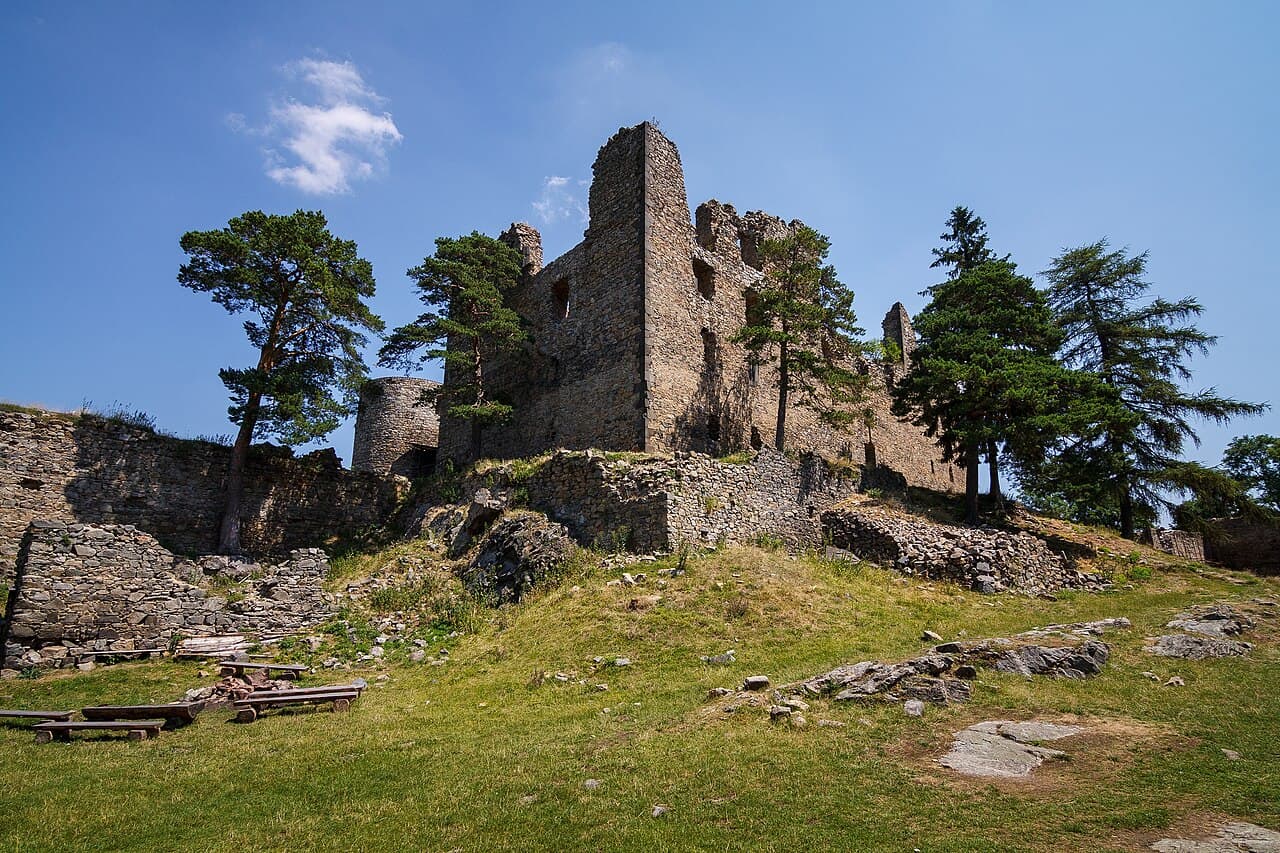
The castle's layout is characterized by a roughly circular plan stretching west to east, with its strongest fortifications facing north toward the main ridge. The core of Helfenburk includes two nearly identical stone palaces facing each other across a square courtyard. These palaces feature vaulted stone basements and large rectangular windows, originally connected by a wooden gallery that was later replaced by a stone arcade supported by octagonal columns. The courtyard walls rise about two stories high, enclosing the residential and administrative heart of the castle.
Surrounding the core is a double curtain wall reinforced with semicircular towers at the corners, providing layered defense. A deep ditch encircles three-quarters of the perimeter, complemented by an earthen rampart. The northern approach is protected by two successive forecourts separated by a curtain wall, with gates featuring drawbridges and portcullises. The castle's bergfried, a tall cylindrical main defensive tower about 18 meters high and 10 meters in diameter, remains largely intact and served as a final refuge and lookout.
Defensive adaptations
In response to evolving military technology during the late 15th century, Helfenburk's defenses were modernized under the ownership of Václav Vlček of Čenov. Additional semicircular bastions with arrow slits and covered walkways were added to enable defenders to utilize both archery and early artillery. These adaptations illustrate the castle's strategic importance and its owners' efforts to maintain its military relevance.
Water supply and economic buildings
A key feature of Helfenburk is its deep well, approximately 63 meters deep, located beneath a trapezoidal tower at the northwest corner. This well ensured a reliable water supply during sieges and was equipped with a tread wheel mechanism, a significant engineering feat of its time. The southern semicircular courtyard housed economic buildings that supported the castle's inhabitants, although many of these structures have not survived.
Historical significance and ownership
Throughout its history, Helfenburk Castle played a vital role in the regional politics and conflicts of Bohemia. After its initial construction by the Ronovci family, it was acquired by Archbishop Jan Očko of Vlašim in 1375, who used it as a countryside residence. His successor, Archbishop Jan of Jenštejn, used the castle to safeguard valuable relics, manuscripts, and treasures from St. Vitus Cathedral during times of unrest.
The castle changed hands frequently during the turbulent Hussite Wars and the subsequent political upheavals. It was held by various nobles, including Aleš of Malíkovice and Zdeněk Konopišťský of Šternberk, and was involved in sieges and royal confiscations. Wilhelm of Ilburg was the last aristocratic owner who favored Helfenburk over nearby Ronov castle until his family's extinction in 1538.
Following its abandonment as a noble residence, Helfenburk suffered damage during the Thirty Years' War, notably being burned in 1622 by the imperial army under Marshal Buquoy. The Jesuit order later acquired the surrounding lands, incorporating them into the estate of Úštěk. In the late 19th century, industrialist Count Josef von Schroll purchased the ruins and initiated restoration efforts, including rebuilding the main tower's third floor and creating a new entrance.
Modern preservation and tourism
Since the mid-20th century, Helfenburk Castle has been the focus of preservation and archaeological efforts led by the Czech Union for Nature Conservation and local volunteers. Excavations uncovered important features such as the well's wooden winch axle, now displayed near the site. Restoration work has stabilized the ruins, and one of the defensive towers was adapted into a lookout point in 1977, providing visitors with panoramic views of the surrounding forests.
The castle is freely accessible year-round, with marked hiking trails leading from nearby villages such as Úštěk. The tower opens on scheduled days with guided tours available, offering insights into the castle's rich history and architectural significance. Managed by a civic association, Helfenburk remains a cultural monument that vividly illustrates the medieval heritage of the Czech Republic.
Notable architectural details
Constructed primarily from locally quarried sandstone, Helfenburk Castle integrates both stone and wooden elements typical of medieval fortifications. The surviving curtain walls, towers, and palace remains exhibit features such as corbels that once supported wooden galleries. The gatehouse displays heraldic stone carvings representing the Lords of Vlašim and the Prague Archbishopric, underscoring the castle's historical affiliations.
The castle's strategic position atop Malošín hill, rising approximately 70 meters above the Hrádecký důl valley, provided commanding views and natural defenses. Its layered fortifications, including moats, curtain walls, and bastions, reflect the evolution of military architecture from the 14th to the 15th centuries, adapting to the changing needs of defense and residence.
Frequently asked questions (FAQ)
- How do I get to Helfenburk Castle and what are the access options?
- Helfenburk Castle is accessible via marked hiking trails from the nearby village of Úštěk and surrounding settlements. Visitors can park at Ostré or Rašovice and follow the well-signposted paths leading to the castle ruins. The site is open year-round and free to access.
- What are the main architectural features of Helfenburk Castle?
- The castle features a roughly circular plan with two stone palaces around a courtyard, double curtain walls with semicircular towers, a tall bergfried tower, and a deep 63-meter well. Late medieval bastions and defensive adaptations reflect its military history.
- When was Helfenburk Castle built and by whom?
- Helfenburk Castle was probably built after 1350 by Berka of Dubé from the Ronovci family. It was later acquired by Prague Archbishop Jan Očko of Vlašim in 1375, who expanded and fortified it.
- Is Helfenburk Castle open for tours and what facilities are available?
- The castle ruins are open to the public year-round with free access. The tower is open on scheduled days with guided tours provided by a local civic association. Facilities at the site are limited, focusing on preservation and visitor information.
- Why is Helfenburk Castle historically significant?
- Helfenburk Castle played a key role in Bohemian medieval politics, serving as a noble residence, an ecclesiastical retreat, and a fortified refuge during the Hussite Wars. Its association with archbishops and noble families highlights its importance in regional history.
Photo gallery

Information
Website
Visit websiteSources & official resources
Verify the information above using these authoritative references.
Loading map...
Visitor reviews
No reviews yet. Been here? Write the first review and help other travelers!
Write the first reviewVisited this castle? Share your experience
Your review helps other travelers and adds first-hand knowledge to our encyclopedia.