Veste Coburg
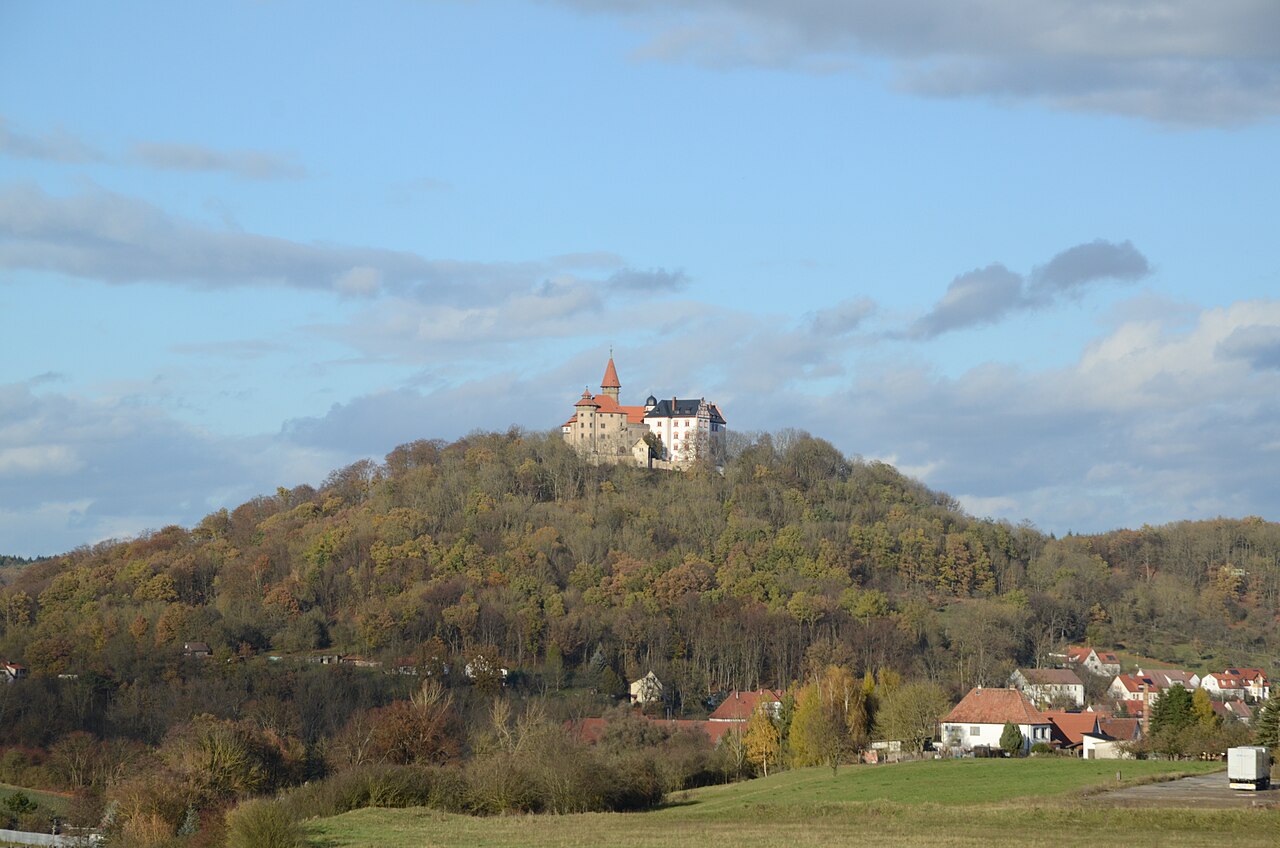
Veste Coburg, also known as Coburg Fortress, is among the largest and most historically significant castles in Germany. Perched on a prominent hill overlooking the town of Coburg in Bavaria, near the border with Thuringia, the fortress dominates the landscape at an altitude of approximately 464 meters above sea level, with its grounds extending around 135 by 260 meters. Its commanding position and size have made it a strategic and cultural landmark for centuries.
The site of Veste Coburg has a rich history of human settlement, with archaeological evidence indicating continuous habitation from the Neolithic period through the early Middle Ages. The first documented mention of Coburg dates to 1056, linked to a donation by Richezza of Lorraine to Archbishop Anno II of Cologne, which facilitated the founding of Saalfeld Abbey in 1071. The fortress itself was first referenced as a "sloss" (castle or palace) in 1225, with the oldest extant structures dating from this period.
Historical development and ownership
Throughout its history, Veste Coburg changed hands among several noble families. Initially controlled by the Dukes of Merania, it later passed to the Counts of Henneberg and briefly to the House of Ascania. In 1353, it came under the rule of the House of Wettin, who maintained possession until the abolition of the monarchy in 1918. The fortress was part of the Duchy of Saxe-Coburg and Gotha from 1826 onward.
During the Thirty Years' War, the fortress was renowned for its strong defenses. Despite repeated sieges, it was never taken by force. The only time it changed hands was in 1635, when it was surrendered after a five-month siege due to a forged letter ordering its handover to Imperial forces under General Guillaume de Lamboy. The fortress was commanded by Georg Christoph von Taupadel during this period.
One of the most notable historical episodes was the stay of Martin Luther from April to October 1530. Under imperial ban, Luther sought refuge at Veste Coburg during the Diet of Augsburg. During his stay, he continued his translation of the Bible into German and composed numerous letters and sermons, making the fortress a significant site in the history of the Reformation.
Architectural features and fortifications
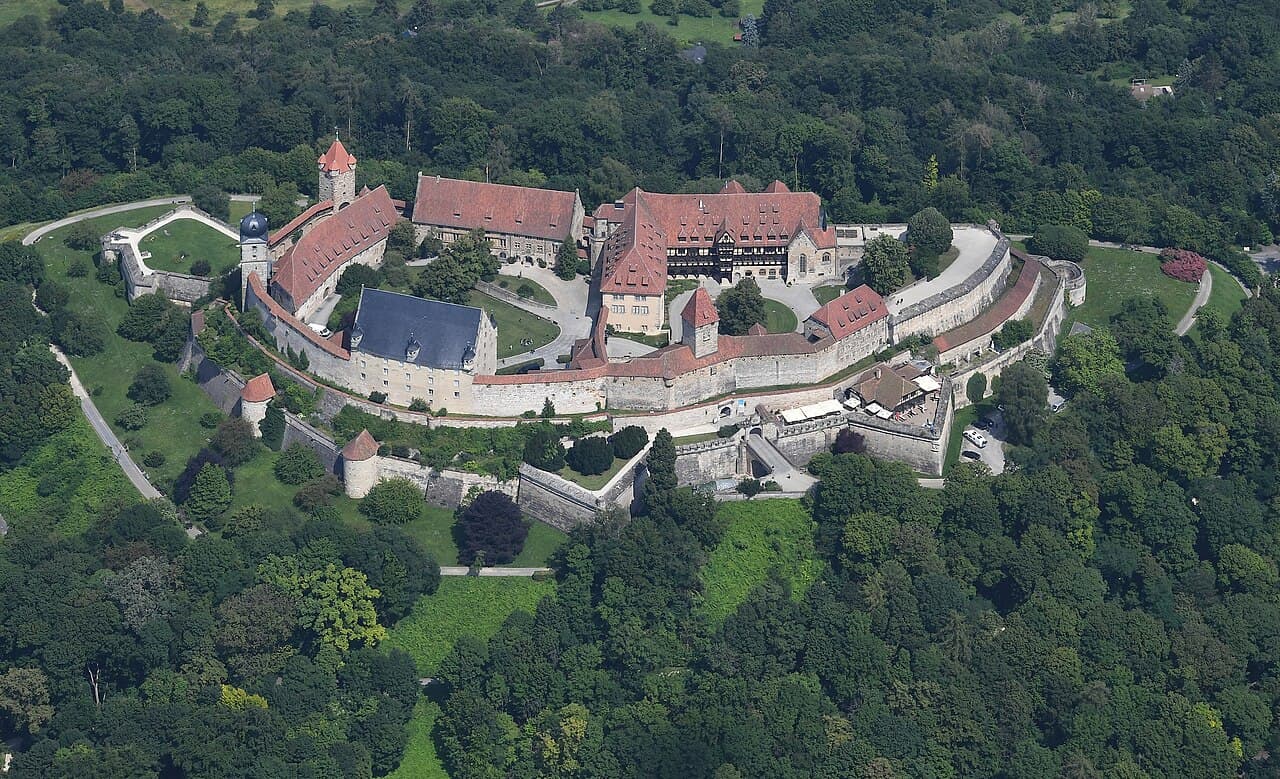
The fortress's architecture reflects its evolution from a medieval stronghold to a Renaissance and later Romantic revival residence and museum. The original layout likely included an eastern main castle with a bergfried (a tall defensive tower or keep), a palas (residential hall), and a chapel. A western outer bailey provided additional defensive and functional space.
Between 1420 and 1430, a comprehensive triple ring of defensive walls was constructed, significantly enhancing the fortress's protection. The outer wall was reinforced with nine round towers known as rondels, six of which survive today. Large bastions such as the Hohe Bastei, Rautenkranz, Bunter Löwe, and Bärenbastei were added, with the Hohe Bastei completed in 1553 specifically designed to withstand cannon fire on the vulnerable eastern side.
The fortress features deep moats and high bridges that further augmented its defenses. The main entrance is marked by a ten-meter-high portal equipped with massive iron gates and a portcullis, a heavy grating that could be lowered to block attackers. Inside, covered walkways and pitch pits—holes through which boiling substances could be poured on assailants—added layers of protection. Remarkably, the fortress's fortifications have never been breached in combat.
Key buildings within the fortress
The Fürstenbau served as the princely residence, while the Luther Chapel is a notable two-aisled structure with rib vaulting. The chapel was rebuilt in 1851 and remodeled between 1910 and 1923 by architect Bodo Ebhardt. Its stained glass windows depict Saxon rulers, saints Peter and Paul, and the family of the last Duke, Carl Eduard. The chapel organ, originally from Münchberg, was enlarged in 1922 and features thirteen registers on two manuals and a pedal.
The Bulgarenturm (Bulgarian Tower) was rebuilt in 1913 with funding from Tsar Ferdinand of Bulgaria. The Herzoginbau houses a remarkable collection of ceremonial carriages and tournament sleds, while the Carl-Eduard-Bau, completed in 1924, served as a congress building. The Hohe Haus, used historically as an armory or arsenal, was rebuilt after suffering fire damage.
Art collections and cultural significance
Today, Veste Coburg functions as a museum complex preserving the rich cultural heritage of the ducal family of Saxe-Coburg and Gotha. It houses extensive collections of art objects and paintings, including works by Lucas Cranach the Elder, Albrecht Dürer, Matthias Grünewald, and Tilman Riemenschneider. The print cabinet contains approximately 330,000 works, many from the Reformation era, while the glass collection boasts around 2,700 pieces, with a focus on Venetian glass. The coin cabinet holds about 20,000 items.
The armory features Gothic wooden shields, firearms and armor from the Thirty Years' War, richly decorated tournament armor, and a notable 49-barrel cannon known as "Emma." Two richly gilded Renaissance wedding carriages are displayed, including the oldest operational carriage of its kind, a dowry gift from Dorothea of Brunswick-Lüneburg.
Outdoor monuments include a 1913 equestrian statue of Martin Luther titled "Light and Power" by Hans Klett and a 1930 relief by Edmund Meusel on the Stone Chamber. The fortress grounds also feature the Coburger Hofgarten, a court garden with a giant sequoia tree planted around 1860, now towering over 32 meters tall.
Restoration and modern use
Military use of Veste Coburg ceased by 1820. From 1827 to 1838, the outer fortifications were removed, and the fortress was remodeled in a Romantic Gothic revival style to serve as a residence and museum. Architect Bodo Ebhardt led extensive restoration and remodeling efforts between 1909 and 1923, removing many 19th-century historicist elements to restore a more authentic medieval appearance. His work included reconstruction of key buildings and was supported by donations and a lottery, with Duke Carl Eduard playing a significant role.
The fortress sustained serious damage from American artillery in April 1945 during the final days of World War II. Post-war restoration was undertaken by the Bavarian state administration, with major renovations completed by the late 20th and early 21st centuries. The Veste became state property in 1919, though the ducal family retained residential rights until 1998.
Currently, Veste Coburg is open to the public as a museum complex managed by the Coburger Landesstiftung and the Bavarian administration of state castles, gardens, and lakes. It remains a vital cultural and historical monument, showcasing the architectural evolution from medieval fortress to Renaissance residence and Romantic revival museum.
Frequently asked questions (FAQ)
- How do I get to Veste Coburg?
- Veste Coburg is easily accessible by public transport or car. If you are traveling by train, you can take a short taxi ride from Coburg's main train station. There are also designated parking areas for visitors arriving by car.
- What is the historical significance of Veste Coburg?
- Veste Coburg is one of the largest and best-preserved castles in Germany, with a history that dates back to the 11th century. It served as a residence for the Dukes of Coburg and played a crucial role in the region's political and cultural history. Today, it houses a museum showcasing artifacts and exhibitions related to its storied past.
- When was Veste Coburg built?
- Construction of Veste Coburg began in the 11th century, and it has undergone numerous renovations and expansions over the centuries. The castle reflects various architectural styles, including Gothic and Renaissance elements, due to its long history. Its impressive structure has made it a landmark in the Coburg region.
- Can I take guided tours of Veste Coburg?
- Yes, guided tours are available at Veste Coburg, providing visitors with in-depth insights into the castle's history and architecture. These tours are led by knowledgeable guides who share fascinating stories about the castle and its significance. It's advisable to check the schedule and book in advance during peak tourist seasons.
- Why is Veste Coburg considered an architectural marvel?
- Veste Coburg is regarded as an architectural marvel due to its strategic hilltop location and its impressive fortifications. The castle features a blend of architectural styles, including Romanesque towers and Renaissance facades, showcasing the evolution of castle design over the centuries. Its unique design and stunning views make it a popular attraction.
- Is it possible to visit Veste Coburg with children?
- Yes, Veste Coburg is family-friendly and offers activities suitable for children. The castle has interactive exhibits and scavenger hunts that engage younger visitors and make learning about history fun. Additionally, the spacious grounds provide plenty of room for children to explore.
- What are the opening hours for Veste Coburg?
- Veste Coburg is typically open to visitors daily, but opening hours may vary by season. It is advisable to check the official website for the most current information regarding hours of operation before your visit. Special holiday hours may also apply.
- What are the ticket prices for Veste Coburg?
- Ticket prices for Veste Coburg vary depending on age and the type of tour chosen. Discounts are often available for students, seniors, and families. Check the official website for the latest pricing information and any special offers that may be available during your visit.
- When is the best time to visit Veste Coburg?
- The best time to visit Veste Coburg is during the spring and early autumn when the weather is mild, and the landscape is particularly beautiful. Summers can be busy with tourists, while winters may offer a quieter experience but can be quite cold. Regardless of when you visit, the castle's charm is sure to impress.
- Are there any nearby attractions to visit after Veste Coburg?
- Yes, there are several nearby attractions, including the scenic Veste Coburg Gardens and the charming Old Town of Coburg. The towns of Bad Rodach and Rödental also offer lovely experiences and can easily be added to your itinerary. Make sure to explore the local shops and cafes for a taste of the region.
Photo gallery

Information
Website
Visit websiteSources & official resources
Verify the information above using these authoritative references.
Loading map...
Visitor reviews
No reviews yet. Been here? Write the first review and help other travelers!
Write the first reviewVisited this castle? Share your experience
Your review helps other travelers and adds first-hand knowledge to our encyclopedia.