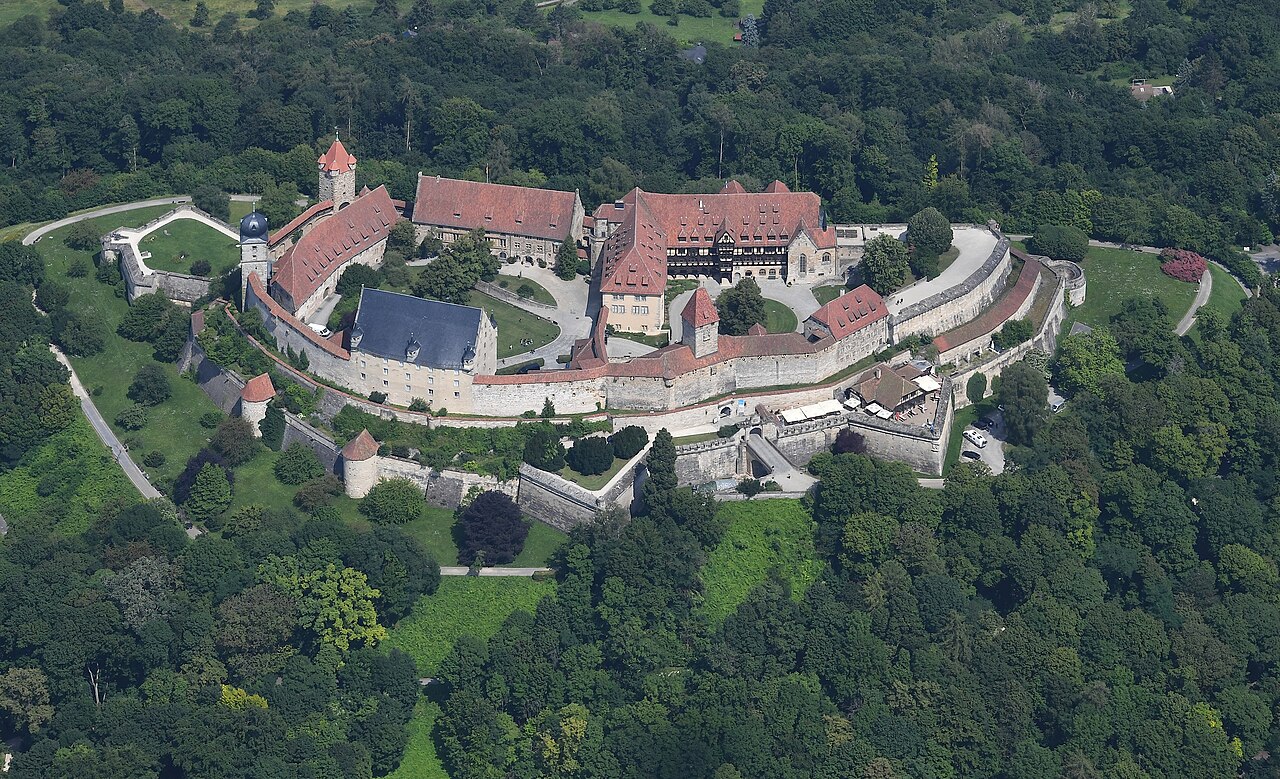
Schloss Rosenau
Schloss Rosenau is a historically significant former castle located near the town of Rödental, Germany. Originally a medieval structure dating back to before 1439, it was transformed into a ducal country house in the early 19th century. This estate is famously known as the birthplace and boyhood home of Prince Albert of Saxe-Coburg and Gotha, who married Queen Victoria of the United Kingdom in 1840, becoming her consort.
Medieval origins and early ownership
The main fabric of Schloss Rosenau is rooted in a medieval castle constructed before the mid-15th century. For approximately three centuries, the estate was held by the Rosenau family. In 1704, the property changed hands when it was sold to Freiherr Ferdinand Johann Adam von Pernau, an Austrian nobleman and member of the Privy Council of Duke Albert V of Saxe-Coburg. Pernau was a pioneering ornithologist who conducted notable experiments on bird behavior at Rosenau, including teaching young common chaffinches to mimic tree pipits between 1704 and 1720.
18th-century transitions and ducal acquisition
Following Pernau's death in 1731, the estate was acquired by Frederick II, Duke of Saxe-Gotha-Altenburg. Due to financial difficulties faced by a successor, the Rosenau estate left the family but was repurchased in 1805 by Francis, Duke of Saxe-Coburg-Saalfeld. He intended it as a summer residence for his son Ernest, who later became Duke of Saxe-Coburg and Gotha.
19th-century reconstruction and gothic revival style
Between 1808 and 1817, Schloss Rosenau underwent a comprehensive renovation and reconstruction in the Gothic Revival style. The redesign was influenced by the architectural trends of the period, led by the addition of crow-stepped gables at each end of the building, reflecting an early Gothic aesthetic. The windows were updated to a later Gothic form, and decorative elements such as small balconies and stone coats of arms were incorporated on the main façade.
The principal tower was modified from its earlier 1700 domed Welsche Haube (onion dome) to a crenellated battlement, enhancing its medieval fortress appearance. Additionally, a ruined tower was intentionally preserved as romantic ruins, a common feature in Gothic Revival architecture symbolizing a connection to the past.
The interior prominently features the Marble Hall (Marmorsaal), occupying half of the ground floor with three aisles and decorated with grey marble, exemplifying the grandeur of the renovation. Concurrently, the surrounding park was redesigned as an English landscape garden, including features such as an orangery, a Tournament Column sundial, the ruins of a hermitage, and two water bodies known as the Swan Lake and the Prince's Pond.
Historical significance and royal connections
On 26 August 1819, Princess Louise, Ernest's first wife, gave birth to Prince Albert at Schloss Rosenau. Prince Albert later married Queen Victoria, linking the estate to British royal history. The castle remained a ducal residence through the 19th century.
After World War I, the last reigning Duke, Charles Edward, abdicated in 1918. In 1919, he sold the estate to the Free State of Coburg, receiving compensation for the land and valuable assets including Schloss Rosenau.
20th-century uses and restoration
During World War II, the house was repurposed to house the Reichsarbeitsdienst (National Labour Service). Post-war, it served as a convalescent home for refugees and later as a nursing home for over two decades. By the early 1970s, the property was in poor condition and was purchased by the Free State of Bavaria with the goal of restoring it.
The restoration, carried out between 1985 and 1990, aimed to return Schloss Rosenau to the state it was in during the time of Victoria and Albert's visits. Watercolors of the castle held at Windsor Castle guided the restoration of both the exterior and interior, including the room layouts and decoration.
Current status and visitor experience
Today, Schloss Rosenau is managed by the Bayerische Verwaltung der staatlichen Schlösser, Gärten und Seen (Bavarian Administration of State Palaces, Gardens, and Lakes). The house and its extensive landscape park have been open to the public since 1990.
Visitors can explore all rooms on the lower two floors, including the eleven-sided library decorated with paintings inspired by Friedrich de la Motte Fouqué's "The Travels of Thiodolf the Icelander." This room once served as a Russian Orthodox chapel during the Grand Duchess Maria's era. The Marble Hall hosts a summer concert series, highlighting its acoustics and historical ambiance.
The upper floors feature rooms with brightly decorated walls and Biedermeier furniture, preserving the 19th-century interior style. Among the family heirlooms is a cradle reputed to have belonged to Prince Albert. The adjacent orangery formerly housed the European Museum of Modern Glass, showcasing modern art glass.
Frequently asked questions (FAQ)
- How do I get to Schloss Rosenau?
- Schloss Rosenau is located in Rödental, Germany, easily accessible by car or public transportation. If you're driving, there are parking facilities available nearby. For those using public transport, check local bus and train schedules for the best routes to Rödental.
- What is the historical significance of Schloss Rosenau?
- Schloss Rosenau is a historic castle that dates back to the 18th century and was the birthplace of the famous German writer, E.T.A. Hoffmann. The castle showcases the transition from Baroque to Romantic architecture, reflecting the cultural shifts of its time. Visiting the castle offers a glimpse into the life and times of influential figures in German literature and history.
- When was Schloss Rosenau built?
- Construction of Schloss Rosenau began in 1752 and was completed in 1756. The castle was designed as a summer residence for the Duke of Coburg and has been preserved to reflect its original architectural style. Its rich history makes it a fascinating destination for visitors interested in Germany's cultural heritage.
- Can I take guided tours of Schloss Rosenau?
- Yes, guided tours are available at Schloss Rosenau, offering visitors an in-depth understanding of the castle's history and architecture. Tours are conducted in several languages and provide insights into the life of E.T.A. Hoffmann and the significance of the castle. It is advisable to check the schedule in advance and book your tour to ensure availability.
- Why is Schloss Rosenau popular among tourists?
- Schloss Rosenau attracts tourists due to its stunning architecture, rich historical background, and picturesque gardens. The castle's association with the renowned writer E.T.A. Hoffmann adds to its allure, making it a cultural hotspot. Additionally, its serene location provides a perfect backdrop for leisurely strolls and photography.
- Is it possible to host events at Schloss Rosenau?
- Yes, Schloss Rosenau offers facilities for hosting various events, including weddings, corporate gatherings, and cultural events. The castle's historic ambiance and beautiful surroundings provide a unique setting for memorable occasions. Interested parties should contact the management for more information on availability and booking procedures.
- What are the opening hours for Schloss Rosenau?
- Schloss Rosenau is typically open to visitors from March through October, with varying hours depending on the season. It is advisable to check the official website for the most current opening hours and any special holiday schedules. Planning your visit during opening hours ensures you can fully explore the castle and its grounds.
- What are the ticket prices for visiting Schloss Rosenau?
- Ticket prices for Schloss Rosenau vary based on age and type of tour, with discounts available for students and seniors. Typically, a standard adult ticket provides access to the castle and its gardens, while guided tours may have an additional fee. For the most accurate pricing, please refer to the official website before your visit.
- When is the best time to visit Schloss Rosenau?
- The best time to visit Schloss Rosenau is during the spring and summer months when the gardens are in full bloom and the weather is pleasant. This allows visitors to enjoy both the castle and its outdoor spaces to the fullest. Additionally, special events and exhibitions often take place during this time, enhancing the visitor experience.
- Is Schloss Rosenau accessible for visitors with disabilities?
- Yes, Schloss Rosenau is committed to ensuring accessibility for all visitors. The castle has facilities in place to assist guests with mobility challenges, including ramps and designated rest areas. It is recommended to contact the castle in advance to confirm specific accessibility features and any assistance that may be needed during your visit.
Information
Loading map...
Visitor reviews
No reviews yet. Been here? Write the first review and help other travelers!
Write the first reviewVisited this castle? Share your experience
Your review helps other travelers and adds first-hand knowledge to our encyclopedia.