Callenberg Castle
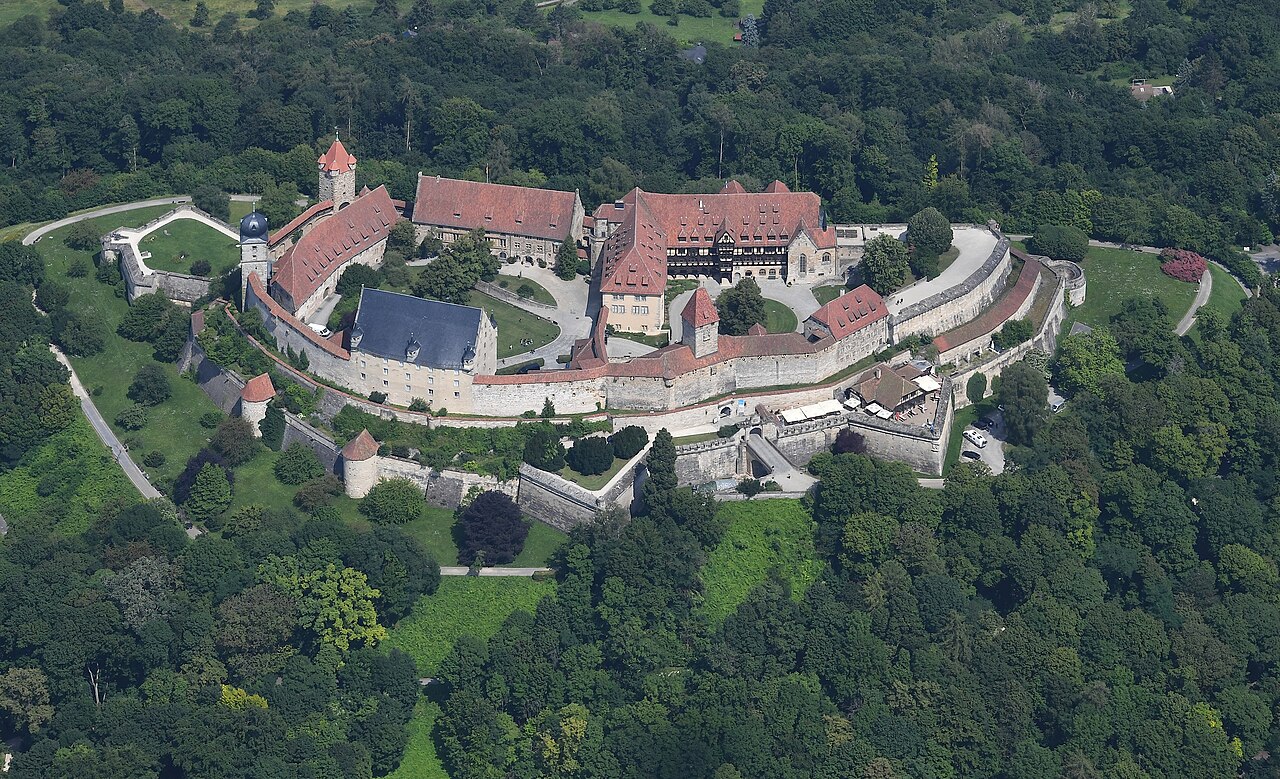
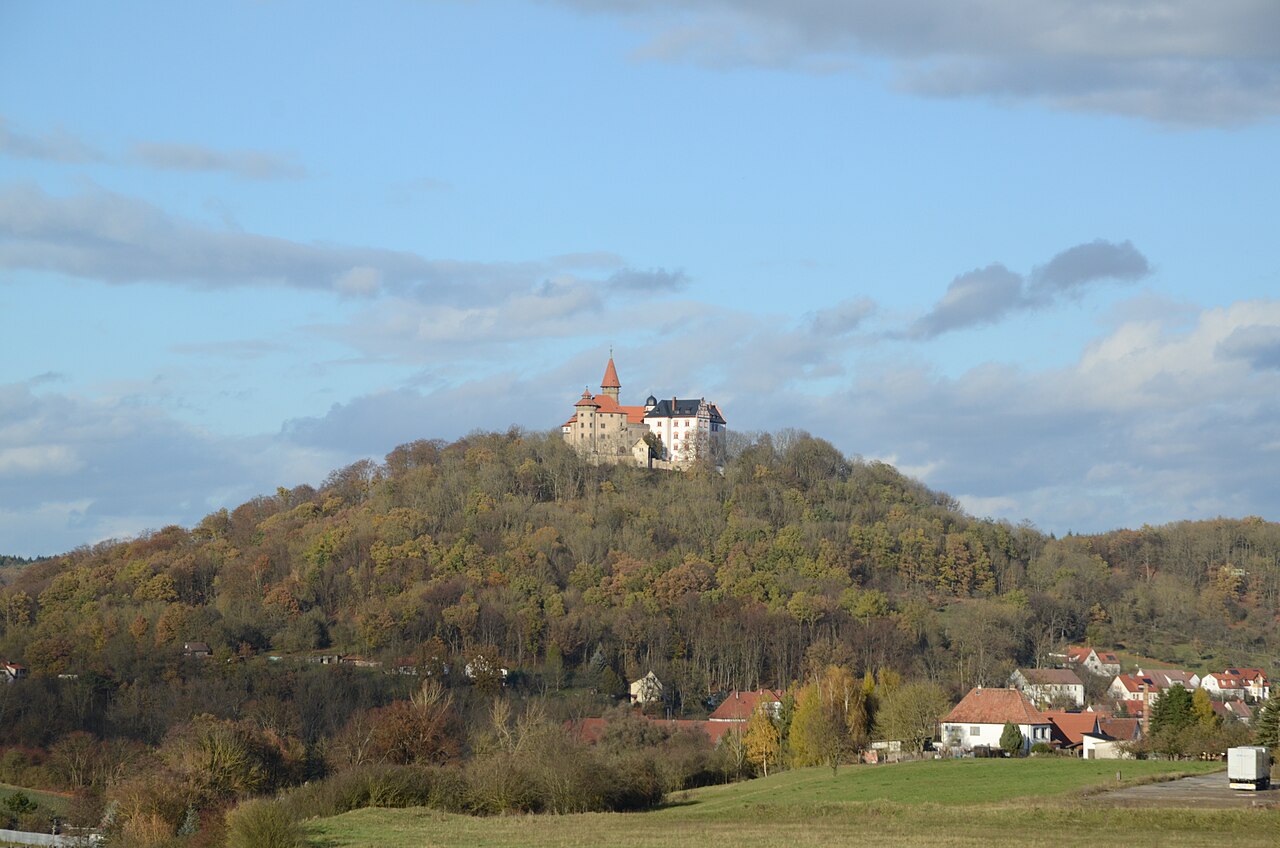
Callenberg Castle stands prominently on a wooded hill in Beiersdorf, just 6 kilometres from the city of Coburg, Germany. This historic hill castle has served multiple roles over its nearly 900-year history, including a medieval fortress, a Renaissance hunting lodge, and a ducal summer residence. Today, it is renowned for its Gothic revival architecture, extensive art collections, and cultural significance as the ancestral seat of the House of Saxe-Coburg and Gotha.
The castle's origins trace back to 1122, when it was first mentioned as "Chalwinberch." Initially, it was the main seat of the imperial knights of Callenberg, with Thiemo of Chalwinberch recorded as castellan. Over the centuries, ownership passed through notable families including the Bishopric of Würzburg, the House of Henneberg, and the Sternberg family. In the late 16th century, the castle came under the control of Duke Johann Casimir of Saxe-Coburg, who began transforming it into a Renaissance hunting lodge, including the construction of a significant castle chapel consecrated in 1618.
Historic evolution and ownership
Throughout the High and Late Medieval periods, Callenberg Castle functioned as a fortified residence for regional nobility and knights. The sale of the property in 1231 by Ulrich of Callenberg to the Prince-Bishop of Würzburg marked an important transition. Later, the House of Henneberg acquired the castle in 1317, granting it as a fief to the Sternberg family, who maintained it until their extinction in 1592.
Following this, the castle became a ducal possession under the Ernestine branch of the Wettin dynasty. Duke Johann Casimir intended to convert the medieval fortress into a summer palace, but only the chapel was completed during his lifetime. The castle saw major renovations and redesigns in the 19th century under Duke Ernst I, who created an English landscape garden and introduced agricultural innovations such as a silkworm breeding farm.
His son, Duke Ernst II, further transformed Callenberg in the 1850s, commissioning architect Georg Konrad Rothbart to rebuild the lower castle in a neo-Gothic style. This period marked Callenberg's prominence as a ducal summer residence and hunting lodge. The castle later served as a dowager house for Princess Alexandrine of Baden and was the summer home of the last ruling duke, Carl Eduard, who was buried there in 1954.
Architectural features and styles
Callenberg Castle is a complex three-winged structure comprising an upper and a lower castle connected by a tall, octagonal stair tower with a bell chamber. The tower retains medieval foundations, highlighting the castle's long history. The ensemble is centered around a lower courtyard and a higher rose garden, linked by a grand neo-Gothic staircase.
The castle chapel is a notable architectural highlight. Built in the early 17th century under Johann Casimir, it is one of the region's earliest Protestant sacred spaces. The chapel features a three-nave hall with pointed arch tracery windows, a continuous gallery (empore), and a pulpit altar. The chapel's design combines Gothic arches, Doric columns, Italian Renaissance parapets, and medieval wall cladding. Early Baroque sculptural elements, such as the pulpit and baptismal font, are attributed to Veit Dümpel.
During the mid-19th century, Duke Ernst II collected 224 colored stained glass panels dating from the 16th to 18th centuries, originally installed in the chapel's windows. These were removed in the 1980s for conservation and replaced with clear glass. Selected panels are now exhibited within the castle's ducal art collection.
Neo-Gothic renovations and expansions
The 1856-1857 renovations under Ernst II introduced neo-Gothic architectural elements to the lower castle, including decorative battlements, pointed arches, and ornamental stonework. This Gothic revival style enhanced the castle's romantic and historic character, aligning with 19th-century tastes for medieval aesthetics.
Landscape and surrounding estate
Between 1827 and 1863, Dukes Johann Casimir, Ernst I, and Ernst II developed an extensive English landscape park around Callenberg Castle. Covering approximately 50 hectares, the park incorporated natural features such as the Drehenweiher pond, the Langer Grund valley, and the Hahnteich pond. The grounds originally included a pheasantry, wild animal enclosures, a foal enclosure, a nursery garden, and a waterworks system.
Post-World War II agricultural use and other changes altered much of the original park layout and features. However, the park remains a significant historic landscape complementing the castle's architecture.
Economic estate and model farm
The estate includes an economic complex northwest of the castle, originally comprising three main buildings: the Kavaliershaus (built 1844), the Beamtenhaus (early 18th century), and the Chauffeurshaus (1939). The Kavaliershaus was demolished in recent years due to structural issues, while the others have been restored.
The Callenberg Model Farm, constructed in 1863-1864 by Georg Rothbart for Duke Ernst II, was among Germany's first English-style model farms. It emphasized hygiene, efficient layout, and modern water supply systems. The farm complex expanded significantly by 1938 and now houses a Waldorf school with anthroposophic additions.
Cultural significance and modern use
Today, Callenberg Castle remains under the ownership of the House of Saxe-Coburg and Gotha, currently held by Andreas, Prince of Saxe-Coburg and Gotha. It is a listed monument recognized for its historical and architectural importance.
Since 1998, the castle has displayed the ducal art and furniture collection, showcasing works spanning five centuries. Since 2004, the German Rifle Museum (Deutsches Schützenmuseum) occupies the northwest wing, celebrating the founding of the German Shooting Federation in 1861 under Duke Ernst II.
The castle grounds include a ducal cemetery established in 1944 on Buchleite hill, containing the graves of notable family members such as Duke Carl Eduard and Princess Victoria Adelaide. Additionally, a historic dog cemetery dating to 1846 commemorates six favored hunting dogs of Duke Ernst II, modeled after London's Hyde Park dog cemetery.
Post-war history and restoration
After World War II, Callenberg Castle was occupied by American troops and later repurposed as a theater, nursing home, and vocational school. The ducal family sold the property in 1972 but reacquired it in 1982. Since then, extensive restoration and renovation efforts have preserved its architectural integrity and cultural heritage.
Frequently asked questions (FAQ)
- How do I visit Callenberg Castle and what are the opening hours?
- Callenberg Castle is open to visitors generally from 10:00 to 16:00 daily, but it is advisable to check the official website for seasonal variations and any special closures.
- What is the historical significance of Callenberg Castle?
- Callenberg Castle has served as a medieval fortress, Renaissance hunting lodge, and ducal residence, playing a central role in the history of the House of Saxe-Coburg and Gotha.
- Can I see art collections at Callenberg Castle?
- Yes, the castle houses the Ducal Art Collection featuring furniture, paintings, porcelain, and applied arts from five centuries, open to the public since 1998.
- Is Callenberg Castle accessible for people with disabilities?
- The castle has some accessibility features, but due to its historic structure and hilltop location, visitors with mobility challenges should inquire in advance for assistance and specific accommodations.
- What architectural styles are represented at Callenberg Castle?
- Callenberg Castle showcases a mix of medieval, Renaissance, Baroque, and neo-Gothic architectural styles, with significant renovations in the 19th century emphasizing Gothic revival elements.
- Are there any museums within Callenberg Castle?
- Yes, since 2004, the German Rifle Museum (Deutsches Schützenmuseum) has been located in the northwest wing, highlighting the history of shooting sports in Germany.
- What is the best time of year to visit Callenberg Castle?
- Spring through early autumn offers the best weather to explore the castle and its extensive English landscape park, with gardens in full bloom and outdoor exhibits accessible.
Information
Website
Visit websiteSources & official resources
Verify the information above using these authoritative references.
Loading map...
Visitor reviews
No reviews yet. Been here? Write the first review and help other travelers!
Write the first reviewVisited this castle? Share your experience
Your review helps other travelers and adds first-hand knowledge to our encyclopedia.